
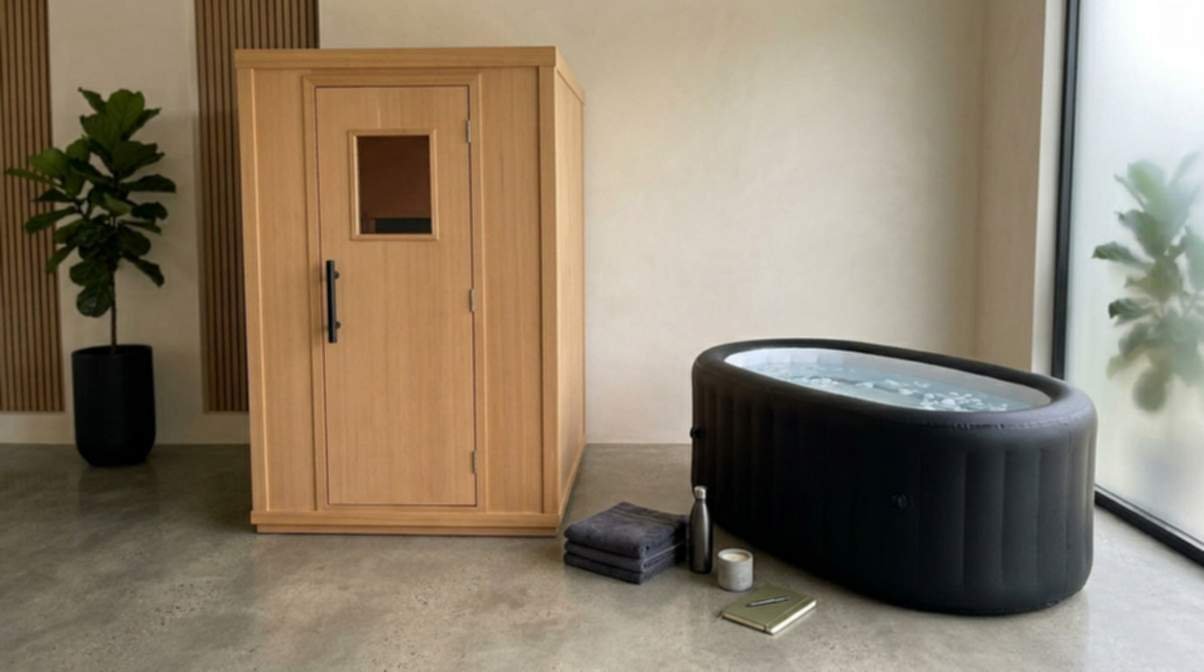
For muscle recovery after hard training, cold plunge wins. The only direct head-to-head trial Hausswirth and colleagues, 2011 found whole-body cold therapy outperformed far-infrared sauna for strength recovery in trained runners. Infrared sauna has its place (relaxation, sleep, skin, modest cardiovascular benefit) but the evidence base is thinner and weaker than the marketing suggests. They’re complementary tools, not interchangeable. Cold Plunge vs Sauna Cryotherapy vs Cold Plunge
Infrared saunas and cold plunges offer complementary benefits, but if you’re considering cold therapy alone, it’s worth understanding the differences between chiller-based cold plunges and traditional ice baths. The choice often comes down to budget, space, and how precise you need your temperature control to be.
Cold plunges excel at reducing muscle soreness, but they aren’t a magic bullet for hormonal boosts. In fact, studies indicate that cold exposure can decrease testosterone levels, debunking a common wellness claim.
Walk into any wellness clinic in Sydney, Melbourne or Brisbane and you’ll see them next to each other: a glowing wooden infrared cabin and a stainless-steel cold plunge with a chiller humming away. The marketing tells you both are essential. The research tells a more interesting story — they do genuinely different things, and one has substantially more evidence for the recovery benefits both are sold on.
This is a deliberately direct comparison. Most articles you’ll find on this topic say “both are great, do both” and leave it there. That’s true at the margins, but it misses the actual question most people are asking: if you can only afford one, or only have time for one, which should it be? The answer depends entirely on what you’re trying to fix — and on whether the science backs the claim that’s drawing you in.
This guide cuts through the marketing on both sides. It covers what each modality actually does to the body, what the research directly shows when they’re tested head-to-head, where each one wins, where the evidence is weak (or contradicted), Australian pricing for both, and how to combine them if you genuinely want both. If you’re still working out where cold plunging fits in your setup, our comparison of the best ice baths covers the cold side in detail. Cold Plunge before or after workout
SAFETY FIRST Cold side. Cold water immersion stresses the cardiovascular system. Start at 12–15°C, never below 10°C as a beginner, and keep first sessions to 1–3 minutes. Don’t plunge alone. Heat side. Infrared sauna sessions of 20–45 minutes at 45–60°C are generally well-tolerated, but heat raises core temperature, lowers blood pressure on standing, and dehydrates. Drink water before, during and after. Skip if you’re pregnant, on blood pressure medication, or have any heart, circulation or recent cardiac event. Both sides. See your GP first if you’re over 50, pregnant, or have any cardiovascular, respiratory or thermoregulatory condition. Never combine either with alcohol. Royal Life Saving Society Australia has guidance on safe water immersion practice. best time to sauna and cold plunge
Infrared sauna vs cold plunge at a glance
Quick reference. The detailed research and Australian pricing are below. Cold Plunge and muscle growth
| Factor | Cold plunge | Infrared sauna |
| Typical temperature | 10–15°C water immersion | 45–60°C dry radiant heat |
| Typical session | 2–5 minutes | 20–45 minutes |
| Strongest evidence for | Reduced muscle soreness, stress reduction, alertness | Relaxation, sleep onset, modest BP improvement (regular use) |
| Weakest claims | Long-term immune “boost” | Detox, weight loss, comprehensive cardiovascular benefit |
| Head-to-head winner (Hausswirth 2011) | Better strength recovery in runners | No better than passive rest at 24/48h |
| Worst time to use | Within 4–6h after strength training | Right before bed (raises body temp acutely) |
| AU upfront cost (home) | $200–$25,000+ AUD | $400 (blanket) – $16,000+ AUD |
| AU running cost | $15–$40/month (chiller) | $5–$20/month (1–2 person, 30 min daily) |
What infrared sauna and cold plunge actually do
KEY TAKEAWAY Cold plunges trigger vasoconstriction, dampen inflammation, and produce a sharp neurochemical spike (dopamine, noradrenaline). Infrared saunas use radiant heat to raise skin and surface tissue temperature, dilate blood vessels, and elevate heart rate. Different mechanisms, different effects and different evidence quality behind each. Cold plunging reduces inflammation
How a cold plunge works
When you immerse in 10–15°C water, peripheral blood vessels constrict within seconds, your sympathetic nervous system fires hard, and noradrenaline and dopamine spike. The cold also slows nerve conduction (which is why pain perception drops) and reduces tissue temperature, which dampens local inflammatory signalling. The 2025 UniSA-led PLOS One meta-analysis by Cain and colleagues (11 studies, 3,177 participants) confirmed measurable reductions in perceived stress 12 hours after a session.
How an infrared sauna works
Infrared saunas emit radiant heat (typically far-infrared, around 4–17 micron wavelength) that warms skin and surface tissues directly without heating the surrounding air much. Cabin temperatures sit at 45–60°C significantly cooler than a traditional Finnish sauna at 80–90°C. Your body responds to the heat load by dilating blood vessels, raising heart rate (often to 100–130 bpm), and producing a sustained sweat response.
Worth flagging: the radiant heat doesn’t penetrate as deeply as marketing claims often suggest. The widely-cited “penetrates 1.5 inches” figure refers to skin and subcutaneous tissue, not muscle or organs. A 2025 study by Atencio and colleagues directly compared hot water immersion, traditional sauna, and infrared sauna for thermal load and found infrared sauna produced the smallest core temperature change of the three. If you’re chasing the deep cardiovascular adaptations that hot bathing produces, an infrared cabin is the weakest of the three options.
The head-to-head: what direct research shows
KEY TAKEAWAY The only published trial directly comparing the two modalities for recovery Hausswirth et al., 2011 gave the win to cold. Whole-body cryotherapy outperformed far-infrared sauna for strength recovery in trained runners; infrared sauna performed no better than just sitting still.
There aren’t many head-to-head trials of these two modalities, but there is one that matters. Hausswirth and colleagues at INSEP (Paris), 2011 ran nine well-trained runners through a simulated trail race three times, each time using a different recovery method: whole-body cryotherapy (cold), far-infrared sauna, or passive rest. They measured maximum isometric strength, plasma creatine kinase (a muscle damage marker), and subjective sensations at 1 hour, 24 hours and 48 hours post-exercise.
The result: cold therapy produced the fastest recovery of muscle strength and the lowest perceived pain at 1 hour. By 24 and 48 hours, cold was still ahead. Far-infrared sauna performed essentially the same as doing nothing passive rest at the 24 and 48 hour marks. For the specific question “which one helps you recover from hard training faster,” the answer in this trial was clear, even if the sample was small.
That doesn’t mean infrared sauna is useless. Mero and colleagues’ 2015 study in SpringerPlus (10 trained men) found far-infrared sauna at 35–50°C improved countermovement jump recovery after endurance training compared to no-sauna controls and produced significantly less cardiovascular strain than traditional Finnish sauna. So infrared sauna may help with neuromuscular recovery from endurance work specifically, even if it loses to cold for strength recovery.
Where each one genuinely wins
KEY TAKEAWAY Cold plunge wins on muscle recovery, alertness, mood, and stress resilience. Infrared sauna wins on relaxation, sleep wind-down, skin appearance, and chronic pain symptom relief. They overlap on circulation and general wellbeing.
Cold plunge wins for:
- Muscle soreness and acute recovery. Strongest evidence base of any recovery modality. The Bieuzen 2013 meta-analysis and the 2025 Wang dose-response review converge on the same finding.
- Mental sharpness and mood. Cold immersion produces a sharp dopamine and noradrenaline spike that lasts for hours. Infrared heat doesn’t.
- Stress resilience. The repeated controlled stress of cold exposure trains your nervous system to recover faster from arousal. The Cain 2025 UniSA meta-analysis showed measurable stress reduction 12 hours after a session.
- Time efficiency. A cold plunge session takes 3–5 minutes. An infrared sauna session takes 30–45. Cold delivers more measurable physiological effect per minute.
Infrared sauna wins for:
- Relaxation and sleep wind-down. A warm cabin in the evening, ending 90–120 minutes before bed, helps drop core temperature on exit which mimics the natural pre-sleep temperature drop. Cold plunges late at night tend to be too activating.
- Chronic pain symptom relief. The Beever 2009 review found fair evidence (from a single study) that far-infrared sauna helps with chronic pain symptoms. Anecdotally, it’s used widely for fibromyalgia and arthritis symptom management though the research base is thin.
- Skin appearance. The combination of heat-driven sweating and increased skin blood flow appears to produce modest improvements in skin elasticity and complexion over weeks of regular use. Studies are small but consistent.
- Comfort. Honestly sitting in a warm cabin reading a book is more pleasant than plunging into 12°C water. If enjoyment drives consistency, that matters.
Where the science is mixed or oversold
KEY TAKEAWAY Infrared sauna marketing makes claims that the research doesn’t support. “Detox,” significant weight loss, and broad cardiovascular protection comparable to traditional sauna are all overstated. Be sceptical of any infrared sauna brand citing the famous Finnish sauna mortality studies those used traditional sauna, not infrared.
A few claims travel widely on infrared sauna marketing pages that don’t survive a careful read of the actual research.
- “Detox.” Sweat does contain trace amounts of metabolic by-products and a few heavy metals, but your liver and kidneys do the actual detoxification work. Sweating more doesn’t meaningfully add to that. The “detox” framing has no clinical basis.
- “Weight loss.” You’ll lose 0.5–1 kg of water in a session through sweat, all of which returns within hours of rehydrating. Beever’s 2009 review described the weight loss evidence as “weak, from a single study.” Infrared sauna is not a fat loss tool.
- “Cardiovascular benefits like Finnish sauna.” The famous Laukkanen Finnish cohort studies showing reduced cardiovascular mortality used traditional Finnish sauna at 80–100°C, not infrared. Infrared sauna research is dominated by small trials, often manufacturer-funded, with much weaker evidence. The Beever 2009 review found “limited moderate evidence” for blood pressure normalisation and “consistent fair evidence to refute claims regarding the role of FIRS in cholesterol reduction.” That’s a long way from the marketing.
- “Boosts immunity.” No good evidence specifically for infrared sauna. Same goes for cold plunges the widely-cited Buijze 2016 cold-shower study measured self-reported sick days, not immune function, and applied to cold showers, not contrast or heat therapy.
On the cold side, the trade-offs are different but worth flagging. The Roberts 2015 work from QUT showed cold water immersion within hours of strength training can blunt anabolic signalling the molecular cascade that drives muscle growth. If hypertrophy matters to you, push cold plunging at least 4–6 hours away from your lifting session, or skip it on training days. Infrared sauna doesn’t appear to have the same effect, which is one specific scenario where heat may have an edge.
Cost comparison: Australia
KEY TAKEAWAY Infrared saunas have a wider price spread in Australia anywhere from a $400 sauna blanket to a $16,000 four-person cabin. Cold plunges land in a similar range but skew higher at the entry tier. Running costs strongly favour infrared sauna: a 30-minute daily session costs $50–$130 per year in Australia depending on state, versus $130–$430 per year for a chiller-equipped cold plunge.
Upfront cost
| Tier | Infrared sauna (AUD) | Cold plunge (AUD) |
| Entry / portable | $400–$700 (sauna blanket) | $200–$600 (inflatable + ice) |
| 1-person home | $1,600–$5,000 | $1,500–$3,500 (portable + chiller) |
| 2-person premium | $4,000–$9,000 (e.g. Sun Stream Evolve ~$6,795) | $4,000–$10,000 (e.g. PlusLife Signature ~$7,300) |
| 3–4 person / commercial | $8,000–$16,000+ (e.g. Clearlight Sanctuary) | $10,000–$25,000+ |
Annual running cost in Australia
These are realistic 2026 estimates assuming daily 30-minute use, average state electricity tariffs, and average ambient conditions. Sources: Inner Light Sauna’s 2026 AU running cost analysis for the heat side, and Canstar’s 2026 electricity rate data for state breakdowns.
| State | 1-person IR sauna | 2-person IR sauna | Chiller-equipped cold plunge |
| TAS / VIC | $45–$60/yr | $60–$90/yr | $120–$320/yr |
| NSW / QLD / WA | $55–$75/yr | $75–$110/yr | $140–$355/yr |
| SA | $70–$95/yr | $110–$140/yr | $175–$430/yr |
On running cost alone, infrared sauna is the cheaper modality to operate in Australia by a factor of two to four. That’s not a small detail over five years. For a deeper breakdown of the cold plunge side specifically, see our Australian cold plunge tub cost guide.
Combining them: contrast therapy with infrared sauna
KEY TAKEAWAY If you have both, pair them as contrast therapy 20 minutes infrared sauna followed by 2–3 minutes cold plunge, repeated 2–3 rounds. End on cold for the metabolic effect, end on hot if you’re winding down for sleep. The two modalities complement each other better than they compete.
A practical 30-minute session
| Step | Modality | Time | Temp |
| 1. Warm-up | Infrared sauna | 15–20 min | 45–55°C |
| 2. First cold | Cold plunge | 2–3 min | 10–15°C |
| 3. Heat | Infrared sauna | 5–10 min | 45–55°C |
| 4. Second cold | Cold plunge | 2–3 min | 10–15°C |
| 5. Optional final heat | Infrared sauna | 5 min | 45–55°C |
End on cold if you want the metabolic effect (the Søeberg principle ending cold forces your body to rewarm and keeps brown fat active). End on hot if you’re using the session to wind down before sleep. We cover the contrast therapy protocol in more depth in our hot plunge vs cold plunge guide most of that guidance applies whether the heat source is a hot tub or an infrared cabin.
which should you buy first?
Buying both at once is rarely necessary and often a sign you’ve been sold by the wellness industry’s natural tendency to package every modality together. Pick the one that maps to your actual goal and use it consistently for 6–12 months before adding the other. Most people who go in expecting to use both daily end up using one heavily and the other rarely.
Buy cold plunge first if:
- You train hard 3+ times a week and want measurable recovery benefit.
- You want a mental edge in the morning alertness, focus, mood lift.
- You’re chasing the strongest research-backed wellness modality at a similar cost.
- You’re time-poor (5-minute sessions vs 30-minute sessions).
Buy infrared sauna first if:
- You want a relaxation tool that the whole family will use.
- You have chronic pain, fibromyalgia, or arthritis symptoms you want to manage.
- You’re chasing better sleep and want an evening wind-down ritual.
- You can’t tolerate cold (cardiovascular condition, Raynaud’s, etc with GP clearance).
- Lower running costs matter more than maximum recovery effect.
Before any final decision, look at how often you’ll actually use it. Our ice bath duration guide and guide to whether ice baths are good for you walk through the protocols and the underlying evidence in detail. Consistency is what separates the people who get results from the people whose plunge or sauna becomes an expensive piece of furniture.
frequently asked questions
Is an infrared sauna or cold plunge better for muscle recovery?
Cold plunge has stronger evidence for muscle recovery. The only direct head-to-head trial Hausswirth and colleagues, 2011 found whole-body cold therapy outperformed far-infrared sauna for strength recovery in trained runners, while infrared sauna performed no better than passive rest at 24 and 48 hours. If muscle soreness and acute recovery are your priority, cold wins.
Is an infrared sauna or cold plunge better for weight loss?
Neither is a weight loss tool. Infrared sauna sweat causes 0.5–1 kg of water loss that returns with rehydration. Cold plunge activates brown fat and burns a small extra amount of calories per session, but the effect is modest. For weight loss, exercise and diet are vastly more effective than either modality.
Should I do infrared sauna before or after cold plunge?
If you’re combining them, start with infrared sauna for 15–20 minutes to dilate blood vessels and loosen muscles. Then alternate: 2–3 minutes cold, 5–10 minutes back in the sauna, repeat. End on cold if you want the metabolic effect; end on heat if you’re winding down for sleep.
Can I do infrared sauna and cold plunge on the same day?
Yes, and most people do. Either as contrast therapy (alternating in the same session) or split across the day sauna in the evening for relaxation, cold plunge in the morning for alertness. The only timing rule that matters: avoid both within 4–6 hours of strength training if hypertrophy is your goal.
How often should you use infrared sauna vs cold plunge?
Both are typically used 3–5 times per week. Cold plunges are typically 2–5 minutes per session; infrared sauna sessions run 20–45 minutes. Daily use is fine for most people but not necessary three good sessions a week captures most of the documented benefit for either modality.
Is infrared sauna or cold plunge better for sleep?
Infrared sauna, used 90–120 minutes before bed, helps with sleep onset by triggering the post-sauna core temperature drop that mimics natural pre-sleep cooling. Cold plunges late at night tend to be too activating because of the noradrenaline spike. For sleep, choose heat in the evening.
Does infrared sauna actually detox the body?
Not in any clinically meaningful way. Sweat contains trace amounts of metabolic by-products and some heavy metals, but your liver and kidneys do the actual detoxification work. Sweating more doesn’t add to that process. The “detox” framing in infrared sauna marketing has no clinical basis be sceptical of any brand leading with it.
Is infrared sauna as good as a Finnish sauna?
For pure heat load and the cardiovascular adaptations associated with traditional sauna, no. The widely-cited Finnish cohort studies showing reduced mortality used traditional sauna at 80–100°C, not infrared at 45–60°C. The 2025 Atencio study found hot water immersion produced the strongest core temperature change, traditional sauna was second, and infrared was third. Infrared is gentler, more comfortable, and easier to install but the evidence is thinner.
Which is cheaper to run in Australia: infrared sauna or cold plunge?
Infrared sauna is significantly cheaper to run. A daily 30-minute infrared sauna session costs $45–$140 per year in Australia depending on state and sauna size. A daily cold plunge with a chiller costs $130–$430 per year. Across five years, the cold plunge running cost is two to four times higher. Upfront costs are similar across both at most tiers.
Can I get the benefits of an infrared sauna from a sauna blanket?
Partially. Sauna blankets ($400–$700 AUD in 2026) deliver infrared heat to the body and produce a similar sweat response, but they don’t enclose the head, the heat is less even, and you can’t easily move during the session. They’re a reasonable entry point if you want to test the practice cheaply, but a full cabin gives a more consistent experience.
Do I need to do both for best results?
No. Both modalities work fine alone. The benefit of pairing them is contrast therapy alternating heat and cold accelerates recovery in studies of athletic populations and gives you both the relaxation effect and the alertness effect from a single session. But if you can only do one, pick based on your goal: cold for recovery and energy, heat for relaxation and sleep.
Are there any risks of using infrared sauna with a cold plunge?
For healthy adults, no significant risks beyond those of either modality alone. Cold shock and post-sauna blood pressure drop both happen anyone with cardiovascular disease, pregnancy, or autonomic dysfunction should clear the practice with their GP first. Don’t combine either modality with alcohol. Step into cold gradually rather than diving so your face isn’t the first part hit.
Direct comparison and recovery research
Hausswirth C, Louis J, Bieuzen F, Pournot H, Fournier J, Filliard JR, Brisswalter J (2011). Effects of whole-body cryotherapy vs. far-infrared vs. passive modalities on recovery from exercise-induced muscle damage in highly-trained runners. PLOS One, 6(12), e27749. DOI: 10.1371/journal.pone.0027749
Mero A, Tornberg J, Mäntykoski M, Puurtinen R (2015). Effects of far-infrared sauna bathing on recovery from strength and endurance training sessions in men. SpringerPlus, 4, 321. DOI: 10.1186/s40064-015-1093-5
Atencio J, et al. (2025). Comparison of thermoregulatory, cardiovascular, and immune responses to different passive heat therapy modalities. American Journal of Physiology — Regulatory, Integrative and Comparative Physiology. DOI: 10.1152/ajpregu.00012.2025
Infrared sauna evidence reviews
Beever R (2009). Far-infrared saunas for treatment of cardiovascular risk factors: summary of published evidence. Canadian Family Physician, 55(7), 691–696. PMC: PMC2718593
Cold water immersion evidence
Bieuzen F, Bleakley CM, Costello JT (2013). Contrast Water Therapy and Exercise Induced Muscle Damage: A Systematic Review and Meta-Analysis. PLOS One, 8(4), e62356. DOI: 10.1371/journal.pone.0062356
Cain T, et al. (UniSA, 2025). Health and wellbeing effects of cold water immersion: a systematic review. PLOS One. DOI: 10.1371/journal.pone.0317615
Wang Y, et al. (2025). Effects of cold water immersion on recovery: a dose-response meta-analysis of 55 RCTs. Frontiers in Physiology. DOI: 10.3389/fphys.2025.1525726
Roberts LA, Raastad T, Markworth JF, et al. (2015). Post-exercise cold water immersion attenuates acute anabolic signalling and long-term adaptations in muscle to strength training. Journal of Physiology, 593(18), 4285–4301. DOI: 10.1113/JP270570
Authority sources and Australian pricing references
Royal Life Saving Society Australia — Position statements on water immersion safety.
Massachusetts General Hospital — Infrared Saunas and Cold Plunges (2025).
Banner Health (2026) — Comparing Cold Plunges and Infrared Saunas.
Inner Light Sauna (2026) — Running Costs of Infrared Saunas in Australia (state-by-state breakdown).
Canstar (2026) — Average electricity cost per kWh in Australia.
Medical disclaimer: This article is for general informational purposes only and is not medical advice. Cold water immersion and infrared sauna sessions both carry cardiovascular risks. Speak with your GP before starting either practice, especially if you have any heart, blood pressure, respiratory or pregnancy-related condition.
