
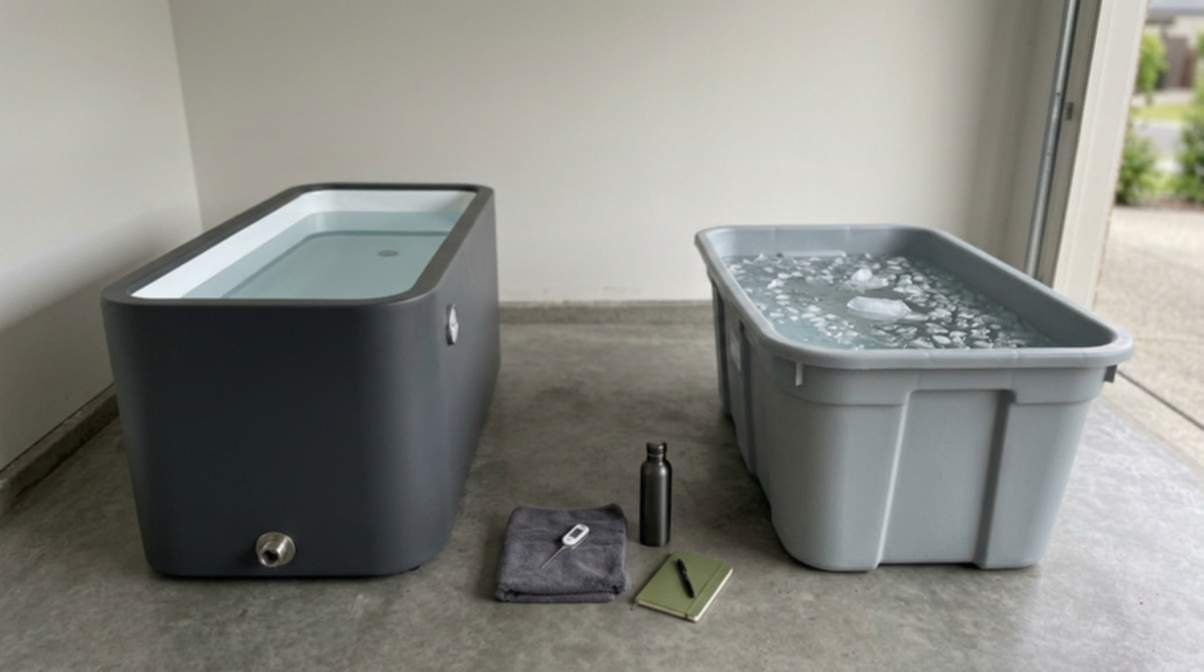
Cold plunge and ice bath describe the same therapy cold water immersion delivered two different ways. A cold plunge is a purpose-built tub with a chiller that holds a set temperature (typically 3–15°C). An ice bath is any tub filled with cold water plus bagged ice. The water doesn’t care how it got cold; your body responds to temperature and duration, not equipment. The real differences are practical: cost, convenience, hygiene, and how reliably you can hit the same temperature every session. Expect AU$2,500–12,000+ for a chiller cold plunge vs AU$50–1,500 for a DIY ice bath setup, plus ~AU$200–600 a year in bagged ice if you use it consistently.
Search “cold plunge vs ice bath” and you’ll get a dozen confident articles each contradicting the next. Some say cold plunges are colder. Some say ice baths are colder. Some claim ice baths give “rapid results” while cold plunges deliver “gentler benefits.” Most of that is marketing, written by brands selling chiller-equipped tubs. The physiology is much simpler. cold plunge vs sauna benefits are ice baths good for you cold shower vs cold plunge cryotherapy vs cold plunge
Both names describe the same therapy: cold water immersion (CWI). The published research uses both methods interchangeably because they produce the same effect when temperature and duration are matched. Your body doesn’t know whether the cold came from a refrigeration unit or a melted bag of ice from the servo it responds to the temperature of the water around your skin and how long you’re in it.
While cold plunges and ice baths share similarities, the benefits of cold therapy extend beyond muscle recovery—some athletes also explore pairing it with heat therapy. For a deeper dive into how cold plunges compare to other recovery methods, check out our analysis on infrared sauna vs cold plunge.
While both cold plunges and ice baths involve cold water immersion, their effects on inflammation differ. Research suggests that cold plunging may temporarily increase inflammation markers before any long-term adaptation benefits kick in. are ice baths dangerous
While cold plunges and ice baths share core benefits like muscle recovery, some enthusiasts swear by cold plunges for skincare, claiming they reduce puffiness and boost circulation—though the evidence is mixed on long-term anti-aging effects.
So if the science is the same, what actually differs? Pretty much everything outside the tub: upfront cost, ongoing cost, time to set up, hygiene, footprint, and how reliably you can hit your target temperature every session. This guide breaks all of that down with Australian pricing, practical trade-offs, and an honest answer to “which should I buy?” If you want a head-to-head comparison of specific models we’ve tested, see our best ice baths in Australia guide. best portable ice baths ice bath temperature guide how long to stay in ice bath
Safety First
Whatever method you use, the water below 15°C carries the same risks. Cold shock response involuntary gasping and a sudden cardiovascular load can hit within seconds of immersion. The Royal Life Saving Society Australia reports that cold-water drowning is overwhelmingly an issue of unexpected immersion in water under 15°C, including in dedicated tubs.
Start at 12–15°C, not 5°C. Don’t plunge alone, especially in your first month. Don’t plunge after alcohol or sleep deprivation. Speak to your GP first if you’re over 50, pregnant, or have any cardiovascular condition (high blood pressure, arrhythmia, history of heart attack), Raynaud’s, or an active autoimmune issue. DIY cold plunge setup best ice baths in Australia
Cold Plunge vs Ice Bath: At a Glance
Quick comparison of the two setups. We’ll get into each row in detail below.
| Factor | Cold Plunge (chiller tub) | Ice Bath (DIY + bagged ice) |
| Temperature range | 3–15°C, set and held | Starts ~5–8°C, drifts up as ice melts |
| Temperature precision | Exact (±1°C) | Approximate, drifts during session |
| Upfront cost (AU) | $2,500–12,000+ | $50–1,500 |
| Ongoing cost | Electricity (~$15–60/mo) + filters | Bagged ice (~$5–15 per session) |
| Setup time per session | 0–2 min (just enter) | 10–20 min (fill, add ice, wait) |
| Water hygiene | Filter + ozone/UV; weeks per fill | Drain after every session |
| Footprint | Permanent, often outdoor | Portable; pack away after use |
| Consistency session-to-session | High | Variable |
| Best for | Daily use, athletes, set-and-forget | Trying it out, occasional use, low budget |
What Is a Cold Plunge?
KEY TAKEAWAY: A cold plunge is a purpose-built tub with an integrated chiller, filtration and (usually) sanitation system. Set the temperature you want, the unit holds it. No ice required.
In practical use today, “cold plunge” refers to a chiller-equipped immersion tub. The tub is typically made from food-grade plastic, fibreglass, acrylic, stainless steel, or insulated timber (cedar is common). A chiller effectively a small refrigeration unit, sized 0.25HP to 1HP for home use cycles water through a heat exchanger to maintain a set temperature. Water passes through filters to remove debris and an ozone or UV sanitation loop to keep it usable for weeks at a time.
Modern units let you dial in any temperature between roughly 3°C and 40°C some double as warm tubs in winter. Wi-Fi control, app scheduling and pre-heating are common at the mid-to-premium tier.
Typical specs: 250–650L water capacity, 3–15°C operating range, 10A power point (most home units run on a standard outlet), 5–15 micron filter, ozone or UV sanitation, footprint roughly 1.5m x 0.8m for a single-person tub.
What Is an Ice Bath?
KEY TAKEAWAY: An ice bath is any tub filled with cold water and bagged ice. No refrigeration. Temperature drops fast, then drifts back up as the ice melts. Cheap to set up, expensive in time and ice over the long run.
An ice bath is the original method. You fill a container a household bathtub, an inflatable plunge tub, a wheelie bin, a dedicated insulated tub, or a horse trough with cold tap water, then add bags of ice until the water hits your target temperature. There’s no electrical equipment. The cold is purely the ice melting and absorbing heat from the water.
In Australian conditions, you typically need 15–25kg of ice to drop a 200L bath to around 5–10°C, depending on your starting tap water temperature. A bag of ice from a service station is usually 2.5–5kg for AU$4–8; supermarket bags are similar. So the ice bill alone for daily use can hit AU$30–60 a week if you’re plunging cold.
The temperature drops quickly while the ice melts, then drifts up. A typical 10-minute session might start at 6°C and end at 9–10°C, depending on tub insulation and air temperature.
Typical setup: Bathtub or 200–400L inflatable/insulated tub, 15–25kg bagged ice per session for sub-10°C, drained after each use (or after 1–2 sessions if water stays clean).
Does the Method Actually Matter? (What the Science Says)
KEY TAKEAWAY: No published research distinguishes the physiological effect of chiller-cooled water from ice-cooled water. The benefit is in the temperature and duration of immersion, not the equipment producing it.
This is the part most comparison articles avoid. The research literature on cold water immersion uses both methods. Studies often use chiller-controlled tubs because they make experimental conditions easier to standardise not because the chiller itself produces a different physiological effect.
The two largest meta-analyses of cold water immersion for muscle recovery both define the dose as a function of temperature and time. Machado et al. (2016), pooling 9 RCTs, found the optimal dose for reducing delayed onset muscle soreness was 11–15°C for 11–15 minutes. The Wang et al. (2025) network meta-analysis of 55 RCTs in Frontiers in Physiology found that medium-duration / low-temperature CWI (10–15 min at 5–10°C) was most effective for biochemical recovery markers and jump performance. Neither study, nor any of the trials they pooled, found that the source of the cold mattered.
On the wellbeing side, the Cain et al. (2025) meta-analysis out of UniSA (11 studies, 3,177 participants) included a mix of pool, tub, and open-water immersion. Stress reduction, mood improvements and sleep benefits were assessed by the temperature and duration of exposure, not the kind of tub.
So: if you can hit 11–15°C for 11–15 minutes consistently, your body responds the same way whether the cold came from a 1HP chiller or a $6 bag of servo ice. The choice between cold plunge and ice bath isn’t a physiology choice. It’s a logistics one.
The Real Differences That Actually Matter
KEY TAKEAWAY: Temperature consistency, cost, time, hygiene, footprint, and aesthetics are the real differences. None of them change what the cold does to your body but they massively change whether you’ll actually use it three times a week, six months from now.
Temperature consistency
This is the cold plunge’s biggest practical advantage. A chiller holds your target temperature within roughly ±1°C across the entire session, including session two later that day. An ice bath drifts. Even with a thermometer and an insulated tub, the water you start in won’t be the water you finish in.
For most users this is a nice-to-have, not a deal-breaker. If your goal is general health and you’re plunging in the 12–15°C range, a 2°C drift across 5 minutes is negligible. If you’re an athlete trying to replicate a specific protocol say 10°C for 10 minutes after every hard session the chiller is genuinely useful.
Cost upfront and ongoing
Where cold plunges and ice baths separate sharply. A serviceable DIY ice bath setup costs AU$50–1,500 depending on the tub. A chiller-equipped cold plunge starts around AU$2,500 for budget units and runs to AU$15,000+ for premium stainless or commercial-grade systems.
Ongoing costs flip the equation. Bagged ice in Australia is roughly AU$1–2 per kg. If you need 20kg per session three times a week, you’re looking at AU$120–240 a month AU$1,400–2,800 a year. A mid-range chiller draws around 200–500W during cooling cycles and idles low; expect AU$15–60 a month in electricity, plus filter changes (AU$30–100/yr). The crossover point is usually 12–18 months: by year two, the chiller is cheaper than ongoing ice.
| Setup type | Upfront (AUD) | Ongoing (AUD/yr) | Notes |
| DIY: bathtub + bagged ice | $0 | $200–600 | Need 15–25kg ice per session in summer |
| Inflatable ice bath + ice | $150–500 | $200–600 | Travel-friendly, less durable |
| Stainless/insulated tub, no chiller | $600–1,800 | $200–600 | Holds temp longer; still need ice |
| Mid-range cold plunge + chiller | $3,500–7,000 | $200–500 | Electricity + filters; no ice needed |
| Premium cold plunge + chiller | $8,000–15,000+ | $300–700 | WiFi control, ozone, larger HP, warranty |
Note: Prices are indicative as of April 2026 in Australia and vary by brand, retailer, and shipping. See our best ice baths in Australia comparisonfor current model-by-model pricing.
Convenience and time to use
A cold plunge is set-and-forget. Walk up, lift the lid, get in. Out, dry off, close the lid. Total time: as long as your session takes.
An ice bath is more like cooking. Fill the tub (5–10 min), drag two or three bags of ice from the freezer or shop, dump them in, stir, wait for the temperature to settle, then plunge. Add 15–25 minutes of overhead per session. After a hard week of training, that overhead is what kills the habit.
This is the most important predictor of whether you’ll actually use the thing six months in. Friction kills habits.
Hygiene
Cold plunges with filtration and ozone or UV sanitation can hold the same water for 2–6 weeks (depending on use). Filters trap skin cells, hair and debris; ozone or UV kills bacteria; the cold itself slows microbial growth. Top up with a small amount of hydrogen peroxide or a spa sanitiser if needed.
Ice baths without filtration need to be drained and refilled ideally after every session, definitely after every two. Standing cold water with skin cells in it grows biofilm faster than people expect, especially in warmer Australian months. The water looks clean for a long time before it isn’t.
Footprint and portability
A chiller cold plunge is a permanent installation. It needs power, space (typically 1.5×0.8m for a single-user tub plus chiller clearance), and ideally an outdoor undercover spot or a garage. Once it’s set up, it stays set up.
An inflatable ice bath packs into a duffel bag and follows you to the beach or a friend’s place. A dedicated insulated tub without a chiller is heavier but still movable. This portability matters if you rent, travel for work, or just don’t want a permanent fixture in your backyard.
Aesthetics
Mostly worth flagging because it influences buying decisions more than people admit. A clean stainless or timber chiller tub looks like a piece of wellness furniture. A wheelie bin filled with ice and water looks like a wheelie bin. Both work. Only one will avoid the comments at your next backyard BBQ.
Australian-Specific Considerations
- Tap water temperature: In Melbourne, Hobart or Canberra in winter, mains water runs 8–12°C you barely need ice to hit therapeutic range. In Brisbane or Darwin in summer it can be 22–25°C, meaning you’ll need 25kg+ of ice to get a 200L tub below 10°C. The same DIY setup that works year-round in Tassie won’t in Queensland.
- Chiller load in summer: A 0.25–0.5HP chiller may struggle to hold 5°C in a 35°C+ Brisbane afternoon, particularly if the tub is in direct sun. Hot-climate buyers should size up the chiller (0.6–1HP+) or accept that the unit will run longer cycles in summer.
- Bagged ice availability: Most servos, supermarkets and bottle-os carry 2.5–5kg ice bags. Bulk ice (15–25kg) from ice suppliers is cheaper per kg but requires a freezer or quick-use trip. Daily-use ice baths get expensive fast in regional areas where servo ice is the only option.
- Power and outlets: Almost all home cold plunge chillers run on standard 10A 240V outlets. Premium 1HP+ units may want a dedicated circuit. Check the electrical spec before placing the unit long extension leads from indoor power points are not a great long-term plan in a wet outdoor setup.
- Open water alternative: Winter sea temperatures along the southern Australian coast (Vic, Tas, southern NSW) sit around 12–15°C squarely in the therapeutic range. If you live near the ocean and only want to plunge in the cooler months, you may not need either setup. Just go to the beach.
Cold Plunge or Ice Bath: Which Should You Get?
KEY TAKEAWAY: Ice bath if you’re testing the habit, plunging once or twice a week, on a budget, or living somewhere with cold tap water. Cold plunge if you’re plunging 3+ times a week long-term, want set-and-forget convenience, or live in a hot climate where bagged ice gets expensive fast.
Buy an ice bath setup if:
- You’re testing whether you’ll actually use cold immersion as a regular habit.
- You’re plunging once or twice a week, not daily.
- You live in a cool climate where tap water gets you most of the way there in winter.
- You rent, travel often, or don’t have a permanent outdoor spot.
- You want to spend AU$50–1,500 instead of AU$3,000+.
Buy a cold plunge with chiller if:
- You’re plunging 3+ times a week and intend to keep going.
- Your time is the bottleneck the 15-minute fill-and-ice routine will eventually kill the habit.
- You live in a hot climate where bagged ice gets expensive fast.
- You want repeatable temperature for athletic recovery (the same 10°C, every session).
- You have somewhere permanent to put it and a 240V outlet within reach.
If you’re unsure which side you’re on, start with an inflatable or basic insulated tub for AU$200–500, run it for three months, and see how often you actually plunge. If you’re still going 3+ times a week and the time is what’s holding you back upgrade. If you’re plunging twice a week and finding the routine fine you saved AU$5,000.
What the Science Doesn’t Support
Common claims in the cold plunge vs ice bath debate that don’t hold up:
- “Cold plunges deliver gentler, less effective benefits than ice baths.” False. Cold plunges cool to the same temperatures (often colder) and the physiological effect is identical at matched dose. Some commerce-driven articles reverse this and claim ice baths are “gentler.” Both framings are wrong.
- “You need a chiller to get real benefits.” False. The same studies driving the popularity of cold plunging used ice baths and tap-and-ice setups. The chiller is a convenience and consistency tool, not a magic ingredient.
- “Colder is always better.” Not supported by the dose-response data. Both Machado 2016 and Wang 2025 meta-analyses converge on roughly 10–15°C as optimal. Going colder doesn’t produce stronger results, just more discomfort and shorter tolerable durations.
- “Ice bath water has cleaning benefits because of the ice.” No. Ice melts and dilutes whatever’s in the water with you. Hygiene comes from drainage or filtration, not from the ice.
- “Ozone-sanitised cold plunge water is unlimited.” Overstated. Ozone and UV slow microbial growth substantially but don’t stop it. Most well-maintained units need a water change every 4–6 weeks even with full sanitation sooner with heavy use.
Frequently Asked Quesions
Is a cold plunge the same as an ice bath?
Functionally, yes. Both deliver cold water immersion (CWI) the same therapy. The difference is the equipment: a cold plunge uses a chiller to maintain a set temperature without ice; an ice bath uses bagged ice in a tub. The body responds to water temperature and immersion duration, not the cooling method.
What’s the temperature difference between a cold plunge and an ice bath?
In practice, both can cool to similar temperatures. Cold plunges typically operate between 3 and 15°C and hold that temperature precisely. An ice bath usually starts around 5–8°C and drifts upward as the ice melts. Most published competitor articles disagree on which is colder the honest answer is that both can hit the same range; only the cold plunge holds it steady.
Which is better for muscle recovery, cold plunge or ice bath?
Neither is inherently better. The Machado et al. 2016 meta-analysis found 11–15°C for 11–15 minutes was optimal for delayed onset muscle soreness regardless of method. If you can hit and hold that temperature, the recovery effect is the same. A chiller cold plunge makes it easier to hit that protocol consistently; an ice bath gets you there with more setup time.
How much does a cold plunge cost in Australia compared to an ice bath?
A chiller-equipped cold plunge typically costs AU$2,500–12,000+ upfront with AU$200–500 a year in electricity and filters. An ice bath setup runs AU$50–1,500 upfront but AU$200–600+ a year in bagged ice if used regularly. The cold plunge typically becomes cheaper than ongoing ice between months 12 and 18 of daily use.
Do you need a chiller for an ice bath?
No. An ice bath by definition uses bagged ice rather than a chiller. A chiller is what makes a setup a “cold plunge.” If you’re plunging only occasionally, or in a cool climate where tap water already sits at 8–12°C in winter, a chiller is unnecessary. If you’re plunging daily in a hot climate, a chiller saves time and money over the long run.
How much ice do you need for an ice bath in Australia?
Roughly 15–25kg of ice for a 200L tub to reach 5–10°C, depending on starting tap water temperature and tub insulation. In Tasmanian winter, you might need 10kg. In a Brisbane summer, 25–30kg. Most servo bags are 2.5–5kg, so plan for 4–8 bags per session.
Can I use a regular bathtub for an ice bath?
Yes, and millions do. The downside is your bathtub then has cold water and ice in it for an hour and your house plumbing has to handle drainage every session. Dedicated tubs are easier on the household but a normal bathtub is a perfectly valid starting point.
Is the water in a cold plunge clean?
With proper filtration and sanitation (ozone or UV), yes for several weeks at a time. Cold water itself slows microbial growth substantially. Most home units need filter changes monthly and a full water change every 4–6 weeks. Without sanitation, water needs to be drained and refilled after every couple of sessions.
How often should I drain an ice bath?
After every session if there’s no filtration. Standing cold water with skin cells, sweat and hair grows biofilm quickly, especially in warmer Australian months. The water can look clean for a week before it isn’t don’t trust appearance.
Are men and women supposed to use cold plunges and ice baths the same way?
Different protocols, same equipment. Women generally do best with shorter sessions at slightly warmer temperatures (14–15°C for 2–5 minutes); men can tolerate longer, colder exposures (10–14°C for 5–10 minutes). The choice between cold plunge and ice bath is the same either way it’s the dose that differs. We cover this in detail in our cold plunge for men vs women guide.
What’s the minimum I can spend to start cold plunging?
Effectively zero if you have a bathtub and access to ice. Cost-realistic minimum: AU$200–300 for an inflatable plunge tub from an Australian retailer, plus AU$10–20 in ice for your first few sessions. Test the habit first; upgrade only when you know you’ll keep using it.
Does a cold plunge double as a hot tub?
Many modern chiller cold plunges can heat as well as cool, typically up to 38–40°C, making them usable as a small hot tub or for contrast therapy (alternating hot and cold). Cheaper and DIY setups don’t. Heating costs more in electricity than cooling does, so a dedicated cold plunge is generally a cold-first device that occasionally warms up, not a true hot tub replacement.
Meta-analyses & systematic reviews
Machado AF, Ferreira PH, Micheletti JK, et al. Can water temperature and immersion time influence the effect of cold water immersion on muscle soreness? A systematic review and meta-analysis. Sports Medicine, 2016; 46(4):503–514. DOI: 10.1007/s40279-015-0431-7
Wang Y, et al. Impact of different doses of cold water immersion (duration and temperature variations) on recovery from acute exercise-induced muscle damage: a network meta-analysis. Frontiers in Physiology, 2025. DOI: 10.3389/fphys.2025.1525726
Cain CC, et al. The effects of cold-water immersion on health and wellbeing: a systematic review and meta-analysis. PLOS One, 2025. DOI: 10.1371/journal.pone.0317615
Bongers CC, Hopman MTE, Eijsvogels TMH. Cold water immersion settings for reducing muscle tissue temperature: a linear dose-response relationship. Journal of Sports Medicine and Physical Fitness, 2019. PubMed: 31203599
Authority sources
- Royal Life Saving Society Australia — Cold water safety research and guidance.
- Cleveland Clinic — Benefits and Risks of Cold Plunges, 2024.
- Mayo Clinic Health System — Cold plunges after workouts, 2024.
Medical disclaimer: This article is for educational purposes only and does not constitute medical advice. Cold water immersion is a stressor and is not appropriate for everyone. Speak to your GP before starting cold water immersion, particularly if you are pregnant, over 50, or have any cardiovascular, autoimmune or hormonal condition.
