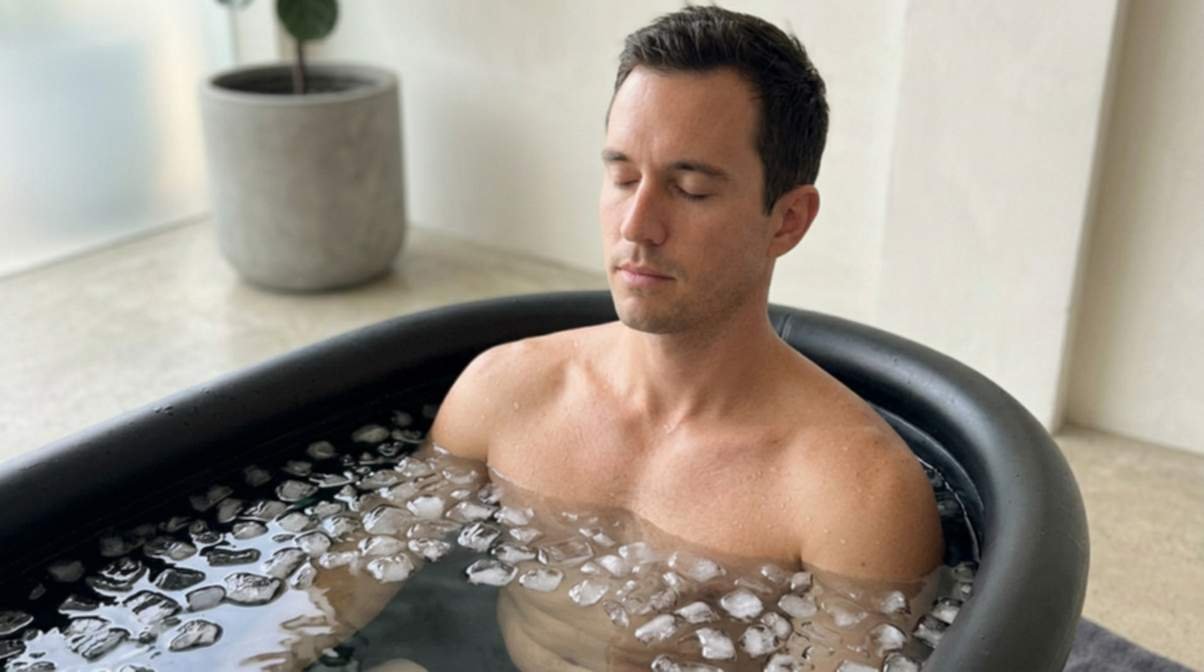
No cold plunges do not increase testosterone. The research points the other way. Three peer-reviewed studies that directly measured testosterone before and after cold water immersion all found either a decrease or a blunting of the normal post-exercise testosterone rise: Sakamoto et al. 1991 found a 10% drop after cold stimulation; Earp et al. 2019 found CWI blunted and delayed the testosterone rise after resistance exercise; and Teległów & Cicha 2025 found a statistically significant drop (p = 0.000037) in young men after a single immersion below 4°C. The claim that cold plunges raise T is a social-media myth it’s not supported by controlled human studies.
It’s one of the most confident claims in wellness content right now. “Cold plunges skyrocket your testosterone.” “Ice baths boost T by 200%.” “Get in the tub, get jacked.” You can find a version of this on TikTok, Instagram, and half a dozen cold-plunge brand blogs that have a financial interest in the claim being true. The trouble is that when you actually go and look at the published studies that measured testosterone before and after cold water immersion, they show the opposite of what’s being sold.
Just as cold plunges don’t boost testosterone, their relationship with inflammation isn’t straightforward. Immediate post-plunge measurements show increased inflammation markers, contrary to popular belief about single-session benefits.
While cold plunges don’t boost testosterone, they do affect men and women differently. Women often benefit from shorter plunges at slightly warmer temperatures due to physiological differences in thermoregulation and body composition. cold plunges and muscle recovery
Already know what you’re after? Browse our full range – see below.
This isn’t an edge-case finding. It’s consistent across a 1991 Japanese study that directly compared cold stimulation with exercise, a 2019 University of Rhode Island study in resistance-trained men, and a 2025 Polish study in young winter swimmers. All three found cold water either dropped testosterone or blunted the post-exercise rise. The 2025 UniSA meta-analysis of 11 studies and 3,177 participants didn’t even list testosterone as a primary or secondary outcome because the evidence base isn’t there. real benefits of ice baths cold plunges for mood and stress
That doesn’t make cold plunging useless. There are real benefits mood, recovery, focus, stress management at 12 hours post and you can read about those in our science guide to ice baths. But testosterone isn’t on the list. This guide walks through why the myth persists, what the actual studies measured, the important distinction between testosterone and sperm quality, and what actually does raise T if that’s your goal.
BEFORE YOU READ FURTHER: If you’re considering cold plunging specifically to address low testosterone, see your GP first. Low T has medical causes worth investigating sleep apnoea, obesity, chronic stress, medication side effects, primary testicular failure, secondary (pituitary) hypogonadism. Cold plunging doesn’t fix any of these. In Australia, healthdirect recommends starting with a morning total testosterone blood test. If yours is genuinely low, a chat with a GP about underlying causes not an ice bath is the evidence-based first move. Never use cold plunging as a substitute for prescribed testosterone replacement therapy (TRT) if you’re on it. Do not change TRT dosing without your prescriber’s input.
What three direct-measurement studies actually found
Competitor blogs cite mechanistic speculation. These are the studies that actually drew blood before and after cold water immersion and measured circulating testosterone. Every one of them showed a decrease or a blunted response:
| Study | Population | Cold exposure | Testosterone finding |
| Sakamoto et al. 1991 (Jpn J Hygiene) | n = 32 healthy men, age 19 | Cold water stimulation (vs bicycle exercise in same subjects) | Testosterone decreased 10.0% after cold. Exercise in the same men increased T by 20.8%. |
| Earp et al. 2019 (Eur J Appl Physiol) | n = 11 resistance-trained men | 15 min CWI immediately after a heavy back-squat session | CWI blunted and delayed the normal post-exercise testosterone rise (p = 0.030 for condition × time interaction). |
| Teległów & Cicha 2025 (PLOS ONE) | n = 13 young men, age 21–25 | Single immersion in <4°C water, air at −15°C, ~5 min total exposure | Statistically significant drop in testosterone (p = 0.000037). Changes remained within the non-pathological range. |
All three studies measured serum testosterone via blood draw pre- and post-immersion. None used self-report or indirect markers. The direction of the effect is consistent: cold exposure does not raise testosterone acutely in healthy men.
The short answer: cold plunges don’t raise testosterone
SECTION TAKEAWAY: Every published human study that measured testosterone before and after cold water immersion found a decrease or a blunted post-exercise rise. The common “cold increases T” claim is based on mechanistic speculation (vasoconstriction, dopamine, brown fat) rather than direct measurement. When researchers actually drew blood, the numbers went the other way.
There’s a useful lesson here about how wellness claims get made. A neurochemical effect of cold the noradrenaline and dopamine surge everyone quotes is real. From there, the argument tends to go: “dopamine is a precursor for other hormones → therefore cold plunges increase testosterone.” That’s a leap. Dopamine is a precursor for noradrenaline and adrenaline, not for testosterone. Testosterone is synthesised from cholesterol in Leydig cells in the testes, regulated by luteinising hormone (LH) from the pituitary. The acute hormonal response to cold elevated cortisol, elevated catecholamines, transient changes in LH tends to suppress, not stimulate, testosterone production.
That matches what Andrew Huberman who popularised many of the cold exposure protocols now in circulation has actually said on his own podcast when asked directly. His Lab’s summary explicitly notes that “well-controlled studies directly linking deliberate cold exposure to significant increases in testosterone are limited” and that the mechanism is speculative. That caveat gets stripped out when the claim is repurposed by influencers and cold-plunge brands.
Why does this myth persist?
Four reasons the “cold plunges boost testosterone” claim won’t die, even though the direct evidence is against it:
The feeling is real, so people assume T is behind it
After a cold plunge you feel alert, focused, energised, quietly aggressive. That feels like “more testosterone.” It isn’t. What you’re feeling is a noradrenaline and dopamine surge different hormones, different mechanism. Feeling “manlier” isn’t a valid proxy for measured free testosterone.
Conflation with scrotal-cooling research
There’s a real body of research showing that elevated scrotal temperature (from hot baths, saunas, laptops on laps, prolonged sitting) harms sperm production. One widely-cited study by Jung et al. (2007) found that men who stopped regular wet-heat exposure saw sperm counts rise by around 491%. That’s a real finding for sperm. It gets quoted as if it’s evidence for testosterone. It isn’t. Sperm and testosterone are made by different cells in different structures within the testis, regulated by different hormones. Keeping your testes cool helps sperm. It doesn’t, on current evidence, do anything measurable for serum testosterone.
Brand incentives
If you sell $8,000 cold plunge tubs, “helps with recovery” is a less powerful pitch than “boost your testosterone.” A lot of cold plunge product copy and blog content has been written with that pressure in mind. When a brand’s evidence list for a T claim consists of a single 2019 anecdote from Men’s Health magazine referencing a Swansea University study that never materialised in peer review, that’s the signal. Real evidence gets cited properly.
Rogan, Huberman clips out of context
A short podcast clip where someone says “cold exposure could plausibly increase testosterone through vasoconstriction-rebound” becomes, after four reposts, “Huberman says cold plunges boost testosterone.” Mechanism becomes claim becomes fact, without any actual study ever being added to the chain. The original speaker usually had caveats. The caveats never make the repost.
Cold plunges after strength training are actively counterproductive for anabolic response
SECTION TAKEAWAY: If you lift for muscle growth and want the post-exercise testosterone surge, do not cold plunge within 4–6 hours of training. The Earp 2019, Roberts 2015, and Fyfe 2019 trials all showed cold water immersion after resistance exercise blunts the normal anabolic response, including the testosterone rise and downstream muscle-growth signalling.
This is where the myth flips from merely wrong to actually harmful to your training. Heavy resistance exercise squats, deadlifts, presses produces a transient rise in circulating testosterone over the following hour or two. That acute T response is part of the anabolic signalling cascade (along with mTOR pathway activation and satellite-cell recruitment) that drives muscle growth. Earp et al. (2019) had 11 resistance-trained men do a 6 × 10 back-squat session at 80% of 1-rep max, followed by either 15 minutes of cold water immersion or a control condition. The cold water group had a blunted and delayed free testosterone response compared to control. That’s a direct measurement, not mechanistic speculation.
The pattern replicates across the strength-training literature. Roberts et al. 2015 showed long-term gains in muscle mass and strength were smaller in lifters who cold plunged after every session compared to those who did active recovery. Satellite cell activity was suppressed. mTOR signalling was attenuated. If you’re trying to build muscle, the most expensive timing mistake you can make is a post-lift cold plunge and the irony is that a lot of people are making that mistake because they’ve been told it raises testosterone.
Sperm quality is a separate question & cold may help
SECTION TAKEAWAY: Keeping the testicles below core body temperature is useful for sperm production. The testicles sit outside the body because sperm needs a temperature of roughly 31–37°C a few degrees below core. Chronic elevated scrotal temperature (from hot baths, saunas, laptops, prolonged driving) is associated with reduced sperm count and motility. Avoiding heat is the evidence-based move; whether adding cold helps further isn’t well established.
This is where the myth and the reality start to overlap. If you’re asking “does cold help with fertility,” there’s a case to be made not because cold does anything special, but because avoiding heat is protective. A 2007 study at the University of California, San Francisco found that men who quit regular hot baths or Jacuzzi use saw sperm counts rise by an average of 491% over three to six months. That’s an avoidance of heat effect. Whether deliberately adding cold further improves sperm counts beyond heat avoidance isn’t well-studied.
Two important clarifications:
- Sperm ≠ testosterone. Sperm is produced by Sertoli cells in the seminiferous tubules; testosterone by Leydig cells in the interstitium. Cold exposure affecting sperm production doesn’t automatically translate to changes in circulating testosterone. The 1987 Nakamura paper often cited by cold-plunge blogs talks about DNA, RNA, and protein synthesis in the testis sperm-related processes, not testosterone synthesis.
- Don’t put ice directly on your testicles. Some influencers recommend ice packs applied to the scrotum. Frostbite is a real risk, as is tissue damage to the structures that make sperm in the first place. If you’re concerned about fertility, Healthy Male (formerly Andrology Australia) is the evidence-based AU resource start there, not with a bag of frozen peas.
What actually raises testosterone (by order of evidence strength)
If the goal is to genuinely raise testosterone, these are the interventions with the strongest evidence. In rough order of impact:
| Intervention | Expected effect | Evidence |
| Treat sleep apnoea; sleep 7+ hours | Large, sustained increase in those who were deficient | One week of sleep restriction (5 h/night) drops T by 10–15% in healthy young men. Sleep is the single most controllable driver. |
| Resistance training (heavy, compound lifts) | Acute 20–30% rise post-session; modest long-term effect | Sakamoto 1991 showed a 20.8% acute rise from 20 min cycling at 90W. Heavy compound lifts (squat, deadlift, press) produce similar or larger acute responses. |
| Lose visceral fat if overweight | Meaningful long-term increase | Adipose tissue contains aromatase, which converts T to oestrogen. Losing visceral fat reduces this conversion. |
| Correct vitamin D deficiency | Modest increase in deficient individuals | Supplementation raises T in men who were deficient; no effect in men who were already replete. About 1 in 4 Australians are vitamin D deficient in winter. |
| Correct zinc deficiency | Modest increase in deficient individuals | Same pattern helps if you’re low, not if you’re replete. No mass-supplementation benefit. |
| Reduce chronic alcohol intake | Small to moderate increase | Heavy drinking (20+ standard drinks/week) lowers T in men. Moderate intake has smaller effects. |
| Testosterone replacement therapy (TRT) | Large, sustained increase prescribed only | For medically diagnosed hypogonadism. PBS access in Australia requires documented low T plus qualifying clinical criteria; administered by a GP or endocrinologist. |
| Cold plunging | None or slightly negative | Per the three direct-measurement studies in this article. Good for recovery, mood, focus. Not a T intervention. |
6. Where cold plunging actually does help men’s health
None of this is an argument against cold plunging. It’s an argument against one specific claim about cold plunging. Cold water immersion has real, measurable benefits just not in the T column. The honest list:
- Stress reduction at 12 hours post-exposure. The 2025 UniSA meta-analysis by Cain et al. pooled 3,177 participants and found significant stress reduction at 12 hours post-CWI. This is the most solid general-population benefit in the current literature.
- Recovery from endurance training. Machado 2016 meta-analysis and multiple follow-ups support 11–15 min at 11–15°C within 30 min of finishing. Reduces DOMS.
- Sleep quality when timed correctly. Chauvineau 2021 showed improved slow-wave sleep when CWI was done ~2–3 hours before bed after training.
- Mood effects. Multiple studies report reduced negative affect for hours after immersion. Not a replacement for mental health treatment, but a real shift.
- Habituation to stress. Repeated cold exposure blunts the cardiovascular and subjective stress response to subsequent cold, which has been proposed (without strong outcome evidence yet) to transfer to other stressors.
Still weighing it up? Our full range is worth a look before you decide.
For the full evidence-based picture, see our science guide to ice baths. None of the benefits listed above are testosterone-dependent. You can have all of them without any T change which is, in fact, what the research shows.
Australian-specific context
Low T in Australia – what the actual data looks like
“Low testosterone” is a medical diagnosis, not a self-assessed state. Healthy Male (the former Andrology Australia, funded by the Department of Health) notes that about 1 in 200 Australian men under 60 have clinically low testosterone from a testicular or pituitary cause. Age-related decline is separate total T falls by about 1% per year from around age 30, but most older men still sit in the normal range. If you’re feeling tired, foggy, or low-libido, the most useful first move is an 8am fasted blood test ordered by your GP, not a cold plunge.
Winter tap water and scrotal exposure
For Australian users in Melbourne, Hobart, Canberra, or the Southern Highlands, winter morning tap water routinely comes out of the mains at 8–12°C. A morning plunge is genuinely cold similar to or colder than the water used in some of the direct-measurement testosterone studies discussed above. Don’t assume “I only plunge for 2 minutes” means the exposure is gentler than what the Polish or Japanese studies used; the duration is shorter, but the starting temperature can be lower. The biological stressor is real.
TRT access in Australia
Australian prescribing rules for testosterone replacement therapy are stricter than the US. PBS-subsidised TRT requires documented androgen deficiency from a specific cause and meets criteria under the Pharmaceutical Benefits Scheme. “Private” TRT clinics advertising direct-to-consumer testosterone access are a grey area and operate outside standard specialist pathways. If you genuinely have low T, an endocrinologist referral via your GP is the correct path not a cold plunge, and not an online “men’s health” subscription service.
Frequently asked questions
Shop Cold Plunge Gear
Thinking about giving cold plunging a proper trial? Our storefront lists ice baths, chillers, thermometers and accessories to help you start.
If it is the recovery and mental-clarity benefits that interest you rather than any testosterone claim, our best ice baths in Australia guide ranks the tubs worth buying on build quality and running cost, not marketing, so you are not just picking whatever the storefront pushes hardest.
Do cold plunges increase testosterone in men?
No. Three peer-reviewed studies that directly measured testosterone before and after cold water immersion found a decrease or a blunting of the normal post-exercise rise. The 2025 UniSA meta-analysis of 11 studies and 3,177 participants didn’t even list testosterone as a measured outcome because the evidence base isn’t there.
Does cold plunging lower testosterone?
The direct evidence suggests it can. Sakamoto et al. 1991 found a 10% decrease after cold stimulation. Teległów & Cicha 2025 found a statistically significant drop (p = 0.000037) in young men after a single immersion below 4°C. Earp et al. 2019 found cold water immersion blunted and delayed the normal post-resistance-exercise testosterone rise.
Does cold water increase sperm count?
It may help indirectly by avoiding heat, not by adding cold. Elevated scrotal temperature (from hot baths, saunas, laptops) harms sperm production. A 2007 study found men who stopped regular hot baths saw sperm counts rise by ~491%. Keeping the testicles cool is protective, but deliberately adding cold (like ice packs) isn’t well-studied and carries frostbite risks.
Is it better to cold plunge before or after a workout for testosterone?
After a workout is actively counterproductive. Research shows cold water immersion within 4–6 hours of resistance exercise blunts the post-exercise testosterone rise and interferes with muscle growth signalling. If your goal is muscle growth, avoid cold plunges post-workout.
Do cold plunges help with low T or support TRT?
No. Low testosterone has medical causes (sleep apnoea, obesity, pituitary issues) that cold plunging doesn’t address. It is not a substitute for prescribed testosterone replacement therapy (TRT). Never change TRT dosing based on cold exposure.
How long do cold plunges affect testosterone?
The studies measured acute effects within minutes to a few hours post-immersion. The testosterone drop or blunting appears to be a transient hormonal response to cold stress, not a long-term change.
Can women benefit from cold plunges for hormones?
The research on testosterone and cold exposure is in men. For women, cold plunges may offer similar non-hormonal benefits (recovery, mood, stress reduction). Hormonal effects in women are not well-studied.
Does sauna increase testosterone more than cold plunge?
Neither reliably increases testosterone. Sauna may have a modest effect on growth hormone, but evidence for testosterone is weak. The most reliable way to acutely raise testosterone is heavy resistance training.
Can cold plunges increase estrogen?
There’s no strong evidence that cold plunges increase estrogen in men. The primary hormonal responses are increased noradrenaline, dopamine, and cortisol.
What actually raises testosterone naturally?
In order of evidence strength: treating sleep apnoea/getting 7+ hours sleep, heavy resistance training, losing visceral fat if overweight, correcting vitamin D or zinc deficiencies (if deficient), and reducing chronic heavy alcohol intake.
Is the “cold plunge boosts testosterone” claim in any peer-reviewed study?
No peer-reviewed study that directly measured testosterone has found an increase from cold water immersion. The claim is based on mechanistic speculation, not direct measurement.
Should I stop cold plunging because of this?
Not necessarily. Cold plunges have other evidence-backed benefits (recovery, mood, stress reduction). Just don’t do it for testosterone, and avoid it within 4–6 hours of strength training if muscle growth is your goal.
Sources
- Sakamoto, K., Wakabayashi, I., Yoshimoto, S., Masui, H., & Katsuno, S. (1991). Effects of physical exercise and cold stimulation on serum testosterone level in men. Nippon Eiseigaku Zasshi (Japanese Journal of Hygiene), 46(2), 635–638. DOI: 10.1265/jjh.46.635. PubMed: 1890772.
- Earp, J. E., Hatfield, D. L., Sherman, A., Lee, E. C., & Kraemer, W. J. (2019). Cold-water immersion blunts and delays increases in circulating testosterone and cytokines post-resistance exercise. European Journal of Applied Physiology, 119(8), 1901–1907. DOI: 10.1007/s00421-019-04178-7. PubMed: 31222379.
- Teległów, A., & Cicha, I. (2025). Single immersion in cold water below 4°C: A health hazard in young healthy men? PLOS ONE, 20(5), e0324502. DOI: 10.1371/journal.pone.0324502. PubMed: 40408371.
- Roberts, L. A., Raastad, T., Markworth, J. F., Figueiredo, V. C., Egner, I. M., Shield, A., et al. (2015). Post-exercise cold water immersion attenuates acute anabolic signalling and long-term adaptations in muscle to strength training. The Journal of Physiology, 593(18), 4285–4301. DOI: 10.1113/JP270570.
- Fyfe, J. J., Broatch, J. R., Trewin, A. J., Hanson, E. D., Argus, C. K., Garnham, A. P., et al. (2019). Cold water immersion attenuates anabolic signalling and skeletal muscle fiber hypertrophy, but not strength gain, following whole-body resistance training. Journal of Applied Physiology, 127(5), 1403–1418. DOI: 10.1152/japplphysiol.00127.2019.
- Cain, T., Brinsley, J., Bennett, H., Nelson, M., Maher, C., & Singh, B. (2025). Effects of cold-water immersion on health and wellbeing: A systematic review and meta-analysis. PLOS ONE, 20(1), e0317615. DOI: 10.1371/journal.pone.0317615. Testosterone not included as a measured outcome across the 11 included studies.
- healthdirect Australia — Low testosterone in men. Australian Government-funded consumer health resource.
- Healthy Male (formerly Andrology Australia) — Androgen deficiency. National men’s health resource funded by the Department of Health.
- Huberman Lab — Cold water exposure and testosterone (official position summary). Acknowledges “well-controlled studies directly linking deliberate cold exposure to significant increases in testosterone are limited.”
- Healthline — Do Cold Showers Increase Testosterone? (2019, medically reviewed). Summarises the older evidence base.
- Legacy Sperm Experts — Can cold plunging really improve male fertility and testosterone levels?. Fertility-specialist view.
Medical disclaimer: General information based on current research. This article is not medical advice and should not be used as a substitute for evaluation by a qualified clinician. If you’re concerned about low testosterone, suspect androgen deficiency, or are considering testosterone replacement therapy, discuss it with your GP and (if indicated) an endocrinologist.
