
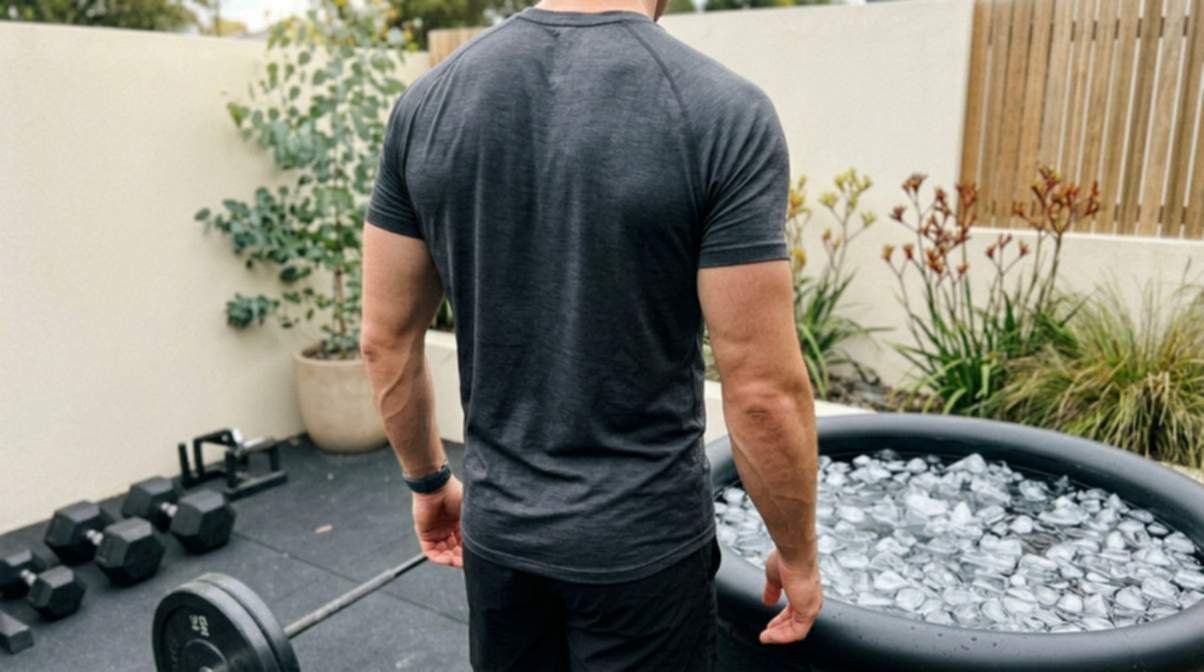
KEY TAKEAWAY: Yes, cold plunges can reduce muscle growth but only when used immediately after resistance training. The 2024 Piñero/Schoenfeld meta-analysis of 8 RCTs found that post-exercise cold water immersion blunts hypertrophy compared to resistance training alone, though it doesn’t eliminate gains entirely. The mechanism: cold reduces muscle blood flow by up to 70%, suppresses anabolic signalling (mTOR pathway), and blunts satellite cell activity needed for muscle repair. The practical fix is simple: wait at least 4–6 hours between your last set and your cold plunge, or use cold exposure on rest days. Strength gains appear largely preserved even with immediate CWI.
You’ve just finished a heavy squat session. Your legs are on fire, every rep of that last set felt like negotiating with gravity, and all you want is something anything to take the edge off. The cold plunge is right there. Three minutes of icy water and the soreness melts away. It feels like the smart move.
Skip to the products if you’d rather – our full range is below.
But if you’re training for size, that cold plunge might be costing you. Not all your gains. Not even most of them. But enough to matter if you’re doing everything else right tracking protein, programming progressively, sleeping well and wondering why the needle isn’t moving as fast as it should.
This is one of the most researched questions in sports recovery, and the science has advanced significantly in 2024–2025. We now have a first-of-its-kind meta-analysis on hypertrophy specifically, new mechanistic data from Maastricht University explaining why cold blunts growth, and clearer practical guidelines than ever before.
This guide reviews every major study, explains the mechanisms in plain language, and gives you a clear protocol for getting the benefits of cold exposure without sacrificing your gains. If you want the full picture on ice bath benefits beyond muscle growth, see our science guide to ice bath benefits.
SAFETY WARNING: Cold water immersion carries cardiovascular risks for people with heart disease, hypertension, or arrhythmia. If you have any cardiovascular condition, are over 50, pregnant, or take cardiac medication, consult your GP before using cold plunges. For the full risk breakdown, see our ice bath safety guide.
The Evidence at a Glance
| Study | Year | Design | Key Finding |
|---|---|---|---|
| Roberts et al. (QUT) | 2015 | 12-week RCT, 21 men, CWI vs active recovery after strength training | CWI attenuated anabolic signalling (p70S6K, satellite cells). Type II fibre CSA gains significantly lower with CWI. |
| Peake et al. (QUT) | 2017 | Same cohort, inflammation + cell stress markers | CWI blunted satellite cell activity and markers of muscle remodelling for up to 48h post-exercise. |
| Fyfe et al. | 2019 | 7-week RCT, 16 men, CWI vs passive recovery | CWI attenuated type II fibre hypertrophy but NOT strength gains. HSP27 and HSP72 responses blunted. |
| Fuchs et al. (Maastricht) | 2020 | Crossover, 12 men, CWI vs thermoneutral after exercise | CWI reduced muscle protein synthesis rates during recovery. First direct MPS measurement. |
| Piñero/Schoenfeld et al. | 2024 | Meta-analysis of 8 RCTs (116 participants) | First meta-analysis on CWI + hypertrophy. RT alone produced greater hypertrophy than RT + CWI. Effect was consistent across all studies. |
| Betz et al. (Maastricht) | 2025 | Crossover, 12 men, one leg cold/one thermoneutral | CWI reduced microvascular blood flow by 70% and blunted amino acid incorporation into muscle protein. Explains the MPS mechanism. |
| Fuchs et al. (Maastricht) | 2025 | 2-week RT protocol, CWI vs control | CWI lowered dietary protein-derived amino acid incorporation into myofibrillar protein over 2 weeks of training. |
1. What the Research Actually Shows
KEY TAKEAWAY: Cold water immersion after resistance training consistently blunts hypertrophy across multiple study designs from acute molecular markers to 12-week training outcomes. However, it does not eliminate muscle growth entirely, and strength gains appear less affected than size gains.
The landmark study: Roberts et al. (2015), QUT, Australia
This is the study that started the conversation. Researchers at the Queensland University of Technology (QUT) in Brisbane had 21 men complete a 12-week resistance training program. Half did 10 minutes of cold water immersion at 10°C after each session; the other half did active recovery (low-intensity cycling). The results were striking: the CWI group showed significantly blunted activation of key anabolic signalling proteins (p70S6K phosphorylation), reduced satellite cell numbers, and smaller gains in type II muscle fibre cross-sectional area (Roberts et al., 2015).
The satellite cell study: Peake et al. (2017), QUT
From the same research group and overlapping cohort, this study drilled into the cellular mechanisms. Peake et al. (2017) found that CWI blunted the activity of satellite cells the stem cells responsible for donating new nuclei to muscle fibres, a process considered essential for long-term hypertrophy. These effects persisted for up to 48 hours after cold exposure, suggesting that the interference isn’t just an acute blip it lingers.
The protein synthesis study: Fuchs et al. (2020), Maastricht University
This study from the Netherlands was the first to directly measure muscle protein synthesis (MPS) rates after CWI versus thermoneutral recovery. Twelve recreational athletes completed a resistance exercise bout, then had one leg immersed in cold water (8°C for 20 minutes) and the other in thermoneutral water (30°C). Fuchs et al. (2020) found that MPS rates were significantly lower in the cold-immersed leg. This was the first direct evidence that cold doesn’t just affect signalling molecules it measurably reduces the rate at which your muscles build new protein.
The meta-analysis: Piñero, Schoenfeld et al. (2024)
Published in the European Journal of Sport Science, this was the first meta-analysis to specifically examine CWI’s effect on hypertrophy (not just strength). Piñero et al. (2024) pooled 8 RCTs with 116 participants and found that resistance training alone produced greater hypertrophic adaptations than resistance training combined with CWI. The effect was consistent regardless of immersion duration, participant training status, or exercise frequency. Critically, they noted that CWI + RT still produced some gains just less than RT alone.
The blood flow mechanism: Betz et al. (2025), Maastricht University
The newest piece of the puzzle. Betz et al. (2025) published in Medicine & Science in Sports & Exercise, demonstrated the why behind the reduced MPS: cold water immersion reduced microvascular blood flow in the exercised muscle by approximately 70% compared to the thermoneutral control leg. This reduction in blood flow was strongly correlated (r = 0.65) with reduced amino acid incorporation into muscle tissue. In simple terms: cold constricts the blood vessels that deliver protein to your muscles after training, and less protein delivery means less muscle building.
2. Why Cold Blunts Muscle Growth: The 4 Mechanisms
KEY TAKEAWAY: Cold water immersion interferes with muscle growth through four overlapping mechanisms: reduced blood flow, suppressed inflammation, blunted anabolic signalling, and impaired satellite cell activity. Each of these is a normal part of the muscle-building process that cold disrupts.
- Reduced muscle blood flow and nutrient delivery. Cold causes vasoconstriction blood vessels narrow, reducing blood flow to the muscle. Betz et al. (2025) measured a 70% reduction in microvascular perfusion after CWI. This directly reduces the delivery of amino acids (from your post-workout protein) to the muscle fibres that need them for repair and growth. The cold-immersed leg in their study incorporated significantly fewer dietary amino acids into new muscle protein.
- Suppressed inflammatory response. This is the paradox that most people don’t understand. Inflammation after exercise feels bad it’s the soreness, the swelling, the stiffness. But that inflammation is part of the growth signal. It recruits immune cells that clear damaged tissue and triggers the molecular cascade that leads to muscle repair and adaptation. When you ice the inflammation away immediately after training, you’re removing a trigger that your muscles need. As Prof Christopher Joyce (MCPHS) puts it: the inflammatory process sends cells to heal and regenerate the muscles you damage during exercise.
- Blunted anabolic signalling (mTOR pathway). The mTOR signalling pathway is the master switch for muscle protein synthesis. Roberts et al. (2015) found that CWI after resistance exercise reduced phosphorylation of p70S6 kinase a key downstream target of mTOR and other markers of the anabolic response. When mTOR signalling is suppressed, the molecular machinery that builds new muscle protein runs at a lower gear.
- Impaired satellite cell activation. Satellite cells are muscle stem cells that sit on the outside of muscle fibres. When you train hard enough to cause damage, these cells activate, proliferate, and fuse with existing fibres adding new myonuclei that allow the fibre to grow larger. Both Roberts et al. (2015) and Peake et al. (2017) found that CWI reduced satellite cell numbers and activity. This effect persisted for up to 48 hours, suggesting a meaningful disruption to the muscle remodelling process.
3. The Nuance: What Cold Doesn’t Destroy
KEY TAKEAWAY: Cold plunges don’t eliminate muscle growth they reduce it. And strength gains appear to be less affected than hypertrophy. If you’re training for performance rather than pure size, the impact may be acceptable.
The conversation around cold plunges and muscle growth has become unnecessarily black-and-white. Headlines like “cold plunges kill your gains” aren’t supported by the research. Here’s what the evidence actually shows:
- You still gain muscle with CWI just less of it. Piñero et al. (2024) were explicit: RT combined with CWI still induces gains in muscle mass, but to a lesser degree compared to RT alone. This isn’t zero growth. It’s reduced growth.
- Strength gains are largely preserved. Fyfe et al. (2019) found that CWI attenuated type II fibre hypertrophy but not maximal strength gains. This dissociation matters: if you’re training primarily for strength and performance, CWI may have minimal impact on your 1RM numbers even if it slightly reduces muscle fibre size.
- The studies used immediate post-exercise CWI. Every study in the Piñero meta-analysis applied CWI within 15 minutes of the last set. None tested what happens when you wait 4–6 hours. The interference effect may be largely or entirely avoidable with timing.
- Study quality is mixed. Piñero et al. noted the overall “relatively fair to poor quality” of the studies examined. Sample sizes are small (8–21 participants per study), study durations are short (4–12 weeks), and women are almost entirely unrepresented. The “20% less muscle growth” headlines extrapolate from limited data.
- Context matters. An endurance athlete using CWI during a tournament week for soreness management isn’t in the same situation as a bodybuilder in a hypertrophy block. The cost-benefit calculation changes with your goals.
4. The Practical Protocol: How to Use Cold Plunges Without Sacrificing Gains
KEY TAKEAWAY: The simplest fix: separate your cold plunge from your strength training by at least 4–6 hours, or use cold exposure on rest days. This preserves the acute anabolic window while still giving you the mood, alertness, and recovery benefits of cold exposure.
| Scenario | Protocol |
|---|---|
| Hypertrophy/bulking phase | Avoid CWI within 4–6 hours of resistance training. Use cold plunges on rest days or in the morning if you train in the evening. |
| Strength phase (1RM focus) | CWI impact on strength is minimal. Use strategically if soreness is limiting training frequency, but still prefer timing separation. |
| Endurance / cardio focus | CWI appears to have little or no negative effect on endurance adaptations. Use freely after running, cycling, or swimming sessions. |
| Tournament / competition period | Immediate post-exercise CWI is justified here. Reduced soreness and faster perceived recovery outweigh the modest hypertrophy cost during a taper or competition block. |
| General wellness (not training-focused) | Use cold plunges whenever you like. The muscle growth interference only matters during structured resistance training programs. |
| Contrast therapy (sauna + cold) | Same 4–6 hour rule applies to the cold component. See our contrast therapy guide for protocols. |
The Mayo Clinic’s Dr Andrew Jagim makes the same recommendation: use ice baths strategically during intense two-week practice periods or three-day tournaments, but avoid using them every day throughout an entire season or training cycle.
For cold plunge duration guidelines, see our full duration guide. For choosing the right equipment, check our tested comparison of the best ice baths in Australia.
5. What About Cold Showers?
Most of the research on cold and muscle growth uses full-body cold water immersion at 8–15°C. Cold showers don’t produce the same degree of core or muscle cooling and likely have a smaller (possibly negligible) effect on hypertrophy. If you enjoy a cold shower after training and you’re worried about your gains, the risk is almost certainly lower than full immersion but no study has directly compared the two in a hypertrophy context.
If muscle growth is the goal, our full range is worth a browse now.
6. What About Endurance Athletes?
Good news if your focus is running, cycling, swimming, or team sports: the evidence suggests CWI has little or no negative effect on endurance training adaptations. The Malta et al. (2021) meta-analysis found that CWI specifically impaired resistance training adaptations, not endurance outcomes. Piñero et al. (2024) confirmed this distinction. If you’re training for a marathon, triathlon, or AFL season and using cold plunges for recovery, the muscle growth concern is largely irrelevant to your goals.
7. What the Science Doesn’t Support: Common Myths
- “Cold plunges completely kill your gains.” No. Every study and the Piñero meta-analysis show that CWI + RT still produces muscle growth just less than RT alone. The effect is a blunting, not an elimination.
- “Cold plunges are bad for everyone who lifts.” No. The interference is specific to the timing (immediately post-exercise), the type of training (resistance, not endurance), and the goal (hypertrophy more than strength). Strategic use is fine.
- “The ‘66% less muscle growth’ headline is accurate.” Misleading. That figure comes from extrapolating a single study’s acute signalling data to long-term outcomes. The actual difference in real-world muscle size over training programs is more modest, and the Piñero meta-analysis describes it as a reduction from ‘small’ to ‘small-to-negligible’ effect sizes not a 66% reduction.
- “You should never combine cold exposure with lifting.” Unnecessarily extreme. Timing separation (4–6 hours) likely avoids most or all of the interference effect, though this hasn’t been directly tested in a hypertrophy study yet.
- “Reducing inflammation is always good for recovery.” This is the fundamental misconception. Post-exercise inflammation is part of the adaptation signal. NSAIDs (like ibuprofen) have been shown to blunt muscle adaptations for the same reason they suppress the inflammatory response your muscles need to grow. Cold does the same thing.
Frequently Asked Questions
Shop Cold Plunge Tubs And Recovery Gear
If recovery timing matters to your training, our storefront lists ice baths, chillers, thermometers and accessories worth a look.
Do cold plunges reduce muscle growth?
Yes, but only when used immediately after resistance training. The 2024 Piñero/Schoenfeld meta-analysis of 8 RCTs found that post-exercise cold water immersion blunts hypertrophy compared to resistance training alone. The effect is a reduction, not an elimination. Strength gains appear less affected than muscle size gains.
Are cold plunges bad for muscle growth?
They can be if timed poorly. Using a cold plunge within 15 minutes of your last set interferes with muscle protein synthesis, blood flow, and satellite cell activity. However, if you separate your cold plunge from your strength training by 4–6 hours, or use it on rest days, you can avoid most or all of this interference while still getting the mood and recovery benefits.
Does cold plunge inhibit muscle growth permanently?
No. The blunting effect is acute and related to the timing of the cold exposure relative to your workout. There is no evidence that cold plunges cause permanent damage to your muscle-building capacity. If you stop using cold plunges immediately after training, your muscle growth rate should return to normal.
How long should I wait between lifting and cold plunging?
Based on the mechanism (reduced blood flow and protein synthesis), waiting at least 4–6 hours is recommended to avoid interfering with the acute anabolic window. This timing has not been directly tested in a long-term hypertrophy study, but it aligns with the known duration of elevated muscle protein synthesis post-exercise.
Do cold plunges affect strength gains?
The evidence suggests strength gains are less affected than hypertrophy. The Fyfe et al. (2019) study found that cold water immersion attenuated muscle fibre growth but did not impair maximal strength gains. If your primary goal is increasing your 1RM, the impact of strategic cold plunge use is likely minimal.
Can I cold plunge on rest days without affecting muscle growth?
Yes. The interference effect is specific to the post-exercise recovery period. Using a cold plunge on a rest day, when muscle protein synthesis has returned to baseline, should not blunt the adaptations from your previous day’s training. This is a highly effective strategy for getting cold exposure benefits without cost.
Does cold plunge temperature matter for muscle growth?
Yes, colder temperatures and longer durations produce greater vasoconstriction and likely a greater blunting effect. The studies showing reduced muscle growth used temperatures between 8–15°C for 10–20 minutes. A brief, less intense cold exposure (like a 2-minute shower) would likely have a smaller effect, though this hasn’t been directly studied for hypertrophy.
Should endurance athletes worry about cold plunges and muscle?
No. The research indicates that cold water immersion specifically impairs resistance training adaptations, not endurance outcomes. The Malta et al. (2021) and Piñero et al. (2024) analyses confirm this distinction. Endurance athletes can use cold plunges for recovery without concern for blunting their aerobic adaptations.
Is contrast therapy (sauna + cold plunge) also bad for muscle growth?
The cold component of contrast therapy carries the same risk if applied immediately post-workout. The same 4–6 hour separation rule should apply to the cold plunge portion of your contrast protocol. The heat (sauna) component does not appear to blunt muscle growth and may even support it through HSP induction.
What’s better for muscle recovery: cold plunge or active recovery?
For pure muscle growth, active recovery (light cycling, walking) is superior because it maintains blood flow without suppressing inflammation and anabolic signalling. For immediate soreness reduction and perceived recovery, a cold plunge is more effective. Your choice should depend on your primary goal for that session: long-term adaptation (active recovery) or short-term feel-good (cold plunge, with proper timing).
Sources
Roberts LA, Raastad T, Markworth JF, et al. Post-exercise cold water immersion attenuates acute anabolic signalling and long-term adaptations in muscle to strength training. Journal of Physiology. 2015;593(18):4285–4301. DOI: https://doi.org/10.1113/JP270570
Peake JM, Roberts LA, Figueiredo VC, et al. The effects of cold water immersion and active recovery on inflammation and cell stress responses in human skeletal muscle after resistance exercise. Journal of Physiology. 2017;595(3):695–711. DOI: https://doi.org/10.1113/JP272881
Fuchs CJ, Kouw IWK, Churchward-Venne TA, et al. Postexercise cooling impairs muscle protein synthesis rates in recreational athletes. Journal of Physiology. 2020;598(4):755–772. DOI: https://doi.org/10.1113/JP278996
Piñero A, Burke R, Augustin F, Mohan AE, DeJesus K, Sapuppo M, Weisenthal M, Coleman M, Androulakis-Korakakis P, Grgic J, Swinton PA, Schoenfeld BJ. Throwing cold water on muscle growth: A systematic review with meta-analysis. European Journal of Sport Science. 2024;24(2):177–189. DOI: https://doi.org/10.1002/ejsc.12074
Betz MW, Fuchs CJ, Chedd F, et al. Post-exercise cooling lowers skeletal muscle microvascular perfusion and blunts amino acid incorporation into muscle tissue in active young adults. Medicine & Science in Sports & Exercise. 2025;57(9):1866–1876. DOI: https://doi.org/10.1249/MSS.0000000000003723
Fuchs CJ, Hermans WJH, Nyakayiru J, et al. Cold water immersion during recovery from resistance-type exercise lowers dietary protein-derived amino acid incorporation into myofibrillar protein. Journal of Physiology. 2025;603(13):3837–3856. DOI: https://doi.org/10.1113/JP286065
Fyfe JJ, Broatch JR, Trewin AJ, et al. Cold water immersion attenuates anabolic signaling and skeletal muscle fiber hypertrophy, but not strength gain, following whole-body resistance training. Journal of Applied Physiology. 2019;127(5):1403–1418. DOI: https://doi.org/10.1152/japplphysiol.00127.2019
Malta ES, Dutra YM, Broatch JR, Bishop DJ, Zagatto AM. The effects of regular cold-water immersion use on training-induced changes in strength and endurance performance: A systematic review with meta-analysis. Sports Medicine. 2021;51(1):161–174.
Grgic J. Effects of post-exercise cold-water immersion on resistance training-induced gains in muscular strength: A meta-analysis. European Journal of Sport Science. 2023;23(3):372–380.
Machado AF, Ferreira PH, Micheletti JK, et al. Can water temperature and immersion time influence the effect of cold water immersion on muscle soreness? Sports Medicine. 2016;46(4):503–514. DOI: https://doi.org/10.1007/s40279-015-0431-7
Wang Y, et al. Dose-response of cold water immersion for recovery. Frontiers in Physiology. 2025. DOI: https://doi.org/10.3389/fphys.2025.1525726
Medical Disclaimer: This content is for informational purposes only and does not constitute medical or exercise advice. Consult a qualified professional before changing your training or recovery protocols.
