
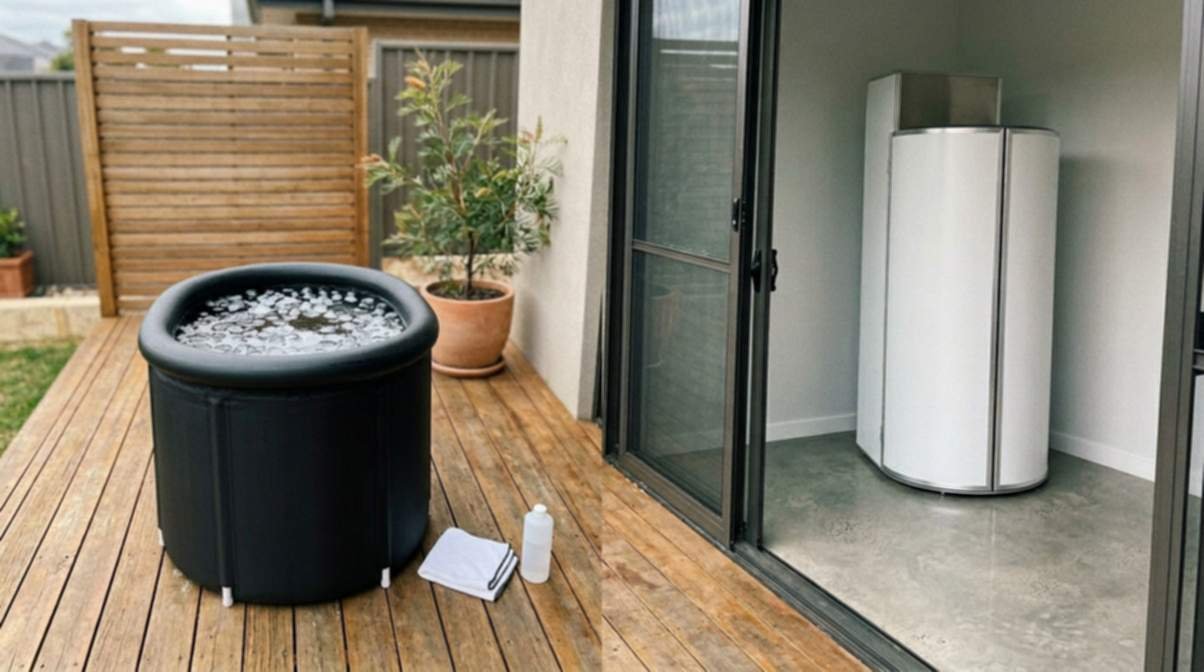
KEY TAKEAWAY For muscle recovery and overall wellbeing, the head-to-head research favours cold plunges not cryotherapy. The 2015 Cochrane review concluded there is insufficient evidence that whole-body cryotherapy reduces muscle soreness, and direct comparison RCTs (Abaïdia 2017, Wilson 2018) show cold water immersion outperforms cryo chambers for post-exercise recovery. Cryotherapy has real advantages — it is fast, dry, and tolerable for people who hate water — but the scientific case is weaker and the cost per session is much higher.
Three minutes in a nitrogen-cooled chamber at minus 140 degrees sounds more hardcore than three minutes in 10-degree water. The marketing certainly leans that way. Every cryo clinic in Sydney, Melbourne and Brisbane will tell you that their chamber is colder, faster, cleaner, and better than an ice bath. Some will quote you a 800-calorie burn per session. A few will call it “ice bath on steroids.”
Unlike cryotherapy, cold plunges allow for more precise temperature control, which is important since optimal cold exposure varies significantly between men and women due to differences in body composition and thermoregulation.
Here is what the research actually shows: when you put whole-body cryotherapy and cold water immersion in the same study, cold water keeps winning. Not by a landslide, but consistently enough that the peer-reviewed literature has stopped pretending it is a close call for athletic recovery. The cryotherapy vs cold plunge question is not really about which is colder — cryo is colder on paper — it is about what that cold actually does once it hits your body.
Unlike whole-body cryotherapy, cold plunges allow for targeted applications like facial ice immersion, which has gained popularity through social media trends. While both methods trigger similar physiological responses, plunges offer more control over temperature and duration for skincare purposes.
Unlike cryotherapy’s dry cold, water-based methods like cold plunges and ice baths provide superior conductive cooling. The choice between them often comes down to budget and setup preferences rather than therapeutic differences.
This guide compares the two head-to-head on recovery, mood, cost, safety, and what the marketing quietly skips. Every claim links to a specific study or authority source. If you want the broader picture, see our comparison of the best ice baths and our science guide on whether ice baths are actually good for you.
SAFETY FIRST — BOTH HAVE real risks Cryotherapy: The US FDA has never cleared or approved any whole-body cryotherapy device for any medical condition. Treat any medical claim with skepticism. Liquid-nitrogen cooled chambers carry an asphyxiation risk. A 24-year-old Las Vegas clinic worker died in a cryo chamber in 2015. Only use TGA-registered chambers with supervised operation. Documented hazards include frostbite, burns, and eye injury from the extreme temperatures. Cold plunge: Never plunge alone. Cold shock can cause involuntary gasping and cardiac arrhythmias in the first 60 seconds. Start at 15°C and drop 1°C per week. There is nothing elite about doing 3°C on day one. Both: If you are over 50, pregnant, have cardiovascular disease, Raynaud’s, uncontrolled hypertension, or are on beta-blockers — see your GP first. Guidance is consistent with the Royal Life Saving Society Australia and FDA consumer update on whole body cryotherapy.
The Quick Comparison
Here is the honest side-by-side before we get into the evidence behind each row. cost per session
| Factor | Cold Plunge (CWI) | Cryotherapy (WBC) |
| Typical temperature | 3–15°C water | −110°C to −140°C air (TGA-listed AU chambers) |
| Typical duration | 2–15 minutes | 2–3 minutes |
| Cooling depth | Deep tissue — water conducts heat ~25× more efficiently than air | Surface only — skin temperature drop, minimal deep tissue effect |
| Hydrostatic pressure | Yes — aids circulation and recovery | None — dry air only |
| Head-to-head recovery evidence | Favoured in Abaïdia 2017 and Wilson 2018 marathon RCT | Cochrane 2015: insufficient evidence |
| Regulatory status (AU/US) | Not a medical device — no approval required | No device FDA-approved for any condition; some AU chambers TGA-listed as medical devices |
| Cost (AUD) | $200 (inflatable) to $10,000+ (chiller tub) — one-off | $50–$90 per 3-minute session — ongoing |
| Accessibility in AU | At-home or gym — available everywhere | Clinic-only — Sydney, Melbourne, Brisbane, Perth, Adelaide |
| Experience | Wet, slow cold build, longer duration | Dry, sharp, brief — many find it more tolerable |
| Best for | Athletic recovery, daily practice, cold adaptation, DIY | People who hate water, time-poor users, certain skin conditions |
Different Between Cryotherapy and a Cold Plunge
SECTION TAKEAWAY A cold plunge cools your body through water conduction — your tissues lose heat quickly because water pulls heat out of your skin roughly 25 times faster than air can. Cryotherapy cools through very cold air — the surface temperature drops dramatically but the deeper tissues barely change. Same family, very different mechanism.
Mechanism: water vs air
This is the one technical detail every cryo clinic glosses over. Water is a dramatically better thermal conductor than air. The thermal conductivity of water is around 0.6 W/m·K; still air is around 0.024. Even accounting for temperature differences, a 3-minute session at −140°C in dry air produces less core cooling than 10 minutes at 10°C in water. The marketing is the reverse: cryo clinics emphasise how cold the air is and ignore the fact that cold air cannot move heat out of you efficiently.
Coverage and duration
A cold plunge immerses your entire trunk, limbs, shoulders and neck in water at chest level. The exposure lasts minutes. A cryotherapy session — in most AU clinics that use the °CRYO Arctic chamber — keeps your head out, uses cooled air around your body, and lasts 2 to 3 minutes. Older nitrogen-cooled chambers were open-topped; modern TGA-listed AU chambers are electric and use refrigerated air, so there is no nitrogen exposure.
Hydrostatic pressure
Being submerged adds a gentle squeeze on the peripheral tissues — hydrostatic pressure. This is thought to help with the flush effect that aids muscle recovery. Cryo chambers cannot replicate this; you are standing in cold air. Mawhinney et al. (2017) ran a direct head-to-head comparison and demonstrated — as the paper’s title says — that cold water mediates greater reductions in limb blood flow than whole body cryotherapy. Femoral artery and muscle temperature changes were both significantly larger after CWI than after WBC, which is part of why the recovery effect is stronger in water.
The Head-to-Head Research
SECTION TAKEAWAY When researchers put WBC and CWI in the same trial, CWI wins for functional recovery. The 2015 Cochrane review on whole-body cryotherapy found insufficient evidence. The most-cited head-to-head RCTs favour CWI. This is the single most important fact the cryotherapy industry does not advertise.
Cochrane 2015: the gold-standard verdict
Costello et al. (2015) performed a Cochrane systematic review specifically on WBC for exercise-induced muscle soreness. Their conclusion in plain English: there is insufficient evidence to determine whether WBC reduces self-reported muscle soreness or improves subjective recovery after exercise compared with rest. They also noted there was no evidence for women or elite athletes, and the lack of reporting on adverse events was itself a concern. Cochrane reviews are the gold standard for evidence synthesis — they trump any individual clinic’s testimonials.
Abaïdia 2017: direct RCT comparison
Abaïdia et al. (2017) ran a randomised crossover trial: 10 physically active men did eccentric hamstring exercise, then recovered with either CWI (10 min at 10°C) or WBC (3 min at −110°C). They tested creatine kinase, strength, countermovement jumps and soreness over 72 hours. The result: CWI produced a very likely moderate effect in favour of CWI for both single-leg and 2-leg countermovement jumps at 72 hours post-exercise. That is a functional outcome — actual jumping performance — not just perceived soreness.
Wilson 2018: the marathon study
Wilson et al. (2018) is the study cryo clinics really do not want you to read. They took 31 endurance-trained males who completed a marathon, randomly assigned them to CWI, WBC, or a placebo control, and measured muscle function, soreness and inflammatory markers over 48 hours. The finding: WBC had a harmful effect on muscle function compared to CWI post-marathon. WBC was better for perceived training stress (a subjective measure), but it made objective recovery worse. This is the opposite of what you hear at a cryo clinic.
The pattern across meta-analyses
The Wang et al. (2025) network meta-analysis pooled 55 RCTs on cold water immersion for exercise recovery and identified 10–15 minutes at 5–10°C as the optimal dose. The Cain et al. (2025) UniSA meta-analysis on wellbeing outcomes explicitly included ice baths, cold plunges and cold showers — not WBC. The research base for CWI is substantially larger and more recent than for WBC. That gap matters when you are trying to design a protocol.
Where Cold Plunges Clearly Win
Post-exercise muscle recovery
The combination of the Cochrane 2015 review, the Abaïdia 2017 crossover, the Wilson 2018 marathon study, and the Wang 2025 meta-analysis points in one direction: for actual muscle function recovery, cold water immersion has better evidence than whole-body cryotherapy. The usual caveat applies — avoid either immediately after strength training if hypertrophy is the goal, because Roberts et al. (2015) showed CWI blunts anabolic signalling after resistance exercise for 4–6 hours.
Deep tissue cooling
If the point of cold exposure is to lower tissue temperature enough to alter inflammation and metabolic activity, water does it better. Air at −140°C feels dramatic on your skin but cannot transfer heat out of your muscle fast enough in a 3-minute session. The HydroWorx-summarised international comparison study found CWI lowered femoral artery blood flow and muscle temperature to a greater extent than a typical WBC protocol after endurance exercise.
Cost over time
Cryotherapy in Australia runs roughly $50 to $90 per single casual 3-minute session at major clinics in Sydney and Melbourne, with multi-session packages and memberships typically bringing the effective per-session cost down to $27 to $40. If you use it three times per week at the casual rate, that is $7,800 to $14,000 AUD per year — forever. A decent home cold plunge with chiller is a one-off purchase between $2,000 and $10,000 AUD. Even the premium end of the plunge market pays for itself inside 12–18 months versus a regular cryo habit at casual pricing.
Research base and protocol clarity
This is the quiet advantage. There are literally hundreds of RCTs on cold water immersion and two major 2025 meta-analyses. There are dozens on WBC and one Cochrane review that said the evidence is insufficient. If you want an evidence-based protocol, you can build one for CWI (see our guide on how long to stay in an ice bath). WBC protocols are mostly vibes plus whatever your local clinic decides.
Where Cryotherapy Has Genuine Advantages
This is where the honest cold-plunge vs cryotherapy comparison matters. Cryo is not useless — it has real advantages the water can’t match.
Time and convenience
A cryo session is 3 minutes, dry, and you walk out in the clothes you arrived in. A cold plunge is 10 minutes of setup, 5–10 minutes of immersion, a rewarm, and a towel-off. For a time-poor executive who will not commit to a plunge routine, a weekly cryo session may actually produce more consistent cold exposure than the plunge tub gathering dust in their backyard.
Tolerability for the water-averse
Some people genuinely cannot handle being wet and cold. For these users, cryo is not a lifestyle competitor to plunging — it is the only cold modality they will actually do. A consistently done cryo session beats a perfect plunge you never take.
Certain dermatological and inflammatory use cases
Localised cryotherapy (not WBC) has genuine medical uses — warts, certain skin lesions, some inflammatory joint conditions. Whole-body cryotherapy has been studied for rheumatoid arthritis and fibromyalgia with mixed results. The FDA explicitly stated it does not have evidence that WBC treats Alzheimer’s, fibromyalgia, migraines, rheumatoid arthritis, multiple sclerosis, stress, anxiety or chronic pain. If you see those claims on a clinic’s website, push back.
Perceived recovery and training stress
The Wilson 2018 marathon study found that while WBC was worse than CWI for objective muscle function, it was better for perceived training stress. That is not nothing — feeling recovered affects how hard you train the next day. Cryo may have a stronger placebo component, and placebo effects are real effects. Just do not confuse them with physiological superiority.
What the Science Does NOT Support
This is the part most comparison articles skip because the claims are useful for selling cryo sessions. Here is what the evidence actually says.
Cryotherapy burns 800 calories per session
This is the most repeated claim in the industry and the most exaggerated. Research focused specifically on the 2–4 minutes spent in the chamber indicates the actual energy expenditure is closer to 5 to 150 calories. The “800 calories” figure conflates a short spike in metabolic rate with a 24-hour total that has never been cleanly measured in a well-controlled study. A 2026 American Council on Science and Health review concluded the effect is “small, inconsistent, and far below the 800 kcal frequently advertised.” Treat the calorie-burn framing as marketing.
Cryotherapy cools deeper than ice baths
The opposite is true. Water conducts heat far more efficiently than air, and the hydrostatic pressure of full immersion means cold plunges produce greater muscle temperature reductions than WBC. Cryo gets your skin colder faster; that is not the same as getting your muscles colder.
Cryo chambers treat medical conditions
The FDA has not cleared or approved any WBC device for any medical condition. In Australia, some chambers (like the °CRYO Arctic) are TGA-listed as medical devices, but being listed as a device is not the same as being approved to treat a specific disease. Clinics that claim cryo treats fibromyalgia, arthritis, Alzheimer’s, MS, depression, or anxiety are outrunning the evidence.
It’s ice bath on steroids
You will see this phrase at every cryo clinic. It is catchy and technically wrong. The direct comparison evidence says cryo is not a stronger version of a cold plunge for the outcomes people actually care about — it is a different modality with a weaker evidence base and a narrower set of genuine advantages.
Cryotherapy vs Cold Plunge by Goal
Match the tool to the outcome.
Goal: athletic recovery after hard training
- Best choice: cold plunge
- Protocol: 10–15 min at 10–15°C, within 1–4 hours of training
- Why: Wang 2025, Abaïdia 2017, Wilson 2018 all favour CWI for functional recovery
Goal: strength training day
- Best choice: neither within 4–6 hours of lifting
- Why: Roberts 2015 and Peake 2017 — CWI blunts anabolic signalling. WBC likely does similar, though less studied
Goal: quick mental reset / alertness
- Best choice: either — cryo is faster if you live near a clinic
- Cryo protocol: 2–3 min at −110°C to −140°C
- Plunge protocol: 2–5 min at 10–12°C
Goal: I hate being wet
- Best choice: cryotherapy
- Why: the best cold exposure is the one you will actually do
Goal: weight loss
- Best choice: neither, primarily — train and manage your diet
- Why: The 800-calorie claim is not supported. Actual burn is 5–150 kcal per cryo session. Cold exposure is a recovery and mood tool, not a metabolic shortcut
Goal: stress and mood regulation
- Best choice: cold plunge (or cold shower if budget is the constraint)
- Why: Cain 2025 UniSA meta-analysis pooled CWI/ice bath/cold shower data and found reduced stress at 12h post-exposure. WBC was not in the pool — the evidence base is much thinner
Cost and Availability in Australia
Cryotherapy pricing
AU cryo clinics typically charge $50–$90 AUD per 3-minute whole-body session. Packages bring the per-session cost down to around $40. Major clinic networks operate in Sydney, Melbourne, Brisbane, Perth, Adelaide, and the Gold Coast. The dominant chamber in TGA-registered AU clinics is the °CRYO Arctic, which operates at −110°C to −140°C using refrigerated air (no nitrogen).
Cold plunge pricing
Home cold plunge options in Australia span a wide range:
- Inflatable tub with bags of ice: under $300 AUD one-off, plus ice costs (~$5–$10 per session in summer)
- Chiller setup (budget): $2,000–$4,000 AUD
- Premium home chiller tubs: $5,000–$10,000+ AUD
- Gym access: $20–$40 per session at recovery centres
For a typical 3-sessions-per-week user, a $5,000 AUD home plunge pays back a $70-per-session cryo habit in under 12 months. For the full cost breakdown by model, see our comparison of the best ice baths in Australia.
Australian-Specific Considerations
TGA listing is not FDA approval — and neither means “treats disease”
Several AU cryo clinics advertise their chambers as “TGA-approved” or “TGA-listed.” This means the chamber has been listed as a medical device with the Therapeutic Goods Administration — a regulatory step that deals with the device’s safety and manufacturing standards. It does not mean the TGA has concluded that whole-body cryotherapy treats any specific condition. Read claims accordingly.
Nitrogen-cooled vs electric chambers
Most modern AU clinics use electric, refrigerated-air chambers (the °CRYO Arctic is the most common TGA-listed model). These do not use liquid nitrogen and do not carry the asphyxiation risk that led to the FDA’s 2016 consumer update. Older nitrogen-cooled chambers exist overseas; the safety incidents that drew regulator attention happened in those systems. If you use a cryo clinic, confirm it is electric-cooled.
Climate and practicality
In a Brisbane or Darwin summer, maintaining a home cold plunge at 10°C requires a properly sized chiller. A 1 HP chiller in a 40°C Adelaide afternoon will struggle. Cryotherapy is unaffected by ambient temperature — the chamber controls the environment. For humid, hot parts of the country where plunge maintenance is harder, cryo can be a reasonable occasional alternative.
Supervision and safety
AU cryo clinics are supervised by trained staff — that is part of what you pay for. At-home plunges have no supervisor. The Royal Life Saving Society Australia is the authority on cold water immersion safety. Their core message for home plunging: never alone, do not submerge the head, and have a warm-up plan.
[INTERNAL LINK OPPORTUNITY — link to “Cold Shock Response Explained” once published]
Frequently Asked Questions
Is cryotherapy better than a cold plunge?
No — for muscle recovery and athletic performance, the head-to-head research favours cold plunges. The 2015 Cochrane review found insufficient evidence that whole-body cryotherapy reduces muscle soreness, and direct comparison RCTs (Abaïdia 2017, Wilson 2018) show cold water immersion outperforms cryo chambers for post-exercise recovery. Cryotherapy has advantages in speed, convenience, and tolerability for those who dislike water, but the scientific case for recovery is weaker.
Cold plunge vs cryotherapy — which cools you more?
Cold plunges cool deeper tissues more effectively. Water conducts heat roughly 25 times faster than air, and full immersion adds hydrostatic pressure that aids circulation. Cryotherapy cools the skin surface dramatically but has minimal effect on deep muscle temperature in a typical 2–3 minute session.
Cryo chamber vs cold plunge for muscle recovery?
Cold plunge. The direct comparison studies are clear: Abaïdia 2017 found cold water immersion produced a moderate effect in favour of better jump performance at 72 hours post-exercise. Wilson 2018 found cryotherapy had a harmful effect on muscle function compared to cold water immersion after a marathon.
Does cryotherapy really burn 800 calories?
No, this is a marketing exaggeration. Research indicates the actual energy expenditure during a 2–4 minute cryo session is closer to 5–150 calories. A 2026 American Council on Science and Health review concluded the effect is “small, inconsistent, and far below the 800 kcal frequently advertised.”
Is whole-body cryotherapy safe?
It carries documented risks and is not FDA-approved for any medical condition. Hazards include frostbite, burns, eye injury, and in older nitrogen-cooled chambers, asphyxiation (a fatal incident occurred in 2015). Modern electric chambers in Australia are TGA-listed, which addresses some safety standards, but the procedure itself is not risk-free. Always use supervised clinics with trained staff.
What about cold plunge safety?
Cold plunges carry cardiovascular risks, especially cold shock in the first 60 seconds. Never plunge alone. Start at 15°C and reduce temperature gradually. The Royal Life Saving Society Australia advises against submerging the head and emphasises having a warm-up plan. Those over 50, pregnant, or with cardiovascular conditions should consult a GP first.
How much does cryotherapy cost in Australia?
Typically $50–$90 AUD per 3-minute casual session at major clinics in Sydney, Melbourne, Brisbane, Perth, and Adelaide. Multi-session packages or memberships can reduce the effective cost to around $27–$40 per session. This is an ongoing expense versus the one-off purchase of a home cold plunge.
Can cryotherapy treat medical conditions?
No whole-body cryotherapy device is FDA-approved to treat any medical condition. In Australia, some chambers are TGA-listed as medical devices, but this relates to manufacturing and safety standards, not therapeutic approval for specific diseases. Claims that cryo treats fibromyalgia, arthritis, Alzheimer’s, MS, or anxiety are not supported by robust evidence.
Should I do both cryotherapy and cold plunges?
There’s little evidence that combining them provides additive benefits for recovery. They work through different mechanisms (water conduction vs. air cooling). For most people, choosing one based on your primary goal, budget, and preference is sufficient.
Is cryotherapy worth it if I already have a cold plunge at home?
Probably not for recovery purposes, given the stronger evidence for cold water immersion. The only scenario where it might make sense is if you travel frequently and want to maintain cold exposure near a clinic, or if you occasionally want the dry, fast experience for a mental reset without the setup of your plunge.
Meta-analyses and systematic reviews
Costello, J. T., Baker, P. R. A., Minett, G. M., Bieuzen, F., Stewart, I. B., & Bleakley, C. (2015). Whole-body cryotherapy (extreme cold air exposure) for preventing and treating muscle soreness after exercise in adults. Cochrane Database of Systematic Reviews, (9), CD010789. https://doi.org/10.1002/14651858.CD010789.pub2
Cain, T., Brinsley, J., Bennett, H., Nelson, M., Maher, C., & Singh, B. (2025). Effects of cold-water immersion on health and wellbeing: A systematic review and meta-analysis. PLOS ONE, 20(1), e0317615. https://doi.org/10.1371/journal.pone.0317615
Wang, H., Wang, L., & Pan, Y. (2025). Impact of different doses of cold water immersion (duration and temperature variations) on recovery from acute exercise-induced muscle damage: A network meta-analysis. Frontiers in Physiology, 16, 1525726. https://doi.org/10.3389/fphys.2025.1525726
Head-to-head comparison studies
Abaïdia, A. E., Lamblin, J., Delecroix, B., Leduc, C., McCall, A., Nédélec, M., Dawson, B., Baquet, G., & Dupont, G. (2017). Recovery from exercise-induced muscle damage: Cold-water immersion versus whole-body cryotherapy. International Journal of Sports Physiology and Performance, 12(3), 402–409. https://doi.org/10.1123/ijspp.2016-0186
Wilson, L. J., Cockburn, E., Paice, K., Sinclair, S., Faki, T., Hills, F. A., Gondek, M. B., Wood, A., & Dimitriou, L. (2018). Recovery following a marathon: A comparison of cold water immersion, whole body cryotherapy and a placebo control. European Journal of Applied Physiology, 118(1), 153–163. https://doi.org/10.1007/s00421-017-3757-z
Wilson, L. J., Dimitriou, L., Hills, F. A., Gondek, M. B., & Cockburn, E. (2019). Whole body cryotherapy, cold water immersion, or a placebo following resistance exercise: A case of mind over matter? European Journal of Applied Physiology, 119(1), 135–147. https://doi.org/10.1007/s00421-018-4008-7
Mawhinney, C., Low, D. A., Jones, H., Green, D. J., Costello, J. T., & Gregson, W. (2017). Cold-water mediates greater reductions in limb blood flow than whole body cryotherapy. Medicine & Science in Sports & Exercise, 49(6), 1252–1260. https://doi.org/10.1249/MSS.0000000000001223
Supporting studies
Roberts, L. A., Raastad, T., Markworth, J. F., Figueiredo, V. C., Egner, I. M., Shield, A., Cameron-Smith, D., Coombes, J. S., & Peake, J. M. (2015). Post-exercise cold water immersion attenuates acute anabolic signalling and long-term adaptations in muscle to strength training. Journal of Physiology, 593(18), 4285–4301. https://doi.org/10.1113/JP270570
Machado, A. F., Ferreira, P. H., Micheletti, J. K., de Almeida, A. C., Lemes, Í. R., Vanderlei, F. M., Netto Junior, J., & Pastre, C. M. (2016). Can water temperature and immersion time influence the effect of cold water immersion on muscle soreness? A systematic review and meta-analysis. Sports Medicine, 46(4), 503–514. https://doi.org/10.1007/s40279-015-0431-7
Authority sources
US FDA — Whole Body Cryotherapy (WBC): A “Cool” Trend that Lacks Evidence, Poses Risks (consumer update, 2016, reviewed multiple times since)
Royal Life Saving Society Australia — Guidance on cold water immersion (2024)
Harvard Health — Cold plunges: Healthy or harmful for your heart? (2025)
Cleveland Clinic — The Benefits and Risks of Cold Plunges (2024)
American Council on Science and Health — The Cold, Hard Truth About Cryotherapy and Calories (2026)
Medical disclaimer: This article is for informational purposes only and does not constitute medical advice. Both cold water immersion and whole-body cryotherapy carry cardiovascular and physical risks. Consult a qualified healthcare professional before starting a cold exposure routine, particularly if you are over 50, pregnant, or have any cardiovascular, respiratory, or neurological condition.
