
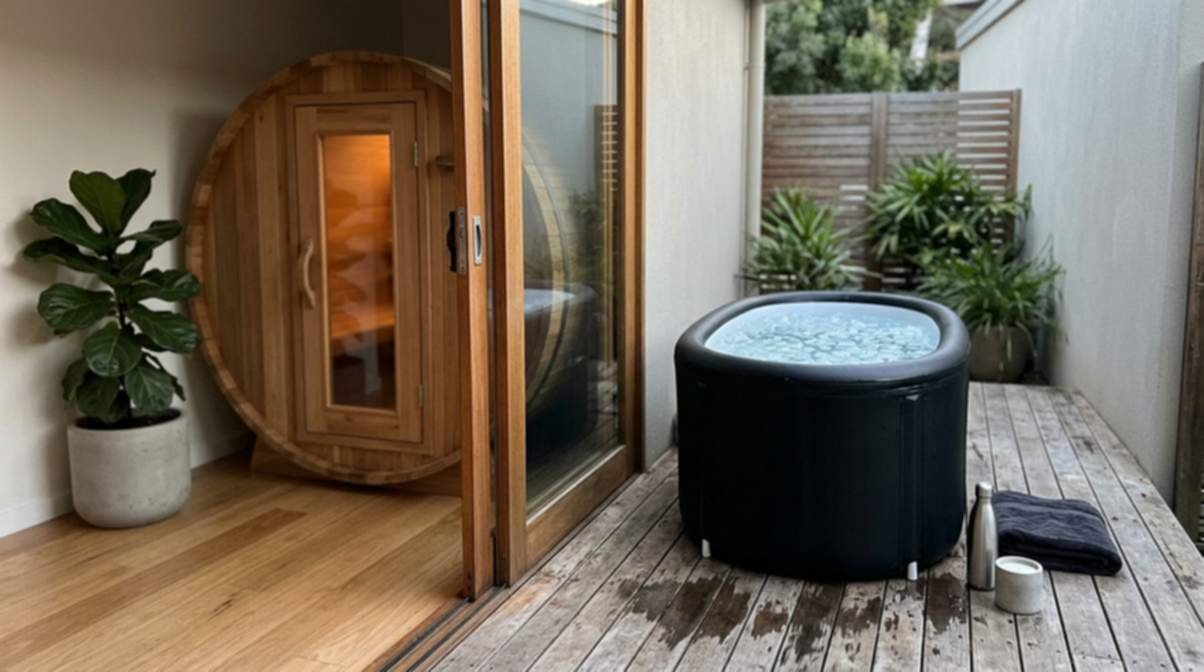
The best time of day to sauna and cold plunge depends on what you want out of it. For focus and mood: cold plunge first thing in the morning, 1–3 minutes at 10–15°C. For endurance recovery: cold plunge within 30 minutes of finishing. For strength and hypertrophy training: wait at least 4–6 hours post-workout or skip that day (Roberts et al., 2015). For sleep: sauna or contrast therapy 2–3 hours before bed, not within an hour of bedtime (Chauvineau et al., 2021). For combined sauna + cold plunge: always sauna first (15–20 min at 80–90°C), then cold (1–3 min at 10–15°C), 2–3 rounds. End on cold if metabolism is the goal. sauna and cold plunge contrast therapy cold plunge before or after workout cold plunge and muscle growth
There’s a specific feeling to a 6am cold plunge in a Melbourne winter. The backyard is grey-blue, the water hits 8°C before the chiller has to do anything, and the first 30 seconds feel like someone has set a defibrillator to your rib cage. Then you’re standing there, wet hair steaming in the cold air, and your brain is sharper than two espressos could make it. That’s why people ask about timing the feeling is different in the morning versus the evening, and it isn’t just placebo.
Morning plunges may sharpen focus, but if you’re aiming for recovery, timing matters less than consistency—research shows chronic inflammation reduction requires repeated exposure, not isolated sessions.
Timing matters differently for each modality: saunas promote evening relaxation, while morning cold plunges sharpen focus. For those weighing the trade-offs, our infrared versus cold therapy analysis breaks down their distinct evidence bases.
Morning cold plunges may sharpen focus, but don’t expect them to boost testosterone. Controlled studies reveal that cold water immersion often has the opposite effect, countering a persistent myth in biohacking circles.
Timing your cold plunge can optimize its effects, but so can choosing the right equipment. Whether you opt for a dedicated cold plunge tub or an ice bath setup, consistency in temperature and duration matters more than the specific method of cooling.
Morning cold plunges may sharpen focus, but some prefer evening sessions for post-skincare cooling, especially after treatments that cause redness—just don’t expect miracles beyond temporary vasoconstriction.
The honest answer to “when’s the best time to cold plunge?” is that it depends on what you’re trying to get out of it. A morning plunge for alertness and a pre-bed plunge for sleep are not interchangeable. Cold immersion straight after a heavy leg day can actively work against your hypertrophy goals. And if you’re adding a sauna to the mix, the order matters more than most blogs admit. This guide walks through the specific protocols for each goal morning, post-workout, evening, and combined with sauna with the research that supports each one.
Timing your cold plunge can also depend on gender-specific responses. Research shows women cool faster and may need adjusted durations compared to standard male-focused protocols.
Timing your sauna and cold plunge sessions strategically can amplify their benefits, especially when used in sequence—learn more about the cold plunge vs sauna dynamic to optimize your routine.
Before you start, it’s worth weighing up the tub you’re plunging in temperature control is the whole point of timing protocols, and a tub that can’t hold 10–12°C in a Queensland summer is going to make the research recommendations impossible to follow. See our tested comparison of the best ice baths in Australia if you’re still choosing gear.
BEFORE YOU START Get GP clearance first if you have any cardiovascular history. Cold plunging acutely raises heart rate and blood pressure see our guide on cold plunges and blood pressure for the full list of contraindications. Never plunge or sauna alone if you’re new to it. Cold shock response below 15°C can cause involuntary gasp and drowning Royal Life Saving Australia considers 10–15°C the safe temperature range. Don’t cold plunge or sauna drunk, dehydrated, or running on no sleep. The cardiovascular stress from heat or cold compounds with these states in ways that aren’t worth the “optimisation.” If you’re pregnant, on beta-blockers, or over 50: discuss timing and duration with your GP before starting. A morning plunge at 15°C for 60 seconds is very different to 10 minutes at 5°C.
When to sauna and cold plunge: a quick reference
The table below is the fast answer. If you’re short on time, find the goal that matches yours and skip to the section that covers it in depth.
| Your goal | Best time | Protocol | Evidence |
| Alertness / mood / focus | Morning (6–9 am) | Cold plunge 1–3 min at 10–15°C. No sauna needed. | Strong Šrámek 2000; Reed 2023 (mood only) |
| Endurance recovery | Within 30 min post-session | Cold plunge 10–15 min at 11–15°C. | Strong Machado 2016 meta-analysis |
| Strength / hypertrophy training | 4–6 hours after lifting — or skip | If you must plunge, delay at least 4 hours. Ideally skip cold on lifting days. | Strong Roberts 2015; Fyfe 2019 |
| Sleep quality | 2–3 hours before bed | Cold plunge 10 min at ~13°C, or sauna 15 min then cold 2 min. Never within 1 hour of bed. | Moderate Chauvineau 2021 (athletes only) |
| Metabolism / brown fat | Morning, fasted if tolerable | Contrast: sauna 15 min → cold 2 min × 2 rounds. End on cold, no hot shower after. | Moderate Søberg 2021 (n=8 winter swimmers) |
| Cardiovascular adaptation | Any consistent time, 4–7 x per week | Sauna 15–20 min primary driver. Cold adds contrast pump. Finnish cohort data favour frequent sauna use. | Strong for sauna Laukkanen cohort studies |
All protocols assume you’re already cleared to plunge. Temperatures and durations are the evidence-based starting ranges; tailor down if you’re new to cold exposure.
timing follows goals, not the other way around
SECTION TAKEAWAY There is no single best time of day to cold plunge or sauna. Morning shifts the autonomic nervous system toward activation, which is useful for focus and mood but unhelpful close to bedtime. Post-workout cold plunging reduces soreness but can blunt muscle growth if done too soon. Evening sauna or cold — timed correctly — can improve sleep. Pick your goal first, then the time.
Most blogs trying to answer this question do one of two unhelpful things: give you a generic “depends on your preferences” shrug, or pick a time and pretend it’s universally optimal. Neither helps. The useful framing is that cold and heat exposure both trigger strong autonomic responses — sympathetic (“go”) with cold, parasympathetic rebound (“rest”) after heat and after cold both. When you schedule those autonomic shifts relative to your day, your training, and your sleep is what actually matters.
Three things drive the timing decision:
- Circadian and autonomic state. Cortisol peaks roughly within an hour of waking and declines through the day. A morning cold plunge rides that natural activation. An evening plunge fights it if done too close to sleep.
- Training interactions. Cold immersion after strength training blunts the anabolic signalling that drives muscle growth. After endurance training, the same cold immersion is net positive for recovery.
- Individual tolerance. Not everyone handles cold before eating, before driving, or before working. Your best time is partly the time you’ll actually do it consistently.
Morning cold plunge: alertness, mood & the dopamine story
SECTION TAKEAWAY A morning cold plunge 1–3 minutes at 10–15°C reliably increases alertness, elevates catecholamines (noradrenaline, dopamine), and is the most common protocol among habitual cold plungers. The effect on focus is real and lasts hours. It does not replace sleep, caffeine, or exercise it stacks on top.
The morning time slot is popular for the same reason coffee is: it works for wakefulness. Cold on skin triggers a sympathetic nervous system surge heart rate up, blood pressure up briefly, breathing sharper, noradrenaline pouring into the bloodstream. That’s the mechanism behind the “hours of sharpened focus” people report.
The often-quoted Šrámek et al. (2000) study a 530% rise in noradrenaline and a 250% rise in dopamine — is the mechanistic backbone for this effect. The important caveat that gets dropped: that study used a one-hour immersion at 14°C, not a three-minute dip. The neurochemical surge from a short morning plunge is real but smaller. It doesn’t need to be as big as Šrámek’s to change how your first hour of work feels.
The Reed et al. 2023 study at the University of Oregon is worth noting here they found reductions in negative mood three hours after a 15-minute 10°C immersion in healthy young adults, even though the acute experience was stressful. Morning cold exposure seems to “buy forward” mental wellbeing into the rest of the day. Note they did not find an increase in positive mood — the benefit was reduction of negative feelings, not a euphoria boost. Honest framing matters.
Morning protocol that works for most people
- Water temperature: 10–15°C to start; step down to 8°C later if you want more stimulus
- Duration: 1–3 minutes first few weeks; build up to 5 minutes max
- Timing: within 90 minutes of waking, before coffee or food (but fine after either)
- Post-plunge: don’t immediately jump in a hot shower. Walk around, get warm naturally. See the Søeberg principle in Section 5
Who should skip the morning slot
People on morning blood pressure medication, pregnant women, and anyone with a heart rhythm disorder should avoid first-thing cold exposure specifically BP is already rising naturally with cortisol, and cold adds another surge. A late-morning or lunchtime plunge is a safer slot for these groups, after clearance from your GP.
3. Post-workout timing: the rule that costs strength gains if you get it wrong
SECTION TAKEAWAY Cold water immersion within 30 minutes of strength training blunts muscle hypertrophy. The interference window is real 2015 and 2019 randomised trials both found attenuated muscle growth (reduced muscle mass in Roberts 2015, reduced type II fibre cross-sectional area in Fyfe 2019) in groups that cold plunged right after lifting, compared to active or passive control. If you’re training for size or strength, wait at least 4–6 hours, or skip cold on lift days. For endurance sessions, immediate CWI is fine even helpful.
This is where competitor blogs usually get lazy. “Cold plunge for recovery” gets treated as if it’s the same thing whether you just ran 10 km or deadlifted 140 kg. It isn’t. The evidence for interference with strength training is solid:
- Roberts et al. (2015), J Physiol. Over 12 weeks of resistance training, the cold-plunging group had smaller increases in muscle mass and strength than the active-recovery group. Anabolic signalling pathways (mTOR, satellite cell activity) were suppressed. DOI: 10.1113/JP270570.
- Fyfe et al. (2019), J Appl Physiol. Sixteen men, seven weeks of resistance training three times per week. Immediate post-exercise CWI attenuated type II muscle fibre cross-sectional area gains compared to passive control, though 1-RM leg press strength gains were similar between groups. Replicated the signalling story (reduced mTOR pathway activation) with cleaner biomechanics.
- Peake et al. (2017), J Physiol. Same QUT research group as Roberts 2015, but focused on satellite cells — the mechanism behind muscle repair and growth. Post-exercise CWI blunted their activation. DOI: 10.1113/JP272881.
The practical guidance is now fairly well settled: if you lift for muscle growth, don’t plunge within four hours of training. Six hours is safer. The American College of Sports Medicine position is the same — during strength and hypertrophy phases, delay CWI by four to six hours, or skip it that day. Endurance athletes get a pass: the same 10–15 min cold plunge immediately after a long run reduces DOMS without blunting the aerobic adaptations, per the Machado et al. 2016 meta-analysis.
Practical training-day schedule
- Strength day: lift at 5pm → eat dinner → plunge at 10pm (5+ hours delay) OR plunge next morning OR skip cold that day
- Endurance day: run at 7am → plunge at 7:15am → breakfast
- Mixed day (strength + cardio): schedule cardio second so the post-session plunge applies to endurance, not lifting
Evening cold plunge: the 90-minute-before-bed rule
SECTION TAKEAWAY Cold plunging within an hour of bed typically worsens sleep onset. Cold plunging 2–3 hours before bed can help — the Chauvineau et al. 2021 study found a 10-minute whole-body immersion at 13.3°C around 6pm increased slow-wave sleep in the first part of the night in trained male runners. Not a universal fix — the study was small (n=12), all athletes, all male, and the plunge followed high-intensity exercise.
Evening is where the timing advice splits most sharply. The popular idea — “cold plunge relaxes you, so do it before bed” — is half right and half wrong. Cold activates the sympathetic nervous system. That activation can linger. If you plunge 20 minutes before lights out, you’re likely to be wired, not sleepy. The Robey 2013 study using polysomnography in trained cyclists showed post-exercise cold water immersion dropped core temperature for around 90 minutes, but didn’t meaningfully improve overall sleep architecture.
The stronger evidence for an evening cold plunge helping sleep comes from Chauvineau et al. 2021 in the journal Frontiers in Sports and Active Living. Twelve well-trained male endurance runners did a 10-minute cold water immersion at 13.3°C at around 6pm after a simulated trail run. Compared to the no-immersion control, whole-body immersion (including the head) reduced arousals and limb movements during the night and increased the proportion of slow-wave sleep in the first half of sleep. Two key caveats that blogs leave out: the plunge happened 2–3 hours before bed, and it followed a hard exercise session that would on its own raise core temperature.
What seems to work for sleep
- Plunge 2–3 hours before your target sleep time, not closer
- 10 minutes at 12–14°C is the studied dose; shorter and colder also works, longer is not better
- Combine with a sauna beforehand if you have one the heat-then-cool sequence pre-loads the natural evening core temperature drop that drives sleep onset
- Avoid caffeine and bright screens between plunge and bed so you don’t cancel the parasympathetic rebound
What does not work
- A cold plunge 20 minutes before bed sympathetic activation hasn’t faded
- A hot shower immediately after the plunge to “warm up quickly” — re-raises core temperature against the natural evening drop
- Using morning-style protocols (3 min at 5°C) at night too much catecholamine release too close to sleep
Sauna & cold plunge together: order, protocol & the Søeberg principle
SECTION TAKEAWAY Always sauna first, then cold plunge. The standard contrast protocol is 15–20 minutes sauna at 80–90°C → 1–3 minutes cold plunge at 10–15°C → 5 minutes rest, repeated 2–3 rounds. End the final round on cold if your goal is metabolic (Søeberg principle). End on heat if your goal is pure relaxation before sleep. This is the most studied order and matches Finnish and Scandinavian cohort research.
When the primary keyword “best time of day to sauna and cold plunge” gets searched, a lot of people are asking two separate questions at once: what time of day and in what order. The order question has a clearer answer than the timing one.
Why sauna comes first
Starting with heat raises core body temperature, triggers vasodilation, and sets up the vascular contrast effect that cold then delivers. Going cold first means your blood vessels are already constricted, your core is cooler, and the sauna ends up being mostly a rewarming tool rather than a hormetic stress on its own. Every major contrast therapy protocol — Finnish sauna tradition, Russian banya, Scandinavian “ice-bear” practice, the Laukkanen cohort work — runs heat first, cold second.
A standard home protocol
- Round 1: Sauna 15–20 min (80–90°C traditional, or 55–65°C infrared) → cold plunge 1–3 min (10–15°C) → rest 5 min
- Round 2: Sauna 10–15 min → cold plunge 1–3 min → rest 5 min
- Round 3 (optional): Sauna 10 min → cold plunge 1–2 min → end
- Total session: 45–75 min. See our ice bath duration guide for the dose-response on individual plunges.
End on cold or end on hot?
The “Søeberg principle” coined by Stanford’s Andrew Huberman after the Danish metabolic researcher Susanna Søberg — says finish on cold and then let your body rewarm itself without a hot shower. The logic: shivering thermogenesis and brown fat activation continue as long as your body is working to rewarm. Skipping the hot shower extends that metabolic cost. Søberg’s Cell Reports Medicine 2021 study compared eight Scandinavian winter swimmers (who combined cold plunges with sauna 2–3 times per week) to eight matched controls and found meaningful differences in brown fat thermoregulation and cold-induced thermogenesis in the swimmer group.
Two honest caveats. First, n=8 versus n=8 is a small cross-sectional study, not a randomised trial. Second, the “11 minutes of cold per week” number that gets quoted everywhere is Huberman’s reading of the average exposure time in Søberg’s swimmer cohort — it isn’t a prescribed dose from the paper itself. Treat both as directionally useful, not as evidence-grade protocols.
If your goal is sleep rather than metabolism, end on heat. The Finnish sleep-ritual pattern — sauna as the last step before bed — works because the subsequent core temperature drop is a strong sleep cue.
When you probably shouldn’t sauna or cold plunge at all
Timing advice assumes the practice is safe for you on that day. It often isn’t. Skip the session entirely if:
- You slept under 5 hours. Cold and heat stress stack with sleep debt. Cardiovascular strain compounds.
- You’re acutely sick. Sauna-induced hyperthermia while fighting an infection is not therapeutic. Cold is worse.
- You’ve been drinking. Alcohol impairs thermoregulation and the gag reflex. Cold drownings often involve alcohol.
- You’re dehydrated. Sauna without fluid restoration is genuinely dangerous; cold on top of it worsens the picture.
- You’re fasting over 16 hours and new to cold. Glycogen depletion plus cold stress can precipitate hypoglycaemia. Not a good first exposure.
- You’re within 2 hours of a heavy meal. Digestive blood flow gets redirected by the cold shock; not dangerous for most, but uncomfortable.
If a brand is telling you to push through any of these or marketing “hangover plunge” as a wellness ritual that tells you something. Real protocols have contraindications. Marketing scripts don’t.
Australian-specific timing considerations
Daylight saving changes the “morning” window
Most cold exposure research comes out of Northern Europe and North America, where daylight and temperature cycles are very different from ours. In Victoria, Tasmania, NSW, SA and the ACT, daylight saving shifts morning light by an hour twice a year. If you’re using morning cold plunging to reinforce wake-up alertness, the same 6am plunge in October feels very different to the same 6am plunge in April. Anchor your plunge to your actual wake time, not a clock time.
Winter vs summer water starting temperatures
An outdoor Melbourne or Hobart tap-filled plunge in July can hit 8–10°C without a chiller doing anything. The same tub in February can sit at 22°C overnight. If you’re running the same protocol year-round, your chiller has to work harder in summer — and if you’re on a timer-based cooling schedule, a Queensland or NT plunge may need longer pre-cool time than the instructions assume. A cheap pool thermometer from Bunnings or BCF resolves the guesswork for under $15.
Morning cardiovascular risk AU demographics
Heart attacks and strokes are more common in the morning hours in Australia, for the same reasons they’re more common elsewhere: cortisol peaks, BP rises, platelets are stickier. People with any cardiac history, or over 50, should have that context in mind when choosing a 6am cold plunge. The physiology isn’t broken — but layering a cold-shock spike on top of the natural morning BP peak is a specific risk. A later morning or lunchtime slot is often safer for this group. See our guide on cold plunges and blood pressure for the full safety context.
Finding time in an Australian week
For most people the time question is practical, not physiological. The “best” time is the one you’ll actually do three times a week for three months. If your mornings are a scramble to get kids to school, a 7pm plunge timed 2 hours before bed is a better real-world answer than an “optimal” 6am dip you skip four days out of five. Consistency beats optimisation.
Frequently asked questions
Is it better to cold plunge in the morning or evening?
It depends on your goal. For alertness, focus, and mood: morning. For sleep support: evening, but 2–3 hours before bed, not right before.
Can I cold plunge before bed?
Not within an hour of bed — it can worsen sleep onset. For better sleep, plunge 2–3 hours before your target sleep time.
Should I cold plunge before or after a workout?
After endurance workouts: yes, within 30 minutes. After strength/hypertrophy workouts: wait at least 4–6 hours, or skip cold that day to avoid blunting muscle growth.
How long should I wait between sauna and cold plunge?
Go straight from sauna to cold plunge for the contrast effect. The standard protocol is 15–20 min sauna → 1–3 min cold plunge → 5 min rest, repeated.
Should I end my contrast session with hot or cold?
End on cold if your goal is metabolic (Søeberg principle). End on heat if your goal is relaxation before sleep.
Can I sauna and cold plunge at different times of day?
Yes, but the combined contrast effect is strongest when done back-to-back. Separating them loses the vascular pump and thermoregulatory adaptation.
What’s the best time of day to cold plunge for fat loss?
Morning, fasted if tolerable, using a contrast protocol (sauna → cold) and ending on cold without a hot shower to extend shivering thermogenesis.
Can I cold plunge on an empty stomach?
Yes, but if you’re new to cold or fasting over 16 hours, be cautious — glycogen depletion plus cold stress can cause lightheadedness.
How often should I sauna and cold plunge each week?
For cardiovascular benefits: sauna 4–7 times per week (Finnish cohort data). Cold plunge frequency depends on goals and recovery; 2–4 times per week is common.
What time of day should I avoid cold plunging?
Avoid within an hour of bedtime, within 4 hours of strength training, and first thing in the morning if you have uncontrolled hypertension or are on morning BP medication.
Does morning cold plunge replace coffee?
No — it stacks with it. Cold plunge provides alertness via noradrenaline/dopamine; caffeine works via adenosine blockade. Many people do both.
Is infrared or traditional sauna better for contrast therapy?
Both work. Traditional sauna (80–90°C) heats the air; infrared (55–65°C) heats the body directly. Choose based on access, tolerance, and preference.
- Chauvineau, M., Pasquier, F., Guyot, V., Aloulou, A., & Nedelec, M. (2021). Effect of the depth of cold water immersion on sleep architecture and recovery among well-trained male endurance runners. Frontiers in Sports and Active Living, 3, 659990. DOI: 10.3389/fspor.2021.659990
- Roberts, L. A., Raastad, T., Markworth, J. F., Figueiredo, V. C., Egner, I. M., Shield, A., et al. (2015). Post-exercise cold water immersion attenuates acute anabolic signalling and long-term adaptations in muscle to strength training. The Journal of Physiology, 593(18), 4285–4301. DOI: 10.1113/JP270570
- Peake, J. M., Roberts, L. A., Figueiredo, V. C., Egner, I., Krog, S., Aas, S. N., et al. (2017). The effects of cold water immersion and active recovery on inflammation and cell stress responses in human skeletal muscle after resistance exercise. The Journal of Physiology, 595(3), 695–711. DOI: 10.1113/JP272881
- Fyfe, J. J., Broatch, J. R., Trewin, A. J., Hanson, E. D., Argus, C. K., Garnham, A. P., et al. (2019). Cold water immersion attenuates anabolic signalling and skeletal muscle fiber hypertrophy, but not strength gain, following whole-body resistance training. Journal of Applied Physiology, 127(5), 1403–1418. DOI: 10.1152/japplphysiol.00127.2019
- Søberg, S., Löfgren, J., Philipsen, F. E., Jensen, M., Hansen, A. E., Ahrens, E., et al. (2021). Altered brown fat thermoregulation and enhanced cold-induced thermogenesis in young, healthy, winter-swimming men. Cell Reports Medicine, 2(10), 100408. DOI: 10.1016/j.xcrm.2021.100408
- Machado, A. F., Ferreira, P. H., Micheletti, J. K., de Almeida, A. C., Lemes, Í. R., Vanderlei, F. M., et al. (2016). Can water temperature and immersion time influence the effect of cold water immersion on muscle soreness? A systematic review and meta-analysis. Sports Medicine, 46(4), 503–514. DOI: 10.1007/s40279-015-0431-7
- Reed, E. L., Chapman, C. L., Whittman, E. K., Park, T. E., Larson, E. A., Kaiser, B. W., et al. (2023). Cardiovascular and mood responses to an acute bout of cold water immersion. Journal of Thermal Biology, 118, 103727. DOI: 10.1016/j.jtherbio.2023.103727
- Cain, T., Brinsley, J., Bennett, H., Nelson, M., Maher, C., & Singh, B. (2025). Effects of cold-water immersion on health and wellbeing: A systematic review and meta-analysis. PLOS ONE, 20(1), e0317615. DOI: 10.1371/journal.pone.0317615
- Royal Life Saving Society Australia — Position Statement on Cold Water Immersion Therapy Safety (2024, with AUSactive and SPASA).
- American College of Sports Medicine — Cold Water Immersion: Friend or Froze? (2025) — reference for the 4–6 hour post-strength-training delay.
- Harvard Health Publishing — Cold plunges: Healthy or harmful for your heart? (June 2025).
- Mayo Clinic Health System — Cold-water plunging health benefits (2024).
Medical disclaimer: General information based on current research. Not a substitute for medical advice. If you have cardiovascular disease, uncontrolled hypertension, a heart rhythm disorder, are pregnant, are over 50, or take prescription medication, speak with your GP before starting cold or heat therapy.
