
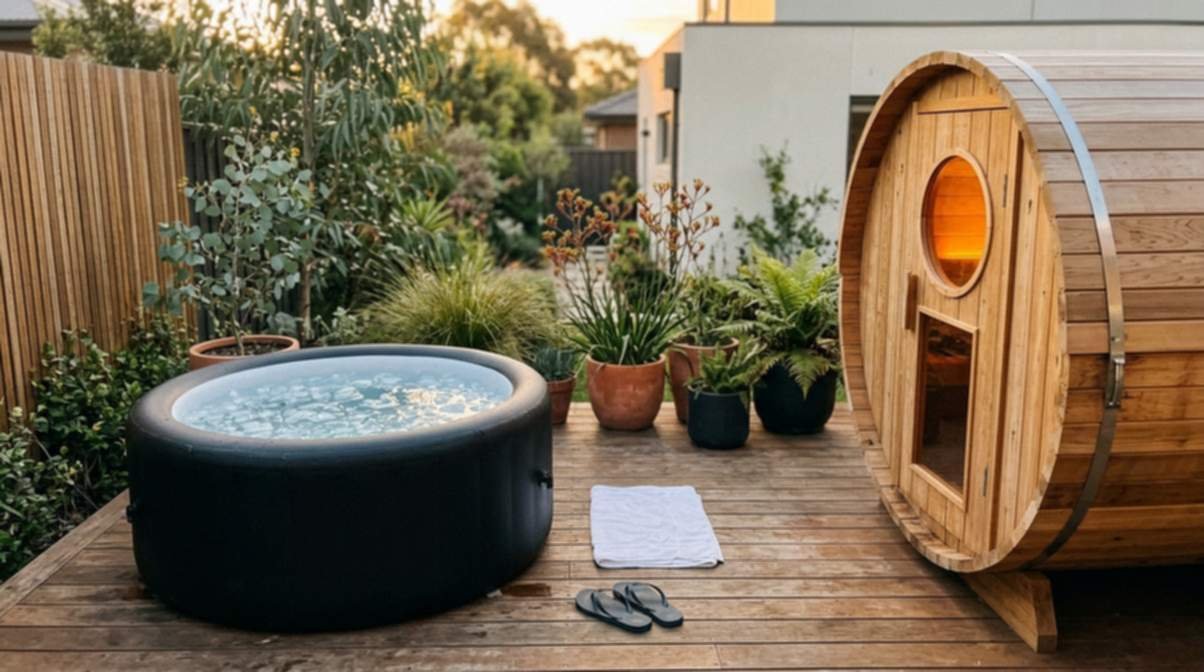
KEY TAKEAWAY The best way to do sauna and cold plunge contrast therapy is to start with the sauna (80–100°C for 10–15 minutes), then move to the cold plunge (10–15°C for 2–5 minutes), and repeat for 2–3 rounds. Always start with heat. If you want to maximise metabolic benefits, end your final round on cold and let your body rewarm naturally the Søeberg principle. Total cold exposure of 11 minutes per week and sauna time of 57 minutes per week is the minimum effective dose suggested by the research.
The first time you step from a 90°C sauna into water that’s barely above freezing, your brain short-circuits for a second. The heat is still radiating from your skin. Then the cold hits and everything snaps into focus. Your heart pounds. Your breathing sharpens. And somewhere between the shock and the shiver, something clicks.
This alternation between heat and cold known as contrast therapy, the Nordic cycle, or simply hot-cold therapy has been practised in Finland, Scandinavia, and Russia for centuries. It’s now one of the fastest-growing wellness practices in Australia, with dedicated contrast therapy studios opening in Sydney, Melbourne, Brisbane, and beyond.
But most guides online get the details wrong. They’ll tell you to “just alternate hot and cold” without explaining the order, the temperatures, the timing, or why any of it matters. This guide gives you the full picture: the science behind contrast therapy, specific protocols for different goals, and the practical details you need to set up a routine that actually works. If you’re still choosing your setup, check out our tested comparison of the best ice baths in Australia.
SAFETY WARNING Contrast therapy involves extreme temperature changes that place additional stress on your cardiovascular system. Do not attempt contrast therapy if you have heart disease, uncontrolled hypertension, arrhythmia, or are pregnant. If you’re over 50 or take any cardiac medication, get GP clearance first. Never use a sauna or cold plunge while intoxicated. The Royal Life Saving Society Australia and AUSactive recommend pre-screening for all cold water immersion activities. For a full breakdown of cold plunge risks, see our ice bath safety guide.
Contrast Therapy Protocol at a Glance
| Element | Beginner Protocol | Experienced Protocol |
| Order | Sauna first, cold plunge second | Sauna first, cold plunge second |
| Sauna temperature | 70–80°C | 80–100°C (traditional Finnish) |
| Sauna duration | 10–15 min per round | 15–20 min per round |
| Cold plunge temperature | 15°C (work down to 10°C) | 3–10°C |
| Cold plunge duration | 1–2 min per round | 2–5 min per round |
| Number of rounds | 2 rounds | 3–4 rounds |
| Rest between rounds | 1–2 min (optional) | 1–2 min (optional) |
| End on | Cold (metabolic) or Hot (relaxation) | Cold (Søeberg principle) |
| Weekly frequency | 2–3 sessions | 4–7 sessions |
| Total session time | 30–40 min | 45–60 min |
1. Do You Cold Plunge or Sauna First?
KEY TAKEAWAY: Always start with the sauna. Heat primes your body for the cold by raising core temperature, dilating blood vessels, and relaxing muscles. This makes the transition to cold more tolerable and amplifies the vascular ‘pump’ effect that drives contrast therapy’s benefits.
This is the single most common question about contrast therapy, and the answer is clear: sauna first, cold plunge second. Every evidence-based protocol and the entire Nordic tradition follows this order.
Here’s why the order matters physiologically:
- Vasodilation before vasoconstriction. Heat causes your blood vessels to dilate, increasing blood flow to muscles and skin. When you then plunge into cold water, those vessels constrict rapidly. This alternating dilation-constriction cycle creates a ‘vascular pump’ that enhances circulation, delivers oxygen to tissues, and helps flush metabolic waste products.
- Raised core temperature buffers the cold shock. Starting warm means your body enters the cold from an elevated baseline. This makes the initial shock more tolerable and reduces the severity of the gasp reflex the most dangerous moment of any cold plunge (Tipton et al., 2017).
- Heat shock proteins are activated first. Sauna exposure triggers the release of heat shock proteins (HSPs), which aid cellular repair and protect against oxidative stress. The subsequent cold exposure then adds its own recovery benefits anti-inflammatory effects and norepinephrine release on top of the heat priming.
The Finnish tradition, where contrast therapy has been practised for over a thousand years, always begins with the sauna. Dr Susanna Søeberg’s research at the University of Copenhagen on winter swimmers who combined cold water immersion with hot sauna sessions followed this same pattern (Søeberg et al., 2021).
Exception: If your primary goal is to cool down after a hard workout in hot conditions, a cold plunge first may make more sense as an immediate cooling intervention but this isn’t contrast therapy. It’s acute cold water immersion for thermoregulation, which is a different protocol.
2. How Long Should You Cold Plunge After Sauna?
KEY TAKEAWAY: Spend 2–5 minutes in the cold plunge after each sauna round. Beginners should start at 1–2 minutes and build up. The cold phase should always be shorter than the heat phase a common ratio is 3:1 (e.g. 15 minutes sauna, 5 minutes cold).
Duration in the cold plunge depends on the water temperature and your experience level. Colder water requires shorter immersion times:
| Water Temperature | Beginner Duration | Experienced Duration |
| 15°C | 2–3 min | 5 min |
| 10–12°C | 1–2 min | 3–5 min |
| 5–8°C | 30–60 sec | 2–3 min |
| Below 5°C | Not recommended for beginners | 1–2 min (advanced only) |
The Machado et al. (2016) meta-analysis of 9 RCTs found that 11–15°C for 11–15 minutes was the optimal dose for reducing muscle soreness but that’s for standalone cold water immersion, not contrast therapy. When you’re cycling between heat and cold, shorter cold exposures are sufficient because your core is already elevated from the sauna.
The minimum effective weekly dose for cold exposure based on the protocols discussed by Dr Andrew Huberman and Dr Søeberg is approximately 11 minutes of total cold immersion per week, spread across multiple sessions. That’s cumulative, not per session. So three contrast sessions with 3–4 minutes of cold per round gets you there comfortably.
For more on standalone cold plunge duration, see our detailed guide on how long to stay in an ice bath.
3. The Søeberg Principle: Should You End on Hot or Cold?
KEY TAKEAWAY: To maximise metabolic benefits including brown fat activation and prolonged calorie burn end your final round on cold and let your body rewarm naturally. This is the Søeberg principle, named after Dr Susanna Søeberg’s research at the University of Copenhagen. If your goal is relaxation or sleep, ending on heat is fine.
Whether you end on hot or cold is one of the most debated questions in contrast therapy. The answer depends on your goal.
End on cold if your goal is metabolism, energy, or alertness.
Dr Søeberg’s 2021 study (Cell Reports Medicine) found that winter-swimming men who regularly combined cold water immersion with hot sauna sessions burned more calories during cooling than controls. The key mechanism: when you don’t immediately rewarm yourself after cold exposure, your body activates brown adipose tissue (brown fat) and recruits shivering thermogenesis to generate heat internally. This self-reheating process keeps your metabolism elevated for hours after the session.
The principle is simple: resist the urge to immediately jump into a hot shower or back into the sauna after your final cold plunge. Towel off, dress warmly, and let your body do the work. The shivering isn’t a bug it’s a feature. It’s your body recruiting brown fat and muscle activity to produce heat, which is one of the most potent stimuli for metabolic conditioning.
End on hot if your goal is relaxation or sleep.
If you’re doing contrast therapy in the evening and want to wind down, finishing with a sauna session can promote parasympathetic nervous system activation and help with sleep onset. Chauvineau et al. (2021) found that cold water immersion improved slow-wave sleep but this was specifically timed 90–120 minutes before bed, not immediately before. If you end on cold too close to bedtime, the sympathetic nervous system activation and norepinephrine release may actually delay sleep.
The practical rule: Morning or midday sessions → end on cold. Evening sessions (within 2 hours of bed) → end on hot, or end on cold at least 90–120 minutes before sleep.
4. The Science Behind Contrast Therapy
KEY TAKEAWAY: Contrast therapy works through the alternating vasodilation (heat) and vasoconstriction (cold) of blood vessels, creating a ‘vascular pump’ effect. Research supports benefits for circulation, muscle recovery, inflammation reduction, and mood though the evidence base is still developing.
What the research supports:
- Cardiovascular conditioning. The Laukkanen cohort study (JAMA Internal Medicine, 2015) tracked 2,315 Finnish men over 20 years and found that those using a sauna 4–7 times per week had a 63% lower risk of sudden cardiac death and 50% lower CVD mortality compared to once-weekly users (Laukkanen et al., 2015). This is observational data on sauna alone, not contrast therapy specifically but it’s the strongest long-term evidence we have for regular heat exposure.
- Muscle soreness reduction. A 2025 scoping review of contrast therapy for musculoskeletal conditions (Leonardi et al., 2025) found that alternating hot and cold reduced pain scores, improved joint range of motion, and alleviated muscle soreness across multiple RCTs. The Wang et al. (2025) meta-analysis of 55 RCTs confirmed a dose-response relationship for cold water immersion specifically.
- Norepinephrine and mood. Cold water immersion triggers a significant release of norepinephrine, a neurotransmitter that improves attention, focus, and mood. Šrámek et al. (2000) measured a 530% increase in norepinephrine and 250% increase in dopamine after immersion at 14°C but this was a 1-hour immersion, far longer than a typical contrast round. Shorter immersions still produce norepinephrine release, though the exact magnitude varies with duration and temperature (DOI: 10.1007/s004210050065).
- Brown fat activation and metabolism. Søeberg et al. (2021) demonstrated that winter swimmers who combined cold dips with sauna sessions showed enhanced cold-induced thermogenesis they burned more calories during rewarming than non-adapted controls, despite similar brown fat glucose uptake.
What the research doesn’t fully support:
- “Detoxification.” Sweating in a sauna eliminates trace amounts of heavy metals, but the amounts are negligible compared to what your liver and kidneys process daily. The word “detox” is marketing, not science.
- “Immune system boost.” As with standalone cold plunging, the evidence for immune benefits is mixed. The Cain et al. (2025) meta-analysis found stress reduction but inconclusive immune outcomes. Buijze et al. (2016) found 29% fewer sick days with cold showers (n=3,018), but this was self-reported, not objective immune measurement.
- “Flushing lactic acid.” This is an outdated model. Lactate is metabolised within 1–2 hours regardless of intervention. What contrast therapy does help with is perceived soreness and inflammatory markers not lactate clearance.
5. Step-by-Step Contrast Therapy Protocol
Here’s a complete protocol from preparation to post-session, based on the research and practical experience:
Step 1: Hydrate beforehand.
Drink 500–750ml of water in the hour before your session. You’ll lose significant fluid through sweat in the sauna. Have a water bottle accessible between rounds.
Step 2: Start in the sauna for 10–20 minutes.
Traditional Finnish saunas operate at 80–100°C with low humidity. Infrared saunas run at 50–65°C and require longer sessions (15–30 minutes) to raise core temperature equivalently. Focus on deep, slow breathing. Exit when you feel genuinely hot but before you feel lightheaded.
Step 3: Transition to the cold plunge within 30–60 seconds.
Move promptly between the sauna and cold plunge. The faster the transition, the greater the vascular contrast effect. Enter feet first. Don’t jump or dive in the gasp reflex is strongest with sudden full-body immersion.
Step 4: Stay in the cold for 2–5 minutes.
Control your breathing. Focus on slow, deliberate exhales. Keep your head above water at all times. Exit when you feel the cold has ‘settled’ and your breathing has normalised or immediately if you feel dizzy, confused, or numb.
Step 5: Rest for 1–2 minutes (optional).
Some people return directly to the sauna. Others take a brief standing rest to let the body begin responding to the contrast. Both approaches work listen to your body.
Step 6: Repeat for 2–3 rounds.
Each round the transition feels easier as your body adapts. Most people find 2–3 full cycles sufficient. Advanced practitioners may do 4 rounds, but more isn’t necessarily better.
Step 7: Choose your ending based on your goal.
End on cold for metabolic benefits (Søeberg principle). End on hot for relaxation. If ending on cold, resist external rewarming dress warmly and let your body generate its own heat.
Step 8: Rehydrate and rest.
Drink water or an electrolyte drink. Allow 15–20 minutes before driving or intense activity. If you ended on cold, be aware of afterdrop your core temperature may continue dropping for up to 20 minutes after exit.
6. Contrast Therapy for Different Goals
| Goal | Protocol Adjustment | Key Research |
| Post-exercise recovery | 2–3 rounds, end on cold, within 30 min of training. Avoid immediately after strength training if hypertrophy is the goal wait 4–6 hours. | Machado et al. 2016; Roberts et al. 2015 |
| Metabolism & fat loss | 3 rounds, always end on cold. Allow natural rewarming. Focus on weekly minimums: 11 min cold, 57 min sauna. | Søeberg et al. 2021 |
| Sleep improvement | 2 rounds, end on HOT, 90–120 min before bed. Warm finish promotes parasympathetic activation. | Chauvineau et al. 2021 |
| Stress reduction & mood | 2–3 rounds, end on cold. Cold triggers norepinephrine release (sustained alertness and mood elevation for hours). | Šrámek et al. 2000; Johnson 1977 |
| Cardiovascular health | Regular sauna 4–7x/week, 15–20 min. Cold plunge added 2–3x/week. Consistency over intensity. | Laukkanen et al. 2015 |
| Joint pain / arthritis | Moderate temperatures (avoid extreme cold below 10°C). Focus on 2–3 gentle rounds. Heat emphasis. | Leonardi et al. 2025 |
7. Australian-Specific Considerations
- Tap water temperatures vary by city and season. Melbourne winter tap water (June–August) can sit around 10–14°C cold enough for contrast therapy without a chiller. Brisbane and Darwin tap water rarely drops below 20°C, so a chiller is essential year-round. If you’re setting up a home contrast station, factor this into your equipment choice.
- Commercial contrast studios are booming. Dedicated studios offering sauna + cold plunge combos have opened across Sydney, Melbourne, Brisbane, and Perth. Look for venues that follow the Royal Life Saving/AUSactive 2024 position statement on cold water immersion including pre-screening, supervision, and emergency protocols.
- Home setups. A basic home contrast setup requires a sauna (infrared or traditional) and a cold plunge tub with a chiller. We’ve tested and compared options in our best ice baths in Australia guide. Ensure any electrical equipment near water meets Australian safety standards and is installed by a licensed electrician.
- [INTERNAL LINK OPPORTUNITY] When a page on best ice bath chillers is published, link from this section.
8. What the Science Doesn’t Support
Contrast therapy has real benefits, but the wellness industry overstates some claims. Here’s what the current evidence doesn’t back up:
- “Contrast therapy detoxifies your body.” Your liver and kidneys handle detoxification. Sweating in a sauna excretes trace minerals, not meaningful toxin loads. The word ‘detox’ applied to sauna is marketing language, not a physiological claim.
- “More rounds = more benefits.” There’s no evidence that 5–6 rounds is better than 2–3. Diminishing returns set in, and the cardiovascular stress accumulates. Quality over quantity.
- “You need to go as cold as possible.” The Machado et al. (2016) meta-analysis found optimal results at 11–15°C. Sub-5°C water dramatically increases cardiac stress and hypothermia risk without proportionally more benefit for most people.
- “Contrast therapy replaces exercise.” While the Laukkanen data shows sauna mimics some cardiovascular effects of moderate exercise, it is not a substitute for physical activity. Dr Rita Redberg wrote in her JAMA editorial on the Laukkanen study that she’d rather patients exercise but if they’re going to watch TV, they might as well do it in a sauna.
Frequently Asked Questions
Do you cold plunge before or after sauna?
Always sauna first, then cold plunge. This order heat before cold is supported by the Nordic tradition and physiology. Heat dilates blood vessels and raises core temperature, making the cold plunge more tolerable and amplifying the vascular ‘pump’ effect that drives contrast therapy’s benefits.
How long should you cold plunge after sauna?
Spend 2–5 minutes in the cold plunge after each sauna round. Beginners should start at 1–2 minutes and build up. The cold phase should always be shorter than the heat phase a common ratio is 3:1 (e.g., 15 minutes sauna, 5 minutes cold).
How many rounds of sauna and cold plunge should you do?
2–3 rounds is optimal for most people. Beginners should start with 2 rounds. Advanced practitioners may do 3–4 rounds, but there’s no evidence that more than 3 rounds provides additional benefits, and it increases cardiovascular stress.
Is contrast therapy better than cold plunge alone?
For some goals, yes. Contrast therapy provides the combined benefits of heat (cardiovascular conditioning, heat shock proteins) and cold (reduced inflammation, norepinephrine release). The alternating vasodilation and vasoconstriction create a ‘vascular pump’ that may enhance circulation and recovery beyond cold alone.
Can you do contrast therapy every day?
Yes, many experienced practitioners do contrast therapy daily. However, the research-backed minimum effective dose for benefits is 2–3 sessions per week. Daily practice is safe for healthy individuals but listen to your body overtraining signs include fatigue, irritability, or disrupted sleep.
What is the best temperature for sauna in contrast therapy?
Traditional Finnish saunas operate at 80–100°C. Beginners can start at 70–80°C. Infrared saunas run at 50–65°C and require longer sessions (15–30 minutes) to raise core temperature equivalently.
What is the Søeberg principle?
The Søeberg principle states that to maximise metabolic benefitsincluding brown fat activation and prolonged calorie burn you should end your final contrast therapy round on cold and let your body rewarm naturally, without external heat sources. This is based on Dr Susanna Søeberg’s 2021 research at the University of Copenhagen.
Is contrast therapy safe during pregnancy?
No. Contrast therapy is not recommended during pregnancy due to the extreme temperature changes and cardiovascular stress. Both sauna use and cold water immersion carry risks for pregnant individuals. Always consult your healthcare provider before starting any new thermal therapy.
Should I do contrast therapy before or after a workout?
For recovery, do contrast therapy within 30 minutes after your workout. However, if your goal is muscle growth (hypertrophy), wait 4–6 hours after strength training, as immediate cold exposure can blunt the anabolic signaling needed for muscle adaptation.
What’s the minimum effective dose for contrast therapy?
Based on the research discussed by Dr Andrew Huberman and Dr Susanna Søeberg, the minimum effective weekly dose is approximately 11 minutes of total cold immersion and 57 minutes of sauna time, spread across multiple sessions.
Sources
Søeberg S, Löfgren J, Philipsen FE, et al. Altered brown fat thermoregulation and enhanced cold-induced thermogenesis in young, healthy, winter-swimming men. Cell Reports Medicine. 2021;2(10):100408. DOI: https://doi.org/10.1016/j.xcrm.2021.100408
Laukkanen T, Khan H, Zaccardi F, Laukkanen JA. Association between sauna bathing and fatal cardiovascular and all-cause mortality events. JAMA Internal Medicine. 2015;175(4):542–548. DOI: https://doi.org/10.1001/jamainternmed.2014.8187
Leonardi G, Portaro S, Milardi D, et al. Mechanisms and efficacy of contrast therapy for musculoskeletal painful disease: A scoping review. Journal of Clinical Medicine. 2025;14(5):1441. DOI: https://doi.org/10.3390/jcm14051441
Tipton MJ, Collier N, Massey H, Corbett J, Harper M. Cold water immersion: kill or cure? Experimental Physiology. 2017;102(11):1335–1355. DOI: https://doi.org/10.1113/EP086283
Machado AF, Ferreira PH, Micheletti JK, et al. Can water temperature and immersion time influence the effect of cold water immersion on muscle soreness? A systematic review and meta-analysis. Sports Medicine. 2016;46(4):503–514. DOI: https://doi.org/10.1007/s40279-015-0431-7
Wang Y, et al. Dose-response of cold water immersion for recovery. Frontiers in Physiology. 2025. DOI: https://doi.org/10.3389/fphys.2025.1525726
Cain T, et al. Effects of cold-water immersion on health and wellbeing: A systematic review and meta-analysis. PLOS One. 2025. DOI: https://doi.org/10.1371/journal.pone.0317615
Šrámek P, Šimecková M, Janšky L, Šavlíková J, Vybiral S. Human physiological responses to immersion into water of different temperatures. European Journal of Applied Physiology. 2000;81(5):436–442. DOI: https://doi.org/10.1007/s004210050065
Roberts LA, Raastad T, Markworth JF, et al. Post-exercise cold water immersion attenuates acute anabolic signalling and long-term adaptations in muscle to strength training. Journal of Physiology. 2015;593(18):4285–4301. DOI: https://doi.org/10.1113/JP270570
Peake JM, Roberts LA, Figueiredo VC, et al. The effects of cold water immersion and active recovery on inflammation and cell stress responses in human skeletal muscle after resistance exercise. Journal of Physiology. 2017;595(3):695–711. DOI: https://doi.org/10.1113/JP272881
Chauvineau M, et al. Effect of the depth of cold water immersion on sleep architecture and recovery. Frontiers in Sports and Active Living. 2021. DOI: https://doi.org/10.3389/fspor.2021.659990
Buijze GA, Sierevelt IN, et al. The effect of cold showering on health and work: A randomized controlled trial. PLOS One. 2016;11(9):e0161749. DOI: https://doi.org/10.1371/journal.pone.0161749
Johnson JM. Nonthermoregulatory control of human skin blood flow. Journal of Applied Physiology. 1977. PubMed: 911386
Royal Life Saving Society Australia, AUSactive, SPASA. Position Statement on Cold Water Immersion Therapy Safety Precautions. January 2024. https://www.royallifesaving.com.au/about/news-and-updates/news/2024/feb/position-statement-cold-water-immersion-therapy
Laukkanen T, Kunutsor SK, Khan H, et al. Sauna bathing is associated with reduced cardiovascular mortality and improves risk prediction in men and women: a prospective cohort study. BMC Medicine. 2018;16:219. DOI: https://doi.org/10.1186/s12916-018-1198-0
Medical Disclaimer: This content is for informational purposes only and does not constitute medical advice. Always consult a qualified healthcare professional before beginning contrast therapy, sauna use, or cold water immersion. IceBathLab is not liable for any adverse outcomes.
