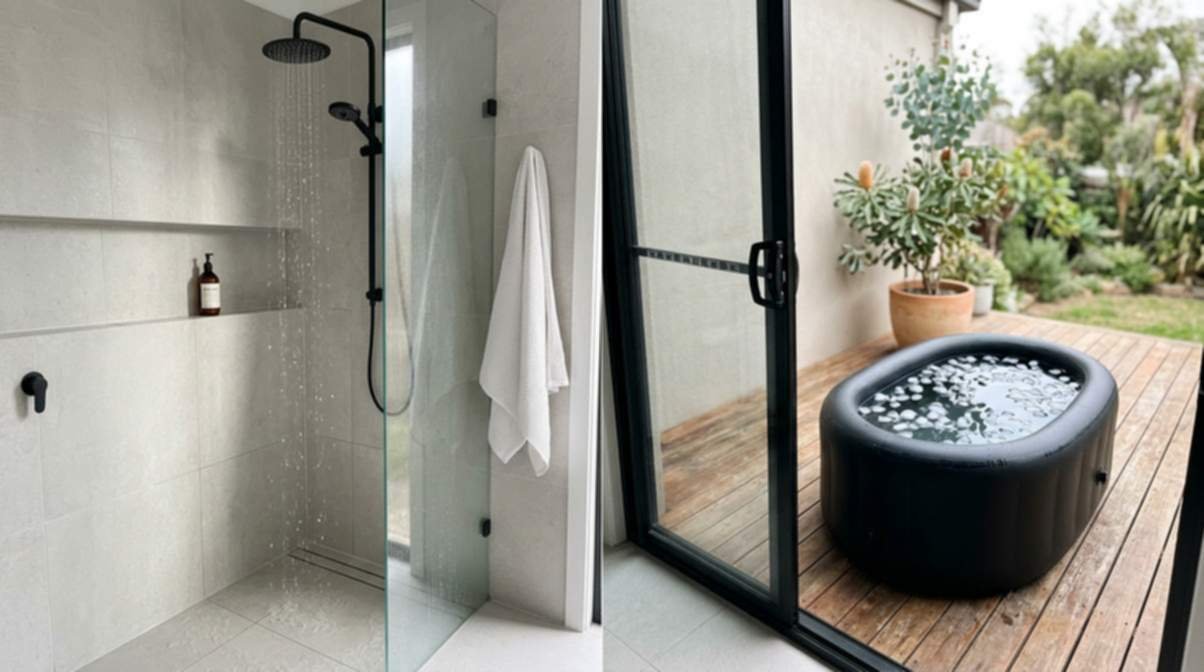
That first gasp when cold water hits the base of your neck is not a personality test. It is your vagus nerve waking up, your noradrenaline spiking, and your breathing trying to hijack itself. People keep asking us the same question: if I can get a version of this by cranking the shower tap cold, do I actually need the tub, the chiller, and the backyard space?
Short answer: it depends on what you are chasing. Long answer: the cold shower vs cold plunge debate is less about philosophy and more about temperature, dose, and what the research has actually measured. Most of the big cold water studies the ones people quote on podcasts used full immersion in water between 10°C and 15°C. A cold shower in Melbourne in January is not that, no matter how long you stand under it.
While cold showers offer convenience, dedicated cold water immersion—whether through a cold plunge or ice bath—provides more precise temperature control and deeper physiological effects. The key difference lies in equipment cost and maintenance, not therapeutic outcomes.
While cold showers provide a gentler introduction to cold therapy, those seeking targeted skin benefits might prefer cold plunges for facial rejuvenation. The vasoconstriction followed by vasodilation can temporarily improve circulation, though long-term anti-aging claims remain unproven.
This guide compares the two head-to-head across recovery, mood, sleep, stress, and daily practicality. Everything is tied to a specific study with a DOI, not vibes. We also cover where the marketing overreaches including the testosterone and fat-loss claims that keep getting recycled. If you want the full hub, see our tested comparison of the best ice baths. If you want the pure science on whether any form of cold exposure is worth it, start with our guide to whether ice baths are actually good for you.
SAFETY FIRST READ BEFORE YOU START – Start warm. Begin at 15°C (plunge) or the coldest your shower naturally goes. Drop 1°C per week. There is nothing elite about shocking yourself at 5°C on day one. Never plunge alone. Cold shock can trigger involuntary gasping and cardiac arrhythmias in the first 60 seconds. A shower is lower-risk because you can step out instantly; a tub is not. See your GP if: you are over 50, pregnant, have high blood pressure, heart disease, Raynaud’s, cold urticaria, a seizure disorder, or are on beta-blockers. Do not submerge your head. Keep the face and back of the neck out of the water until you have built a tolerance over several weeks. These protocols are aligned with the Royal Life Saving Society Australia joint position statement on cold water immersion therapy (published with AUSactive and SPASA, February 2024). If something feels wrong in the water, it is wrong. Get out. cold plunging reduces inflammation
The Quick Comparison
Here is the honest side-by-side before we dig into the evidence behind each row. cold plunges and testosterone
| Factor | Cold Shower | Cold Plunge |
| Typical temperature | 10–18°C (AU tap water, varies by season) | 3–12°C (chiller-controlled) |
| Typical duration | 30 seconds – 3 minutes | 2–15 minutes |
| Body coverage | Partial rotating body parts under a stream | Full-body, chest-deep immersion |
| Hydrostatic pressure | None | Yes compresses tissues, aids recovery |
| Dose consistency | Variable with season and plumbing | Precise and repeatable |
| Evidence for DOMS recovery | Weak barely studied | Strong 55-RCT meta-analysis (Wang 2025) |
| Evidence for stress / mood | Moderate included in Cain/UniSA 2025 | Moderate–strong larger effect sizes |
| Upfront cost (AUD) | $0 your existing shower | $200 (inflatable) to $10,000+ (chiller tub) |
| Daily friction | Very low | Medium–high (setup, maintenance) |
| Best for | Daily habit, alertness, stress resilience, beginners | Post-training recovery, serious cold adaptation |
Different Between a Cold Shower & a Cold Plunge
SECTION TAKEAWAY The three variables that separate a cold shower vs cold plunge are temperature (plunges go colder), coverage (plunges are full-body), and dose control (plunges are repeatable). Everything downstream the hormonal response, the recovery effect, the adaptation scales with those three.
At first glance they look similar. Both involve cold water. Both feel awful for the first 20 seconds. But the physiology diverges quickly.
Temperature
A cold shower is limited by whatever comes out of your tap. In Australia, that is roughly 10–15°C in winter and 20–25°C in summer, depending on where you live (more on state-by-state temps below). A cold plunge uses a chiller to hold the water at a target you set typically 3–12°C year-round. That 5–10°C gap is not cosmetic. Most of the benefit you read about is dose-dependent, and the dose is temperature multiplied by time multiplied by coverage.
Body coverage and hydrostatic pressure
In a shower, water touches the parts of you that are directly under the stream. You rotate, but any given moment only exposes a fraction of your skin. In a plunge, your entire trunk, limbs, neck and shoulders are submerged simultaneously, which triggers a stronger and more uniform response. Full immersion also adds hydrostatic pressure the squeeze of the water column which compresses peripheral tissues and is thought to contribute to the flush effect that helps recovery. ice bath temperature guide
Dose control
This is the underrated one. A shower set to cold in a Brisbane summer is a completely different stimulus than the same tap in a Hobart winter. With a plunge, you pick 10°C and it is 10°C tomorrow, next week, next month. That matters because cold adaptation requires progressive, consistent dosing the same principle as strength training.
Temperature: Where the Real Gap Opens Up
Most people dramatically overestimate how cold their shower actually is. Published tap water temperature data across the four largest Australian cities paints a much warmer picture than the “ice cold shower” marketing suggests: are ice baths dangerous
| City | Avg tap (July) | Avg tap (February) | Cold plunge target |
| Melbourne | 12.5°C | 19.5°C | 10°C |
| Sydney | 15.9°C | 22.5°C | 10°C |
| Perth | 16.3°C | 23.1°C | 10°C |
| Brisbane | 21.2°C | 26.4°C | 10°C |
Data: published Australian tap water averages for the four largest cities. Actual temperatures vary by time of day, distance from the water main, and season. Cooler southern locations (Hobart, southern Victoria) tend to track several degrees below Melbourne in winter; tropical northern locations (Cairns, Darwin) routinely sit 25°C+ year-round.
Two takeaways. First, only Melbourne winter tap water reliably sits in the therapeutic cold range the Machado et al. meta-analysis optimal window is 11–15°C for DOMS recovery. Second, Brisbane tap water is not cold water immersion by any meaningful clinical definition, and that is true year-round. If you live north of about Newcastle, a plunge with a chiller is the only reliable way to get a sub-15°C stimulus without bags of ice every morning. Southerners in Melbourne, Adelaide and Hobart have more slack a winter shower can get close to the research-supported range with no equipment.
The optimal zone that keeps showing up in the literature is 10–15°C. Wang et al.’s 2025 network meta-analysis of 55 RCTs found that 10–15 minutes at 5–10°C was best for creatine kinase recovery and neuromuscular performance, while moderate temperatures were best for reducing muscle soreness the full protocol is in the paper. A tap in Darwin or a summer Brisbane shower simply cannot get you there.
What the 2025 Research Actually Says (About Both)
SECTION TAKEAWAY The largest 2025 meta-analysis on cold water immersion UniSA’s Cain et al. pooled studies that used cold showers, ice baths, and cold plunges together. Stress reduction peaked around 12 hours post-exposure, and sleep quality improved. The paper does not draw a sharp line between showers and plunges, which is itself informative: both modalities produced measurable effects.
Two meta-analyses published in early 2025 reshaped the evidence base. They are the ones we lean on throughout this comparison.
Cain et al. (UniSA, 2025) health and wellbeing
Researchers at the University of South Australia pooled 11 randomised trials with 3,177 participants, looking at the effects of cold water immersion on stress, sleep, mood, inflammation, and immunity. Their inclusion criteria are the key detail: studies had to use cold showers, ice baths, or cold plunges at ≤15°C for at least 30 seconds, with immersion at or above chest level. That threshold is important if you cannot get your shower below 15°C and you cannot spray your torso, you are outside the scope of what the meta-analysis measured. See the full paper in PLOS One.
Findings in plain language: stress reduction is real but time-dependent the strongest effect landed 12 hours after exposure, not immediately. Sleep quality improved. Inflammation actually increased immediately after immersion before settling, which is the body’s normal stress response. The paper flagged that evidence on immunity and mood remained thin and heterogeneous an honest result, not a marketing one.
Wang et al. (2025) recovery dose-response
A separate 2025 network meta-analysis in Frontiers in Physiology looked at 55 RCTs on cold water immersion for exercise recovery, and it is entirely about full-body plunges not showers. The standout finding: the best dose for creatine kinase and neuromuscular recovery was 10–15 minutes at 5–10°C, while moderate temperatures around 11–15°C for similar durations were best for reducing delayed-onset muscle soreness. If recovery is your goal, these are the numbers to aim at and you cannot hit them in a shower.
What the older foundational studies show
The headline figures people quote a 250% jump in dopamine and 530% jump in noradrenaline come from Šrámek et al. (2000). Important context that almost every blog skips: those figures were measured during 1-hour immersion at 14°C. That is not a typical plunge protocol, let alone a cold shower. A more realistic benchmark is Johnson et al. (1977), which showed meaningful norepinephrine increases after just 2 minutes at 10°C a dose any halfway-cold plunge hits easily, and a serious cold shower can approximate in cooler months.
Where Cold Plunges Clearly Win
Muscle recovery after hard training
This one is not close. The Wang 2025 meta-analysis of 55 RCTs, and the older Machado et al. (2016) meta-analysis of 9 RCTs, both found cold water immersion reduces delayed-onset muscle soreness and speeds perceived recovery. Both studies used full-body immersion, not showers. If you ran a hard interval session, a cold shower is not a replacement for a plunge the dose is too small and too inconsistent.
Important caveat: avoid cold water immersion within 4–6 hours of strength training if muscle growth is a goal. Roberts et al. (2015) and Peake et al. (2017), both from the same QUT group, showed that CWI after resistance training attenuates anabolic signalling and satellite cell activity. Both findings are specific to plunges cold showers are almost certainly too mild to cause this interference, which ironically makes them the safer option if you are serious about hypertrophy and still want daily cold exposure.
Dopamine and noradrenaline magnitude
Full immersion in water cold enough to trigger a mammalian dive response produces a larger catecholamine surge than partial exposure. The research base for cold showers producing comparable hormonal spikes is thin. Plunges reliably win on magnitude.
Sleep quality (with caveats on timing)
Chauvineau et al. (2021) found that cold water immersion improved slow-wave sleep in trained athletes. The protocol was full-body immersion, not a shower. Just do not plunge within 90 minutes of bed core temperature needs to drop to fall asleep, and an acute plunge can rebound you warm.
Research base
This is the quiet advantage. Most of the cold exposure research uses plunges or baths. If you want to follow an evidence-based protocol, you are essentially copying what was done in a lab and the lab was not using a shower.
Where Cold Showers Are Surprisingly Competitive
The honest answer a lot of cold plunge brands will not give you: for several outcomes, cold showers are not dramatically worse. Here is where they hold up.
Self-reported sickness absence
The largest RCT on cold showering Buijze et al. (2016), n=3,018 found a 29% reduction in self-reported sick days among participants who ended their normal shower with 30, 60, or 90 seconds of cold, for 30 consecutive days. One critical detail most summaries miss: there was no significant difference in actual illness days. People in the cold shower groups still got sick at about the same rate, but they called in sick less often. That might be a resilience effect, a placebo effect, or a selection effect the paper does not resolve it. It is a real finding, but not the immune-system miracle it often gets sold as.
Morning alertness
The Johnson 1977 data shows norepinephrine climbing meaningfully after 2 minutes at 10°C. A brisk cold shower in Melbourne in winter gets you close to that. If your goal is to replace your second coffee, a 60–90 second cold finish on your morning shower is a reasonable substitute no tub required.
Stress resilience and baseline wellbeing
The Cain 2025 meta-analysis explicitly included cold showers in its inclusion criteria (≤15°C, ≥30 seconds, chest-level or above). It did not separate results by modality, which means the stress-reduction effect pooled across showers and plunges both contributed. A daily cold shower done consistently probably matters more than an irregular plunge. Habit beats intensity when the outcome is long-term mood regulation.
Entry point for cold adaptation
This is the most underrated use of a cold shower: it is the cheapest way to find out whether you can tolerate cold exposure at all before you drop thousands of dollars on a chiller. We recommend two to four weeks of cold finishes on your morning shower before investing in a plunge. If you hate it after a month of showers, you will hate it in a tub.
What the Science Does NOT Support (Debunking Section)
This is the part most comparison articles skip because the claims are useful for selling plunges. Here is what the evidence actually says.
Cold showers boost testosterone
The main study cited for this claim is a small 1993 Thrombosis Research paper that measured testosterone in 10 subjects and did not actually show a meaningful increase from cold showers. There is no well-designed RCT showing that cold showers or cold plunges reliably raise baseline testosterone in healthy men. The Cain 2025 meta-analysis did not find a clear hormonal benefit either. If a brand is telling you cold water fixes low T, ask them for the DOI.
Cold exposure causes dramatic fat loss via brown fat
Cold does activate brown adipose tissue, and BAT does burn calories. But the caloric spend is small on the order of a few hundred calories per hour of cold exposure, and most of us are not spending an hour a day shivering. Cold water is not a weight loss strategy. If you want to lose body fat, train hard and manage your diet. Cold water is a recovery and mood tool, not a metabolic shortcut. Cleveland Clinic and Harvard Health both push back on the miracle-metabolism framing.
Cold showers and cold plunges give equivalent benefits
You will see this claim on fitness influencer pages. It is mostly wrong. For recovery, plunges win clearly. For hormonal magnitude, plunges win. For the research base, plunges win. For sickness absence and daily stress regulation, showers are competitive. “Equivalent” only holds for a narrow slice of outcomes.
Immune system supercharge
Buijze 2016 measured self-reported sick days, not immune function. Versteeg et al. (2023) measured leukocyte counts after three weeks of repeated cold water immersion and found no clinically meaningful changes. Cold water likely nudges the immune system in interesting ways, but “supercharge” is marketing, not science.
Cold Shower vs Cold Plunge Protocols by Goal
Match the tool to the outcome you want. Here are evidence-based starting points.
Goal: post-workout recovery (endurance / metcon)
- Best choice: cold plunge
- Protocol: 10–15 minutes at 10–15°C, within 1–4 hours of training
- Why: Wang 2025 dose-response data this range wins on both CK recovery and DOMS
- Shower alternative: Genuinely weak for this the literature does not support it as a meaningful substitute
Goal: post-workout recovery (strength / hypertrophy)
- Best choice: neither, immediately wait 4–6 hours
- Why: Roberts 2015 and Peake 2017 showed blunted anabolic response when CWI is done soon after resistance training
- Better: plunge or shower on rest days or far from your lifting sessions
Goal: morning alertness / mental clarity
- Best choice: either showers are often the more sustainable option
- Shower protocol: 60–90 seconds on the coldest tap setting, after your normal shower
- Plunge protocol: 2–5 minutes at 10–12°C
- Why: Johnson 1977 shows 2 minutes at 10°C is enough for a norepinephrine spike
Goal: stress and mood regulation
- Best choice: whichever you will actually do daily
- Protocol: ≤15°C for ≥30 seconds, chest-level or above, 4–5 days per week
- Why: Cain 2025 stress reduction peaked at 12 hours post; consistency matters more than intensity
Goal: sleep quality
- Best choice: cold plunge
- Timing: NOT within 90–120 minutes of bed you need core temperature to drop naturally
- Better timing: morning or early afternoon
- Why: Chauvineau 2021 slow-wave sleep improved with properly timed CWI
Goal: building cold tolerance (for surfing, swimming, adventure)
- Best choice: start with showers, graduate to plunges
- Protocol: 2-4 weeks of cold finishes, then a plunge starting at 15°C and dropping 1°C weekly
- Why: progressive, consistent dosing is how cold adaptation works and a chiller gives you that control
Australian-Specific Considerations
Tap water is often not cold enough
Everything north of Sydney in summer produces tap water that sits well above the 15°C therapeutic threshold. If you live in Brisbane, Darwin, or tropical North Queensland and you are serious about cold exposure, a plunge with a chiller is not optional it is the only way to hit a useful dose most of the year. Southerners have more slack: a Hobart or Melbourne winter shower can land inside the research-supported range without any equipment.
Chiller sizing matters
Australian summers are where cheap ice bath setups fail. A 1 HP chiller can struggle to hold 5°C in a 40°C Adelaide afternoon. If you buy a plunge, match the chiller to your climate, not the US-spec temperature chart on the manufacturer’s site. For a full breakdown of what holds up in an Australian summer, see our our comparison of the best ice baths in Australia.
Follow Royal Life Saving guidance
Cold water drownings have risen in Australia as at-home plunges have become popular. In February 2024, Royal Life Saving Society Australia, AUSactive and SPASA issued a joint position statement on cold water immersion therapy safety. The eight-step framework covers pre-activity screening, informed consent, water temperature control (10–15°C considered safe for most individuals), supervision, and emergency management. Core rules: never plunge alone, do not submerge the head, keep an emergency out, and seek medical advice if you are over 50 or have cardiovascular risk factors.
How long should you actually stay in?
For a full breakdown of duration by temperature, experience level, and goal, see our guide on how long to stay in an ice bath. The short version: 2–5 minutes is plenty for most people, and anything past 15 minutes is outside the evidence base.
Frequently Asked Questions
Is a cold shower vs cold plunge really that different?
Yes. The three key differences are temperature (plunges go colder), coverage (plunges are full-body), and dose control (plunges are repeatable). Most of the research on recovery uses full immersion at 10–15°C. A shower in Brisbane summer is 25°C+ and only hits part of your body. For recovery, plunges win clearly. For daily stress and mood, showers are surprisingly competitive.
Can a cold shower replace a cold plunge?
For recovery after hard training, no. The research base for DOMS reduction is built on full immersion. For stress resilience, morning alertness, and building a daily habit, a cold shower can deliver a meaningful share of the benefits. If you live in a cooler southern state (Melbourne, Hobart) and can get your shower below 15°C, the gap narrows.
How cold does a cold shower need to be to get benefits?
The Cain 2025 meta-analysis inclusion threshold was ≤15°C for at least 30 seconds, with immersion at or above chest level. If your tap water cannot get below 15°C (common in summer across most of Australia), you are outside the scope of what the meta-analysis measured. Melbourne winter tap water (~12.5°C) qualifies; Brisbane summer tap water (~26°C) does not.
How long should I take a cold shower compared to a cold plunge?
For recovery: plunges are 10–15 minutes at 10–15°C. For showers, there is no established recovery protocol because the literature barely studies them for that purpose. For mood/alertness: showers 30–90 seconds at the coldest tap setting; plunges 2–5 minutes at 10–12°C.
Cold plunge vs shower which is better for muscle recovery?
Cold plunge, unequivocally. The Wang 2025 meta-analysis of 55 RCTs and Machado 2016 meta-analysis both used full immersion. A shower cannot replicate the hydrostatic pressure, uniform coverage, or temperature control that the research protocols rely on.
Cold shower vs plunge which is better for mental health?
The Cain 2025 meta-analysis pooled studies using both showers and plunges and found stress reduction peaked around 12 hours post-exposure. Consistency matters more than intensity here. A daily cold shower you actually do is likely better than an irregular plunge you skip.
Do cold showers boost testosterone like people claim?
No. The main study cited is a small 1993 paper that did not show a meaningful increase. There is no well-designed RCT showing cold showers or plunges reliably raise baseline testosterone in healthy men. The Cain 2025 meta-analysis did not find a clear hormonal benefit either.
Are cold plunges worth it if I already take cold showers?
If your goal is post-training recovery, yes. If you live in a warm climate (Brisbane, Darwin) and cannot get your shower below 15°C, yes. If you want the larger catecholamine spike and sleep benefits shown in Chauvineau 2021, yes. If you are happy with the daily habit and mood benefits of a shower, maybe not.
What’s the cheapest way to get cold plunge benefits in Australia?
Start with cold showers for 2–4 weeks to see if you tolerate cold exposure. If you want to progress, an inflatable tub with a 1 HP chiller is the entry-level plunge option. In southern states, a winter shower may get you close to the therapeutic range without any equipment.
Can I do both cold showers and cold plunges?
Yes. Many people use a cold shower as a daily habit and a plunge for post-training recovery. The key is timing: avoid plunges within 4–6 hours of strength training if hypertrophy is a goal (Roberts 2015, Peake 2017).
Meta-analyses
Cain, T., Brinsley, J., Bennett, H., Nelson, M., Maher, C., & Singh, B. (2025). Effects of cold-water immersion on health and wellbeing: A systematic review and meta-analysis. PLOS ONE, 20(1), e0317615. https://doi.org/10.1371/journal.pone.0317615
Wang, H., Wang, L., & Pan, Y. (2025). Impact of different doses of cold water immersion (duration and temperature variations) on recovery from acute exercise-induced muscle damage: A network meta-analysis. Frontiers in Physiology, 16, 1525726. https://doi.org/10.3389/fphys.2025.1525726
Machado, A. F., Ferreira, P. H., Micheletti, J. K., de Almeida, A. C., Lemes, Í. R., Vanderlei, F. M., Netto Junior, J., & Pastre, C. M. (2016). Can water temperature and immersion time influence the effect of cold water immersion on muscle soreness? A systematic review and meta-analysis. Sports Medicine, 46(4), 503–514. https://doi.org/10.1007/s40279-015-0431-7
Key individual studies
Buijze, G. A., Sierevelt, I. N., van der Heijden, B. C. J. M., Dijkgraaf, M. G., & Frings-Dresen, M. H. W. (2016). The effect of cold showering on health and work: A randomized controlled trial. PLOS ONE, 11(9), e0161749. https://doi.org/10.1371/journal.pone.0161749
Šrámek, P., Šimečková, M., Janský, L., Šavlíková, J., & Vybíral, S. (2000). Human physiological responses to immersion into water of different temperatures. European Journal of Applied Physiology, 81(5), 436–442. https://doi.org/10.1007/s004210050065 (note: catecholamine figures were from 1-hour immersion at 14°C)
Johnson, D. G., Hayward, J. S., Jacobs, T. P., Collis, M. L., Eckerson, J. D., & Williams, R. H. (1977). Plasma norepinephrine responses of man in cold water. Journal of Applied Physiology, 43(2), 216–220. https://pubmed.ncbi.nlm.nih.gov/911386/
Roberts, L. A., Raastad, T., Markworth, J. F., Figueiredo, V. C., Egner, I. M., Shield, A., Cameron-Smith, D., Coombes, J. S., & Peake, J. M. (2015). Post-exercise cold water immersion attenuates acute anabolic signalling and long-term adaptations in muscle to strength training. Journal of Physiology, 593(18), 4285–4301. https://doi.org/10.1113/JP270570
Peake, J. M., Roberts, L. A., Figueiredo, V. C., Egner, I., Krog, S., Aas, S. N., Suzuki, K., Markworth, J. F., Coombes, J. S., Cameron-Smith, D., & Raastad, T. (2017). The effects of cold water immersion and active recovery on inflammation and cell stress responses in human skeletal muscle after resistance exercise. Journal of Physiology, 595(3), 695–711. https://doi.org/10.1113/JP272881
Chauvineau, M., Pasquier, F., Guyot, V., Aloulou, A., & Nedelec, M. (2021). Effect of the depth of cold water immersion on sleep architecture and recovery among well-trained male endurance runners. Frontiers in Sports and Active Living, 3, 659990. https://doi.org/10.3389/fspor.2021.659990
Authority sources
Royal Life Saving Society Australia, AUSactive & SPASA Position Statement on Cold Water Immersion Therapy Safety (February 2024)
Harvard Health Cold plunges: Healthy or harmful for your heart? (2025)
Mayo Clinic Can taking a plunge in icy water after your workout be beneficial? (2024)
Cleveland Clinic The Benefits and Risks of Cold Plunges (2024)
Medical disclaimer: This article is for informational purposes only and does not constitute medical advice. Cold water immersion carries real cardiovascular risks. Consult a qualified healthcare professional before starting a cold exposure routine, particularly if you are over 50, pregnant, or have any cardiovascular, respiratory, or neurological condition.
