
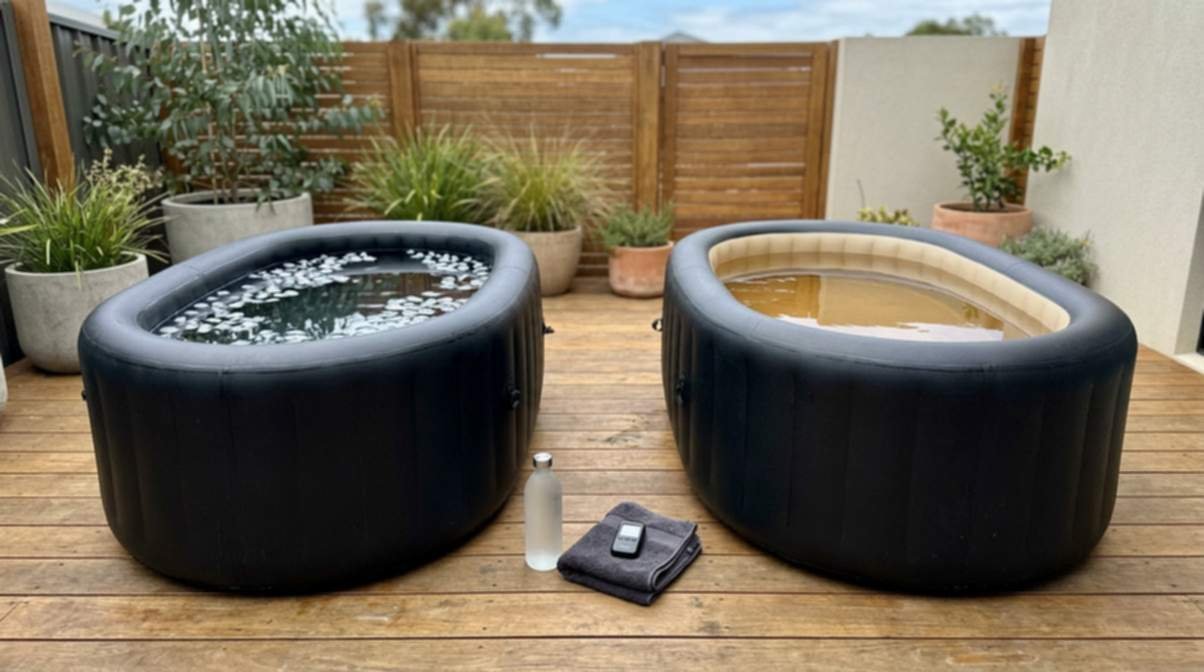
Yes you can have both, and the research backs it. For recovery, alternate 1 minute hot (around 38°C) with 1 minute cold (10–15°C) for 6 minutes total — finishing on cold if you want the metabolic edge. You don’t need an expensive combo unit; two separate tubs (or a chiller-equipped ice bath plus a hot tub) work just as well. how to do contrast therapy
Alternating hot and cold maximizes recovery benefits, but remember that systemic inflammation markers temporarily spike post-plunge before long-term adaptation kicks in.
Alternating between hot and cold plunges creates a pumping effect that may enhance circulation. For those specifically interested in skin and facial benefits, the cold phase appears more impactful, though the evidence for lasting cosmetic improvements remains limited.
When alternating between hot and cold plunges, remember that gender differences matter – women typically benefit from slightly warmer cold plunge temperatures and shorter durations compared to men.
First time you step from a hot soak into a cold plunge, your skin shrieks and your heart kicks like you’ve just been startled awake. Twenty seconds in, the panic settles. By the time you climb back into the warm water, the buzz is unmistakable — alert, light, slightly euphoric. That’s contrast therapy. The Finns have done it for centuries. Australian footy clubs and the AIS have used it for decades. And the question more home wellness buyers are asking in 2026 is whether they need both setups under one roof — or whether one will do. safety risks of ice baths
Alternating between hot and cold plunges can maximize recovery, but it’s worth noting that cold therapy alone has distinct advantages over heat-based methods. For a detailed comparison, see our breakdown of cold plunge vs infrared sauna benefits.
The short answer: hot and cold do different jobs. A cold plunge dampens inflammation, sharpens focus, and gives you a stress-resilience workout you can’t get any other way. A hot plunge (or hot tub) relaxes muscles, improves blood vessel function, and — over months of regular use — looks remarkably good for cardiovascular health. Used together, they create a vascular pump that the research suggests speeds short-term recovery, especially in the 24–72 hours after hard training. cold plunges and muscle growth
This guide cuts through the marketing. It covers what the science actually supports, the specific protocols backed by Australian research, when contrast therapy makes sense (and when it doesn’t), and the real cost of running both setups in an Australian climate. If you’re weighing up your options against the rest of the market, see our tested comparison of the best ice baths in Australia for context on how cold plunges stack up before you decide whether to add heat to the equation. effects of cold plunges on blood pressure
SAFETY FIRST Cold water immersion stresses the cardiovascular system. Start at 12–15°C, never below 10°C as a beginner, and keep first sessions to 1–3 minutes. Don’t plunge alone. Cold shock and post-immersion blood pressure drops can cause fainting. Have someone within earshot, especially in the first weeks. See your GP first if you’re over 50, pregnant, on blood pressure medication, or have any heart, circulation, or respiratory condition. The same applies to hot immersion at 38°C+ if you have low blood pressure, are pregnant, or take medication that affects thermoregulation. Never combine alcohol with either tub. It blunts your ability to feel temperature stress and dramatically raises drowning risk. Royal Life Saving Society Australia has clear guidance on safe immersion and supervision.
Hot plunge vs cold plunge at a glance
Use this table as your quick reference. Specific numbers come from the meta-analyses and research cited later in the guide. ideal cold plunge temperature
| Factor | Cold plunge | Hot plunge / hot tub |
| Typical temperature | 10–15°C | 38–40°C |
| Typical duration | 2–5 minutes | 10–20 minutes |
| Best for | Soreness, alertness, stress resilience | Muscle relaxation, blood vessel health, sleep wind-down |
| Strongest evidence | Reduces DOMS; 12-hour stress reduction | Improves endothelial function, lowers blood pressure |
| Worst time to use | Within 4–6 hours after strength training (if hypertrophy is your goal) | Right before high-intensity training (impairs power output) |
| AU running cost (approx.) | $15–$40/month electricity (chiller) | $40–$120/month (heating + filtration) |
| Beginner risk | Cold shock; cardiovascular strain | Overheating; fainting on exit |
What “hot plunge vs cold plunge” actually means
KEY TAKEAWAY A cold plunge is short, intense immersion at 10–15°C for 2–5 minutes. A hot plunge is longer, gentler immersion at 38–40°C for 10–20 minutes. They trigger opposite physiological responses — vasoconstriction versus vasodilation — and that opposition is why pairing them works.
A cold plunge — also called cold water immersion or an ice bath — is a tub of water held between roughly 10°C and 15°C, used for short bouts of 2 to 5 minutes. A 2025 dose-response meta-analysis of 55 randomised trials by Wang and colleagues confirmed that range as the sweet spot for most recovery and wellbeing outcomes.
A hot plunge is the warm-water counterpart. “Hot plunge” gets used loosely in the industry — sometimes it means a purpose-built hot tub, sometimes it means the heated side of a combo unit, sometimes it just means a residential spa. The water sits between 38°C and 40°C, you stay in for 10 to 20 minutes, and the goal is the opposite of cold: dilate blood vessels, relax muscles, and (over weeks of consistent use) train the cardiovascular system. The University of Oregon team led by Brunt and Minson has published the strongest body of work on this — their 8-week heat therapy trial showed improved endothelial function, reduced arterial stiffness, and lower blood pressure in sedentary adults using nothing more than repeated 40°C baths.
Combine the two and you have contrast water therapy (CWT) — the deliberate alternation of hot and cold immersion. Most researched protocols use 1-minute switches between hot and cold for 6 to 18 minutes total. CWT is what most people are really asking about when they search “hot plunge vs cold plunge” — they want to know if doing both is better than picking one.
What the research supports (strong evidence)
KEY TAKEAWAY Contrast water therapy beats doing nothing for muscle soreness at every time point from under 6 hours to 96 hours post-exercise. It’s roughly equal to cold-only immersion for soreness, but adds heat-driven cardiovascular benefits cold can’t deliver on its own.
1. Reduced muscle soreness after hard training
The clearest evidence for combining hot and cold comes from Bieuzen, Bleakley & Costello’s 2013 PLOS One meta-analysis of 18 controlled trials. Pooled across 13 of those studies, contrast water therapy produced significantly greater reductions in muscle soreness than passive recovery at five time points: under 6 hours, 24, 48, 72 and 96 hours post-exercise. Compared to other recovery methods (cold-only immersion, active recovery, compression), CWT was roughly equivalent — not magic, just consistently effective.
2. Acute recovery from high-intensity sessions
If you train hard and need to back up the next day, the Australian Institute of Sport has done the most useful work. In Versey, Halson & Dawson’s 2011 cycling study and their 2012 follow-up on running performance, they tested CWT durations of 6, 12 and 18 minutes after high-intensity sessions. The 6-minute protocol — alternating 1 minute at 38°C with 1 minute at 15°C — was enough to assist next-session performance. Going longer didn’t help more. That’s a useful finding: you don’t need a 25-minute marathon. Six minutes does the job.
3. Cardiovascular benefits from the hot side alone
Heat does work cold can’t. Brunt and Minson’s 2021 review in the Journal of Applied Physiology summarised the case: regular hot water immersion improves endothelial function, lowers blood pressure, reduces arterial stiffness, and may approach the cardiovascular benefits of moderate exercise in sedentary populations. A 2025 study by Atencio and colleagues compared hot water immersion to traditional sauna and infrared sauna and found that hot water immersion produced the strongest core temperature change and the most robust inflammatory and immune responses — likely because you can’t sweat efficiently when you’re submerged.
4. Stress, mood and the 12-hour effect
On the cold side, the 2025 UniSA meta-analysis by Cain and colleagues (PLOS One, 11 studies, 3,177 participants) found a meaningful reduction in perceived stress 12 hours after cold water immersion. Combine that with the relaxation response from a warm soak — which most people use to wind down before sleep — and you have a tool for both ends of the day: cold to fire up, hot to come down.
Where the evidence is mixed
KEY TAKEAWAY Contrast therapy doesn’t appear to outperform cold-only recovery for soreness, and for strength athletes chasing hypertrophy, both cold and contrast can blunt muscle adaptation if used within 4–6 hours of lifting.
Be honest about what we don’t know yet. The Bieuzen meta-analysis judged all 18 included trials as having a high risk of bias, which means the effect sizes should be treated as indicative, not nailed down. CWT is consistently better than rest, but it’s not consistently better than the alternatives — cold immersion alone, active recovery, even a good cup of tea and an early night.
More important: if you lift weights and want to grow muscle, the heat side of contrast therapy doesn’t rescue you from the cold side. The QUT-led research from Roberts and colleagues (2015) showed that cold water immersion immediately after strength training attenuates anabolic signalling — the molecular cascade that drives muscle growth. Adding a hot soak before or after the cold doesn’t reverse that effect. If hypertrophy matters to you, push contrast therapy at least 4–6 hours away from your strength session, or skip it on lifting days entirely.
What the science doesn’t support
KEY TAKEAWAY Contrast therapy doesn’t “flush toxins,” doesn’t reliably boost immune function in the long term, and won’t compensate for poor sleep, poor diet, or under-recovery. Be sceptical of any brand selling it as a fix for chronic disease.
A few claims get repeated across hot-and-cold marketing pages that don’t survive a careful read of the literature.
You need a 3:1 hot-to-cold ratio. There’s no good evidence for any specific ratio. The AIS work used 1:1 ratios with success. Pick what’s tolerable and consistent — that matters more than chasing a perfect formula.
Contrast therapy flushes toxins. There’s a vascular pumping effect from alternating vasoconstriction and vasodilation, but “toxins” isn’t a meaningful clinical term. Your liver and kidneys do that work. Contrast therapy may modestly assist clearance of metabolic by-products like lactate, but the effect is small and short-lived.
It boosts your immune system. The widely-cited Buijze 2016 study on cold showers found 29% fewer self-reported sick days — but that was a self-report, not a measure of immune function, and it was cold showers (not contrast therapy). The honest summary: cold exposure may help with subjective sickness frequency; contrast therapy hasn’t been shown to do anything special on top.
The practical protocol: how to actually do it
KEY TAKEAWAY Start in the hot tub for 3–5 minutes. Then alternate 1 minute cold (10–15°C) with 1 minute hot (38–40°C) for three rounds. Finish on cold for 1–2 minutes if you want the metabolic edge. Total time: about 10 minutes.
The 10-minute contrast session
| Step | Modality | Time | Temp |
| 1. Warm-up | Hot plunge | 3–5 min | 38–40°C |
| 2. First cold | Cold plunge | 1 min | 10–15°C |
| 3. Hot | Hot plunge | 1 min | 38–40°C |
| 4. Cold | Cold plunge | 1 min | 10–15°C |
| 5. Hot | Hot plunge | 1 min | 38–40°C |
| 6. Final cold | Cold plunge | 1–2 min | 10–15°C |
| Total | — | 8–11 min | — |
should you end on hot or cold?
KEY TAKEAWAY AU climate matters: in summer, your chiller has to fight a 35°C+ ambient air to keep cold water at 10°C — expect higher running costs than US-marketed numbers suggest. A hot tub paired with a chiller-equipped cold plunge typically runs $80–$160/month combined in electricity, more in tropical zones.
Most hot-and-cold content online is written for a US audience. A few things change when you’re plunging in Australia.
Climate and chiller load
Tap water in Sydney, Melbourne and Brisbane sits between 18°C and 25°C through summer. To run a cold plunge at 10°C, your chiller needs to pull that down and hold it against ambient air that’s frequently 30°C+ in southern states and routinely 35°C+ in Queensland and the NT. That means a 1HP chiller suitable for a North American garage may struggle in a Brisbane backyard in February. Look at chiller ratings against your local summer maximums, not the manufacturer’s standard test conditions.
Running costs
Hot tubs in Australia typically cost $40–$120 per month to run depending on size, insulation, and electricity tariff. A well-insulated chiller-equipped cold plunge adds $15–$40 a month. Combined, that’s $80–$160 monthly for both setups. Add chemicals (around $20–$40 a month for both), and the realistic annual operating cost sits around $1,200–$2,400 in AUD. Cheaper than a gym membership for two; not cheap.
Authority guidance
On safety, Australian-specific authorities like Royal Life Saving Society Australia have published clear guidance on cold water immersion supervision. The key rule applies equally to hot tubs: never immerse alone, especially when starting out. Hot tub fainting and cold plunge cardiac events both happen — they’re rare, but they happen, and a buddy is the cheapest insurance you’ll buy.
Combo unit or two separate tubs?
KEY TAKEAWAY You don’t need a combo unit. Two separate setups (or even an ice bath plus your existing bathtub run hot) deliver the same benefits. Combo units save space and time but add cost and a single point of failure — if one side breaks, you lose both.
If a brand tells you a contrast therapy combo unit is “the only proper way” to do hot and cold, that tells you something about the brand. Combo units have real benefits — shared plumbing, smaller footprint, faster transitions — but the research on contrast therapy was conducted with separate tubs, separate buckets, even separate pools. The physiology doesn’t care whether the hot and cold water share a wall.
When a combo makes sense
- You’re tight on space and want both modalities in one footprint.
- You value the under-10-second transition between hot and cold (some people find this matters psychologically more than physiologically).
- You want a single 240V connection and one set of plumbing to maintain.
When two separate setups make more sense
- You already own a hot tub and just need to add a cold plunge.
- You want flexibility — cold plunge in the garage, hot tub on the deck.
- You prefer the redundancy: if one breaks, the other still works.
- You want to spend $4,000–$6,000 instead of $10,000–$15,000.
For a tested look at the cold side of the equation across a range of price points and chiller capacities, see our full Australian ice bath comparison. For more on the science behind the cold side specifically, our guide to whether ice baths are good for you walks through the evidence in detail.
frequently asked questions
Is a hot plunge the same as a hot tub?
In practical terms, yes. A hot plunge typically refers to any vessel of warm water (38–40°C) used for therapeutic immersion. The terms hot tub, spa, and hot plunge are often used interchangeably, though “hot plunge” sometimes specifically describes the heated side of a contrast therapy combo unit. The physiology is identical regardless of what the marketing calls it.
Should I do hot or cold first?
Start with hot. A 3–5 minute warm-up dilates blood vessels, loosens muscles, and makes the cold transition feel less brutal. Most contrast protocols studied at the Australian Institute of Sport began with a hot bout, then alternated minute-by-minute. The exception is post-training: if you’ve just finished a hard session, wait 30–60 minutes before starting heat to avoid blunting the immediate inflammatory recovery signal.
How long should hot plunge vs cold plunge sessions be?
For a cold plunge alone, 2–5 minutes at 10–15°C is the research-backed range. For a hot plunge alone, 10–20 minutes at 38–40°C. For contrast therapy, 6 minutes total (three rounds of 1 minute hot / 1 minute cold) is enough the AIS dose-response work showed no extra benefit from going longer.
Can I do contrast therapy every day?
Most people tolerate daily contrast therapy fine, but daily isn’t necessary. Three to four sessions a week captures most of the benefit. If you lift weights and care about hypertrophy, skip contrast therapy on training days or push it at least 4–6 hours away from your gym session.
Is it dangerous to go from hot to cold suddenly?
For healthy adults, no — the contrast is the point. But cold shock can spike blood pressure and heart rate, which is why anyone with cardiovascular conditions should clear it with a GP first. Don’t dive in headfirst; step in gradually so your face isn’t the first thing hit by 12°C water. And never combine contrast therapy with alcohol.
Does contrast therapy help with weight loss?
Modestly, and indirectly. Cold exposure activates brown adipose tissue, which burns calories to generate heat. The Søeberg principle — ending on cold so your body rewarms itself — extends that effect. But the calorie burn is small (a few dozen extra per session), and contrast therapy isn’t a weight loss tool. It’s a recovery and wellbeing tool that may have a small metabolic side benefit.
Can I use my regular bathtub instead of a dedicated hot plunge?
Yes, for the hot side, your bathtub is fine — fill it at 38–40°C and you’ve got a hot plunge. The cold side is harder: getting domestic tap water to 10–15°C reliably means either bagging large amounts of ice every session (impractical and expensive long-term) or buying a chiller-equipped tub. A bath plus a chilled cold plunge is the cheapest legitimate contrast setup.
Hot tub vs cold plunge — which one should I buy first?
Depends on your goals. If you train hard and want recovery, mood, and a stress-resilience tool, start with cold — it’s cheaper, smaller, and the active ingredient in most contrast protocols. If you want cardiovascular benefit, deep relaxation, and something to share with family, start with hot. You can always add the other later.
Does ending with cold actually matter?
It matters if you’re chasing the metabolic effect. The Søeberg principle holds that ending cold forces your body to rewarm itself, which keeps brown fat and shivering thermogenesis active afterwards. If your goal is sleep wind-down or muscle relaxation, ending on hot is fine. The research isn’t strong enough to call this make-or-break — it’s a tweak, not a fundamental rule.
Can contrast therapy replace exercise?
No. Hot water immersion has produced cardiovascular benefits comparable to mild exercise in sedentary populations, but it doesn’t replace the muscular, metabolic, or skeletal benefits of actual movement. Treat contrast therapy as a recovery and wellbeing complement to exercise, not a substitute.
Bieuzen F, Bleakley CM, Costello JT (2013). Contrast Water Therapy and Exercise Induced Muscle Damage: A Systematic Review and Meta-Analysis. PLOS One, 8(4), e62356. DOI: 10.1371/journal.pone.0062356
Wang Y, et al. (2025). Effects of cold water immersion on recovery: a dose-response meta-analysis of 55 RCTs. Frontiers in Physiology. DOI: 10.3389/fphys.2025.1525726
Cain T, et al. (UniSA, 2025). Health and wellbeing effects of cold water immersion: a systematic review. PLOS One. DOI: 10.1371/journal.pone.0317615
Brunt VE, Minson CT (2021). Heat therapy: mechanistic underpinnings and applications to cardiovascular health. Journal of Applied Physiology, 130(6), 1684–1704. DOI: 10.1152/japplphysiol.00141.2020
Medical disclaimer: This article is for general informational purposes only and is not medical advice. Cold and hot water immersion carry real cardiovascular risks. Speak with your GP before starting either practice, especially if you have any heart, blood pressure, respiratory or pregnancy-related condition.
