
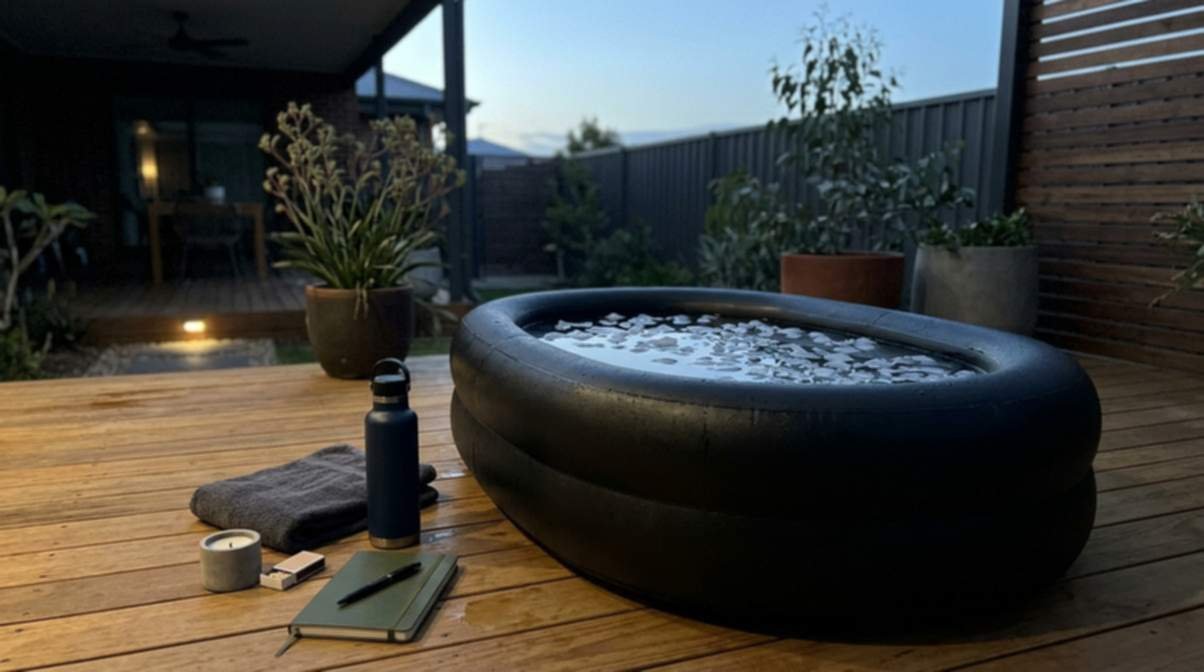
KEY TAKEAWAY: For most people, a morning cold plunge is the better choice for alertness, focus and habit-building. A night cold plunge can support sleep only when it is short, moderate and timed around 90-120 minutes before bed – not straight before lights out.
The first thirty seconds feel the same whether you plunge at sunrise or after dinner. Your chest tightens, your breathing wants to run away, and every part of your body votes to get out. Then your breath settles, the water stops feeling like panic, and the question becomes practical: when should you actually do this?
The honest answer is that cold plunge timing depends on the job you want the cold to do. Morning cold exposure is usually better for wakefulness, mood and consistency. Night cold exposure can work as a wind-down tool for some people, but it is easier to get wrong because cold water is an acute stressor before it becomes calming.
This guide compares cold plunge at night vs morning through the evidence, not wellness hype. You’ll get specific timing windows, temperature ranges, workout caveats and safety rules. If you’re still choosing a setup, start with our tested comparison of the best ice baths in Australia.
Cut-the-BS version: there is no magic hour where cold suddenly becomes “optimal”. There are better and worse times based on sleep, training and risk.
Already know what you’re after? The PRODIGYX Ice Bath Tub is one of our top picks for a repeatable routine, so feel free to check current pricing below.
Safety warning before you choose a time
KEY TAKEAWAY: Cold water immersion is not risk-free. Start warmer than you think, keep the first sessions short, never plunge alone, and get GP clearance if you are over 50 or have any cardiovascular, respiratory, neurological or cold-sensitivity risk.
Royal Life Saving Society Australia warns that cold water immersion carries drowning and safety risks, including cold shock, gasping, hyperventilation, increased heart rate, increased blood pressure, cramps, panic, arrhythmias and hypothermia. Their position statement also notes that cold water immersion can happen in gyms, wellness centres, natural water, at home or completely alone, which is exactly why safety systems matter.
Use these guardrails before you worry about morning vs night:
- Beginners: start around 15-18°C for 30-60 seconds. Build towards 10-15°C only after you can control your breathing.
- Keep your head above water. Do not practise breath holds in the tub.
- Never plunge alone, especially at night, after sauna, after alcohol, or when sleep deprived.
- Stop immediately if you feel chest pain, faintness, confusion, numbness that feels unsafe, or loss of breathing control.
- Avoid cold plunging if you are pregnant unless a doctor clears it. Seek medical advice first if you have heart disease, arrhythmia, uncontrolled high blood pressure, Raynaud’s, cold urticaria, asthma, epilepsy, a history of fainting, or you take cardiac medication.
- If you are over 50, get GP clearance first. Age is not the issue by itself; undetected cardiovascular risk is.
Royal Life Saving’s cold water guidance also states that water below 15°C can trigger cold water shock and increase drowning risk, even in capable swimmers. Their cold water risk page is worth reading before your first session.
Cold plunge timing at a glance
| Goal | Best timing | Starter protocol | Important caveat |
| Energy, focus and mood | Morning, ideally soon after waking or after light movement | 15-18°C for 30-60 sec, building to 10-15°C for 1-3 min | Cold is stimulating. Keep it short enough that you can work afterwards, not shiver for an hour. |
| Sleep wind-down | Early evening, roughly 90-120 min before bed | 12-15°C for 1-3 min; experienced users may use 2-5 min | Avoid plunging immediately before bed if it leaves you wired, shivering or alert. |
| Post-workout soreness | After endurance, sport or competition sessions when rapid recovery matters | 10-15°C for 10-15 min is the evidence-backed recovery range; casual users can use shorter sessions | Do not confuse less soreness with better long-term adaptation. |
| Strength training and muscle growth | Morning on rest days, before lifting, or at least 4-6 hours after resistance training | 10-15°C for 1-5 min depending on tolerance | Avoid immediate post-lift plunges if hypertrophy is the goal. |
| Stress reset | Morning or early evening, depending on when you need the reset | 10-15°C for 1-3 min | The strongest general-population review found stress effects were time-dependent, not instant magic. |
| Beginner consistency | The time you can repeat safely | 15-18°C for 30-60 sec, 2-3 times per week | Consistency beats extreme temperature. |
Morning cold plunges are best for alertness & routine
KEY TAKEAWAY: Choose the morning if your goal is energy, focus, motivation or a routine you’ll actually keep. The cold stress response is stimulating, which is useful at 7am and often annoying at 10pm.
Cold water is not gentle. It activates the sympathetic nervous system first, which is why morning plunges feel like an alarm clock for your whole body. Older physiology research found that cold water can sharply increase catecholamines: Šrámek et al. (2000) reported a 530% rise in plasma noradrenaline and a 250% rise in dopamine during one-hour head-out immersion at 14°C. That was much longer than a normal home cold plunge, so don’t copy-paste those numbers onto a two-minute dip. The useful takeaway is simpler: cold can be a strong alertness signal.
There is also evidence that norepinephrine can rise quickly in colder water. Johnson et al. (1977) found mean norepinephrine increased after two minutes in cold water, which helps explain why even short morning exposure feels sharp.
The best morning protocol is boring on purpose:
- Start with 30-60 seconds at 15-18°C if you are new.
- Build to 1-3 minutes at 10-15°C once your breathing is controlled.
- Do light movement before getting in if you wake up stiff or anxious.
- Use nasal or slow exhale breathing, not breath-holding.
- Get morning light afterwards if you can. The cold wakes you up; the light helps anchor the rest of your day.
A morning plunge is also easier to standardise. Your caffeine intake, dinner, bedtime stress and training fatigue can all interfere with evening cold exposure. Morning routines usually have fewer variables. For weekly routine planning, see our guide on how often you should cold plunge.
Night cold plunges can help sleep, but the timing matters
KEY TAKEAWAY: A night cold plunge is not automatically a sleep hack. If you do it too close to bed, the initial cold shock may leave you alert; if you do it earlier and keep it controlled, it may support sleep for some people.
Sleep and body temperature are linked. A 2023 Journal of Applied Physiology study found that reductions in core body temperature before sleep were associated with nocturnal heart rate variability patterns in poor sleepers, suggesting that the pre-sleep cooling process matters. Bigalke et al. (2023) does not prove that ice baths fix sleep, but it supports the idea that temperature timing is not random.
The most relevant cold-water sleep study is narrow but useful. Chauvineau et al. (2021) studied 12 well-trained male endurance runners after high-intensity evening exercise. They used 10 minutes at about 13.3°C and found that whole-body immersion increased slow-wave sleep proportion during the first 180 minutes of the night compared with partial immersion, and both cold-water conditions reduced arousals compared with control. The same study did not find better muscle damage or fatigue markers over 48 hours.
That nuance matters. Competitor articles often jump from “cold can cool the body” to “cold plunge before bed improves sleep”. The real evidence is more cautious: sleep findings are promising, mostly athlete-based, and highly dependent on timing, protocol and individual response. Cain et al. (2025) reviewed 11 studies with 3,177 participants and concluded that cold water immersion has time-dependent effects on stress, immunity, sleep quality and quality of life, but the evidence base is limited by small samples, few RCTs and low diversity in study populations.
Practical night protocol:
- Do it 90-120 minutes before bed, not straight before sleep.
- Use a moderate range: 12-15°C is enough for most people.
- Keep it short: 1-3 minutes for most non-athletes, up to 5 minutes if experienced.
- Skip the “prove yourself” mindset. Evening cold should settle your system, not turn bedtime into a stress test.
- If you shiver hard, feel wired, or your sleep tracker shows worse sleep, move your plunge earlier or switch it to morning.
Important safety note: Chauvineau’s strongest sleep result involved whole-body immersion including the head in a supervised study. That does not mean you should dunk your head in a home ice bath at night. For home users, keep your head above water.
Morning vs night depends on your goal
KEY TAKEAWAY: The best time to cold plunge is the time that matches the outcome you care about. Energy points to morning. Sleep points to early evening. Recovery depends on the type of training you did.
| If your main goal is… | Choose this time | Why |
| Wake up faster | Morning | The cold stress response is stimulating and easier to use productively at the start of the day. |
| Reduce caffeine reliance | Morning | Cold exposure can create a strong alertness signal without adding caffeine late in the day. |
| Improve sleep routine | Early evening | The timing gives the initial stress response time to settle before bed. |
| Recover from endurance or sport | After training or later that day | Cold water immersion has better evidence for reducing soreness and short-term recovery markers than for long-term muscle growth. |
| Build muscle | Morning on rest days or well away from lifting | Immediate post-lift cold can interfere with adaptation signals. |
| Manage stress after work | Early evening | Cold can create a clear break between work and home, but it should not be so late that it delays sleep. |
| Build the habit | The time you can repeat safely | The best protocol is useless if you only do it once. |
If you want a simple rule: morning for activation, early evening for downshifting, and avoid immediate post-strength training unless short-term soreness matters more than muscle adaptation.
Workout timing changes the answer
KEY TAKEAWAY: Cold plunging after exercise can reduce soreness, but it is not always the best choice after lifting. If muscle growth is your priority, keep cold water away from the immediate post-strength window.
For soreness and short-term recovery, cold water has decent support. Wang et al. (2025) analysed 55 randomised controlled trials and found dose-response differences by duration and temperature. In their ranking, 10-15 minutes at 11-15°C had the highest probability of being best for delayed onset muscle soreness, while 10-15 minutes at 5-10°C ranked highest for jump performance recovery.
That does not mean “colder is always better”. It means protocol matters. For everyday use, 10-15°C is cold enough for most people, and our ice bath temperature guide explains how to set a safe range before chasing colder numbers.
Strength training is the big caveat. Roberts et al. (2015) compared post-exercise cold water immersion with active recovery during a 12-week strength-training study and found smaller gains in muscle strength and mass in the cold-water group. A follow-up muscle-biology paper from the same research group, Peake et al. (2017), found cold water immersion was no more effective than active recovery for reducing inflammatory and cellular stress responses after resistance exercise.
A broader meta-analysis by Malta et al. (2021) found that regular cold-water immersion can affect training-induced adaptations differently depending on training type, with more concern around resistance training than endurance.
Practical rules:
- If you lift for hypertrophy: avoid plunging immediately after the session. Use the morning, a rest day, or leave at least 4-6 hours after lifting. For the detailed strength caveat, see our cold plunge and muscle growth guide.
- If you do endurance, sport or multi-day events: a post-workout plunge may help soreness and perceived recovery. Read more in our guide on whether cold plunging reduces inflammation.
- If you train late at night: choose sleep over recovery theatre. A very cold late plunge that ruins sleep is not good recovery.
Australian timing considerations
KEY TAKEAWAY: In Australia, climate and season can change the practical answer. If your water temperature drifts with the weather, the “same” cold plunge may feel completely different in Melbourne winter and Brisbane summer.
The evidence talks in water temperature, not vibes. If you do not measure temperature, you are guessing. That matters more in Australia because outdoor tubs, garage setups and unchilled water can swing with season and location.
- In hot climates, morning is often easier because the air and water may be cooler before the day heats up.
- In colder southern winters, evening sessions can feel more intense because you are combining cold water with cooler air and a lower post-session body temperature.
- A chiller gives more consistent timing because 12°C is 12°C whether it is January or July.
- If your setup is basic, use a floating thermometer and read our DIY cold plunge guide before adding more ice or electrical gear.
- If you are deciding between products, compare insulation, chillers and usability in our best ice baths in Australia guide.
If you’re ready to sort your tub now, the PRODIGYX Ice Bath Tub is the pick we’d point you towards from this guide.
What the science does not support
KEY TAKEAWAY: The cold plunge industry loves certainty. The evidence is more useful when it is honest: cold can help with alertness, soreness and possibly sleep in specific contexts, but it is not a cure-all.
- “Night plunges always improve sleep.” Not true. The athlete sleep studies are promising, but Cain et al. (2025) notes that sleep evidence is still limited and often drawn from narrow populations.
- “Morning is always better.” Not true. Morning is usually better for alertness, but early evening can be better if your goal is a post-work decompression ritual or sleep support.
- “The colder the better.” Not supported for most users. Wang et al. (2025) shows useful results across defined dose ranges, not a simple race to 0°C.
- “Cold water replaces recovery basics.” No. Sleep, protein, training load, hydration and sensible programming still do the heavy lifting. Mayo Clinic Press summarises the wider cold plunge evidence as still thin in several areas.
- “If it feels brutal, it must be working.” Bad rule. A controlled 12-15°C plunge you repeat safely beats an extreme one you dread or do alone.
7. Simple protocols for morning and night
KEY TAKEAWAY: Use the smallest dose that gives the outcome you want. You do not need an extreme session to get the practical benefits of cold exposure.
Morning cold plunge protocol
| Step | What to do |
| 1. Set temperature | Start 15-18°C. Build toward 10-15°C after a few sessions. |
| 2. Enter slowly | Sit or step in. Do not jump or dive. Keep your head above water. |
| 3. Control breathing | Long exhales. No breath holds. |
| 4. Time it | 30-60 sec for beginners; 1-3 min for most regular users; up to 5 min if experienced. |
| 5. Rewarm | Dry off, move gently and let the body warm naturally. |
Night cold plunge protocol
| Step | What to do |
| 1. Time it early | Aim for 90-120 min before bed. Earlier is better if cold makes you alert. |
| 2. Use moderate cold | 12-15°C is enough for most people at night. |
| 3. Keep it short | 1-3 min for most users. Avoid long shivering sessions. |
| 4. Rewarm gently | Dry off, put on warm clothes and avoid blasting yourself with a hot shower unless you are too cold. |
| 5. Track sleep | If sleep latency, restlessness or wake-ups worsen, move the session to morning. |
Post-workout protocol
| Training type | When to plunge | Protocol |
| Endurance, sport or competition recovery | Soon after training, if short-term recovery matters | 10-15°C for 5-15 min depending on experience and recovery need. |
| Strength or hypertrophy | Morning on rest days, before training, or 4-6+ hours after lifting | 10-15°C for 1-5 min. Avoid immediate post-lift plunges. |
| Late-night training | Usually skip or use a very short moderate plunge | Protect sleep first. A bad night of sleep is poor recovery. |
Choose Your Cold Plunge Tub

TOP PICK
PRODIGYX Ice Bath Tub
The PRODIGYX Ice Bath Tub is our top pick for a reliable, repeatable routine, available through Amazon.
Frequently asked questions
What is the best time to cold plunge, morning or night?
For most people, morning is better for alertness, focus and consistency. Night can work for sleep support, but only when timed 90-120 minutes before bed and kept moderate. The best time depends on your goal: morning for energy and routine, early evening for sleep and stress reset.
Is a cold plunge at night bad for sleep?
Not necessarily, but timing matters. Plunging too close to bed can be stimulating and disrupt sleep. Plunging 90-120 minutes before bed, at a moderate temperature (12-15°C) for a short duration (1-3 min), may support sleep for some people. If it makes you feel wired or shivery, switch to morning.
How long before bed should I cold plunge?
Aim for 90-120 minutes before bed. This gives your body time to settle from the initial cold shock response. Avoid plunging immediately before sleep.
Is a morning cold plunge good for you?
Yes, for most healthy adults, a morning cold plunge can boost alertness, mood and focus. The cold shock response triggers a release of noradrenaline and dopamine, which can feel like a natural energy boost. It can also help build a consistent routine.
Can a cold plunge replace coffee?
For some people, yes. The alertness from cold exposure can reduce reliance on caffeine, especially in the morning. However, it’s not a direct replacement for everyone.
Should I cold plunge after a workout in the morning or at night?
It depends on the workout. For endurance or sport recovery, a post-workout plunge can help soreness. For strength or hypertrophy training, avoid plunging immediately after; do it in the morning on rest days or at least 4-6 hours after lifting.
Does cold plunge help you sleep?
It can, but the evidence is limited. Some studies in athletes show improved sleep architecture after evening cold water immersion, but results are not universal. The key is timing and moderation: a short, moderate plunge 90-120 minutes before bed may help, while a very cold or late plunge may hinder sleep.
What temperature should a night cold plunge be?
For night plunges aimed at sleep support, 12-15°C is a good target. Avoid going extremely cold, as this can be overly stimulating.
How long should a morning cold plunge be?
For beginners, 30-60 seconds at 15-18°C. For regular users, 1-3 minutes at 10-15°C is sufficient for an alertness boost. You don’t need to stay in for long periods.
Can I cold plunge twice a day?
Possible, but not necessary for most people. If you do, keep sessions short and moderate, and ensure you are fully rewarmed between them. Listen to your body and avoid over-stressing your system.
Should I cold plunge before or after sauna at night?
If combining with sauna at night, the typical sequence is sauna then cold plunge. Finish the cold plunge at least 90-120 minutes before bed to allow your core temperature and nervous system to settle.
What if cold plunging makes me anxious?
This is a sign to pull back. Start warmer (15-18°C), keep sessions very short (30 seconds), focus on controlled breathing, and never plunge alone. If anxiety persists, consult a healthcare professional. Cold exposure is a stressor and isn’t suitable for everyone.
Sources
Medical disclaimer: This content is for informational purposes only and does not constitute medical advice. Cold water immersion can place acute stress on the cardiovascular and respiratory systems. Always consult a qualified healthcare professional before beginning cold water immersion, especially if you have a medical condition, are pregnant, take medication, or are over 50.
