
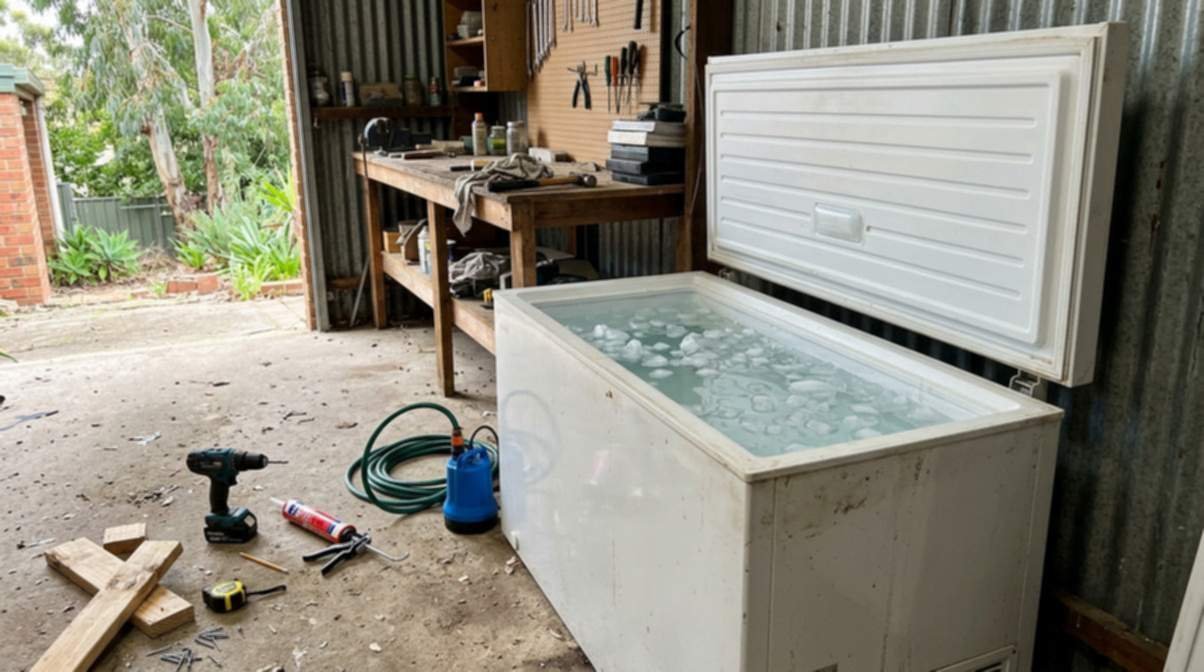
KEY TAKEAWAY: You can build a functional DIY cold plunge for as little as $50–$150 AUD (bathtub + ice) or create a permanent, always-cold chest freezer conversion for $400–$900 AUD. The best method depends on your budget, space, and how often you’ll use it. A chest freezer conversion is the most popular DIY option because it maintains a consistent temperature without buying ice, but it requires waterproofing, a temperature controller, and strict electrical safety. If your budget is over $1,500–2,000 AUD, a purpose-built ice bath with a chiller is almost always the better choice for safety, convenience, and longevity.
There’s a moment – usually right after you’ve priced out your fifth commercial cold plunge -where you think: I could just build one. A chest freezer, some silicone, a temperature controller, and a bit of elbow grease. How hard can it be?
The honest answer: not that hard, but harder than most YouTube videos make it look. And the gap between a DIY cold plunge that works on day one and one that’s still working (and not leaking, rusting, or growing algae) six months later is where the real challenge lies.
This guide covers five different ways to build a DIY cold plunge in Australia, from a $50 bathtub-and-ice setup to a fully plumbed chest freezer conversion. We’ll give you honest costs in AUD, step-by-step instructions for the most popular method (chest freezer), and critically the safety considerations that most DIY guides skip. If you’d rather skip the build and buy something tested, see our comparison of the best ice baths in Australia.
SAFETY WARNING: Electrical safety is non-negotiable. Water and electricity are a lethal combination. Any chest freezer conversion MUST be unplugged from mains power before you get in. No exceptions. Even with an RCD (residual current device) on the circuit, the safest practice is physical disconnection. If you’re adding a pump, filter, or ozone system, have all electrical components installed by a licensed electrician and ensure compliance with AS/NZS 3000 (Australian Wiring Rules). The Royal Life Saving Society Australia recommends that all CWI equipment meet relevant electrical safety standards. For cold plunge health risks and contraindications, see our ice bath safety guide.
Would rather skip the DIY build entirely? The PRODIGYX Ice Bath Tub is one of our top picks and arrives ready to use, no tools required.
5 DIY Cold Plunge Methods Compared
| Method | Cost (AUD) | Temp Control | Maintenance | Best For |
| Bathtub + ice | $50–$150 per month (ice costs) | Manual (add ice each session) | Drain after each use | Beginners testing the waters |
| Inflatable tub + ice | $80–$250 (tub) + ice costs | Manual | Drain regularly; puncture-prone | Portability, renters, travel |
| Stock tank / IBC tote | $150–$400 (tank) + ice or chiller | Manual or add chiller | Clean regularly; exposed outdoors | Outdoor setups, larger bodies |
| Chest freezer conversion | $400–$900 total | Automatic (Inkbird controller) | Waterproofing, water quality management | Most popular DIY; year-round cold |
| Chest freezer + external chiller | $800–$1,800 total | Automatic (chiller thermostat) | Filter + chiller maintenance | Closest to commercial quality |
When to skip DIY and buy commercial: If your total DIY budget exceeds $1,500–2,000 AUD, you’re approaching the price of entry-level commercial ice baths that come with built-in chillers, filtration, warranties, and importantly electrical safety certification. At that point, the convenience and safety of a purpose-built unit almost always wins. Check our Vital+ Ice Bath review for an example of what’s available in that range.
1. The Simplest DIY: Your Bathtub + Ice
KEY TAKEAWAY Cost: $50–$150 per session in ice. Zero setup. The fastest way to try cold water immersion, but the least sustainable long-term due to ongoing ice costs and inconsistent temperatures.
This is where most people start and honestly, it’s fine for testing whether cold exposure is something you’ll actually stick with before investing in a permanent setup.
How to do it:
- Fill your bathtub halfway with cold tap water. In Melbourne or Hobart during winter, tap water can be 10–14°C cold enough for a meaningful session without any ice.
- Add 3–4 bags of commercial ice (8–10kg bags from a servo or Woolworths). This will typically drop the temperature by 5–10°C depending on your tub volume and starting water temp.
- Use a kitchen thermometer or cheap aquarium thermometer to check the temperature. Aim for 10–15°C for your first sessions. For detailed temperature guidance, see our ice bath temperature guide.
- Get in. Stay for 2–5 minutes to start. See our duration guide for evidence-based timing.
Pros: Zero upfront cost (you already have a bathtub). No electrical risk. Easy cleanup.
Cons: Ice costs add up fast ($15–40 per session). Temperature is inconsistent. Water goes to waste each time. Not sustainable for daily use.
Australian tip: In summer, Brisbane and Darwin tap water can be 25–30°C. You’ll need significantly more ice sometimes 5–6 bags to hit 15°C. In southern cities during winter, you may not need any ice at all.
2. Chest Freezer Cold Plunge: The Complete Build Guide
KEY TAKEAWAY The chest freezer conversion is the most popular DIY cold plunge method because it maintains a consistent, adjustable temperature year-round without buying ice. Total cost: $400–$900 AUD depending on whether you buy new or secondhand. Build time: 1–2 days plus curing time for sealant.
What You Need
| Item | Approx. Cost (AUD) | Notes |
| Chest freezer (300–500L) | $200–$500 | Secondhand is fine. 300L minimum for most adults. 400L+ recommended if you’re over 180cm. Check Gumtree, Facebook Marketplace, or Bunnings scratch-and-dent. |
| Inkbird ITC-308 temperature controller | $40–$55 | Plugs between the wall and the freezer. Set your target temp and the controller switches the compressor on/off. Essential. |
| Marine sealant or epoxy putty (JB Water Weld) | $15–$30 | Seal all interior seams to prevent water leaking into the insulation. Do NOT use regular bathroom silicone it breaks down. Marine-grade or aquarium-safe epoxy only. |
| Pond liner or Pond Shield epoxy (optional) | $50–$150 | Fully lines the interior for extra waterproofing and protects against corrosion. Recommended if your freezer has bare aluminium walls. |
| Submersible pump + filter | $30–$60 | Circulates water and catches debris. A small aquarium pump with a sponge filter works well. |
| Digital thermometer | $10–$20 | Waterproof aquarium thermometer for real-time reading inside the tub. |
| Water treatment (chlorine/bromine or ozone) | $20–$50 | Keeps water clean for weeks. Chlorine granules from Bunnings pool section are cheapest. |
| RCD-protected power board | $30–$50 | Non-negotiable for safety. Even though you should unplug before entering, an RCD provides backup protection. |
Step-by-Step Build
- Choose your freezer. Aim for 300–500L capacity. Get in the freezer at the store (yes, really) to check you fit. If you’re over 180cm, 400L+ is strongly recommended. Chest freezers with white inner walls are easier to work with than bare aluminium, which can discolour with ozone treatment.
- Seal all interior seams. Apply marine sealant or JB Water Weld to every seam, corner, and joint inside the freezer. Pay special attention to the drain plug area (seal it from inside). Let it cure fully typically 24-48 hours. This is the most important step. A leak into the insulation will destroy the freezer.
- Apply a liner (optional but recommended). For maximum durability, apply Pond Shield epoxy to the entire interior. This creates a food-safe, waterproof barrier that protects against corrosion and makes cleaning easier. Alternatively, lay a pond liner cut to size. Both options add longevity.
- Install the Inkbird temperature controller. Plug the Inkbird into the wall (via your RCD-protected power board). Plug the chest freezer into the Inkbird’s cooling outlet. Place the Inkbird’s temperature probe inside the freezer, secured below the waterline. Set your target temperature (3–5°C is common; the Inkbird will cycle the compressor on and off to maintain it).
- Fill with water. Use a garden hose. Fill to a level that allows for water displacement when you get in leave 10–15cm from the top. A 400L freezer holds roughly 350–380L of usable water.
- Add your pump and filter. Place a small submersible pump with a sponge filter inside the freezer. This circulates the water (preventing thermal layering) and catches hair, skin, and debris. Run the pump for 30–60 minutes daily but unplug before you get in.
- Treat the water. Add a small amount of chlorine or bromine (follow pool chemical dosing guidelines typically 1–2 ppm for chlorine). Alternatively, install an ozone generator for chemical-free sanitation. Shower before each use to minimise contamination.
- Wait for the temperature to drop. Depending on your starting water temperature and the freezer’s compressor power, it may take 12–48 hours to reach your target. Don’t rush it.
- UNPLUG THE FREEZER AND ALL ELECTRICAL EQUIPMENT BEFORE GETTING IN. This is the single most critical safety step. Every time. No exceptions. Even with an RCD, physical disconnection is the only way to guarantee zero electrical risk in water.
Chest Freezer Maintenance
- Water changes: Every 2–4 weeks with chlorine treatment, or monthly with ozone. If the water looks cloudy or smells off, change it immediately.
- Filter cleaning: Rinse your sponge filter weekly. Replace every 2–3 months.
- Shower before every use. This is the single best thing you can do for water quality. Sunscreen, sweat, dead skin, and hair are the main contaminants.
- Check seals regularly. Inspect your interior seams every month for any signs of water seeping into the insulation. Reseal immediately if you spot any.
- Monitor chlorine/bromine levels. Pool test strips from Bunnings ($10–15) let you check levels in seconds.
3. Stock Tank or IBC Tote Cold Plunge
KEY TAKEAWAY A galvanised stock tank (300–500L) or cleaned IBC tote (1,000L) provides a larger, outdoor-friendly DIY option. Cost: $150–$400 for the vessel. Requires ice or an external chiller to maintain temperature. Best for backyards and shared use.
Stock tanks (available at rural supply stores like Elders or online) are a popular choice for outdoor setups. They’re durable, spacious, and look decent in a backyard. The downside: no built-in cooling, so you’re either adding ice each session or investing in an external chiller ($300–$1,200 AUD).
IBC totes (intermediate bulk containers) are the budget option for a large-volume plunge. You can often find food-grade 1,000L totes for $50–$150 on Gumtree or Facebook Marketplace. Cut the top off, clean thoroughly, and you have a roomy tub. The plastic is UV-resistant but not insulated, so temperature maintenance is challenging in hot climates without a chiller.
Key consideration: Neither option has built-in temperature control. In Brisbane or Perth summer, your water will warm to 25°C+ within hours. If you want consistent cold without daily ice runs, you’ll need to pair a stock tank or IBC tote with an external chillervwhich pushes your total cost into the $800–1,500 AUD range.
4. Inflatable Ice Bath Tub
Inflatable ice bath tubs ($80–$250 AUD) are the entry-level commercial option that blurs the line between DIY and off-the-shelf. They’re portable, require no build, and are ideal for renters or anyone who wants to test cold exposure without a permanent setup. The trade-off: they require ice for every session, have thin insulation (ice melts fast), and the material is susceptible to puncture. For most people, an inflatable tub is a stepping stone to either a chest freezer conversion or a proper commercial unit. See our best ice baths in Australia guide for inflatable options we’ve tested.
5. Keeping Your DIY Cold Plunge Clean
KEY TAKEAWAY: Water quality is where most DIY cold plunges fail. Cold water slows but doesn’t stop bacterial growth. Without proper treatment, your beautiful new plunge will become a petri dish within days especially in Australian summer.
| Method | Cost | Effectiveness | Notes |
| Chlorine granules | $15–25 (lasts months) | High | Use pool-grade from Bunnings. Maintain 1–2 ppm. Shower after use. Cheapest and most reliable. |
| Bromine tablets | $25–40 | High | Gentler on skin than chlorine. Slightly better at low temperatures. Floating dispenser works well. |
| Ozone generator | $80–$200 | High | Chemical-free. Produces ozone gas that kills bacteria on contact. Requires electricity (unplug before use). |
| UV-C steriliser | $50–$150 | Medium-high | Inline UV light kills bacteria as water passes through. Needs a pump to circulate water past the light. |
| Hydrogen peroxide (food-grade) | $20–40 | Medium | Less effective than chlorine at low temps. Breaks down quickly. Not recommended as sole treatment. |
| No treatment (water changes only) | $0 | Low | You’ll need to change water every 2–3 days. Not practical for chest freezer setups. |
The golden rule: Shower before every single use. This removes the vast majority of contaminants (sunscreen, sweat, dead skin cells, hair products) before they enter your water. Combined with chlorine or ozone, this keeps water clean for 2–4 weeks between changes.
6. Australian-Specific Considerations
- Electrical safety standards. All electrical equipment near water must comply with AS/NZS 3000 (the Australian/New Zealand Wiring Rules). Use an RCD-protected circuit. Have any permanent installations done by a licensed electrician. The Western Australian Department of Health has issued specific guidance for commercial ice bath electrical safety the same principles apply at home.
- Tap water temperatures by city. Melbourne winter: 10–14°C (cold enough for cold exposure without ice). Sydney winter: 14–18°C. Brisbane winter: 18–22°C. Darwin year-round: 25–30°C. Perth winter: 12–16°C. This affects how much ice you need (bathtub method) or whether you need a chiller (stock tank/IBC methods).
- Where to buy a chest freezer. New: Bunnings, The Good Guys, Appliances Online. Secondhand: Gumtree, Facebook Marketplace, local auction houses. Scratch-and-dent: major appliance retailers often sell cosmetically damaged units at 30–50% off perfect for a cold plunge since you don’t care about dents.
- Where to buy pool chemicals. Bunnings pool section has everything you need: chlorine granules, bromine tablets, test strips, pH adjusters. No need for specialty suppliers.
- Insurance and building codes. A chest freezer cold plunge on your property is generally treated similarly to a spa or pool for insurance purposes. Check with your home insurer. If you have young children, consider a lockable lid the Royal Life Saving Australia specifically recommends child-safe covers for all CWI equipment.
If building your own is starting to sound like more effort than it is worth, the PRODIGYX Ice Bath Tub is a ready-made alternative worth a look.
7. Should You Build or Buy? The Honest Comparison
| Factor | DIY Chest Freezer | Commercial Ice Bath (Entry-Level) |
| Upfront cost | $400–$900 AUD | $1,500–$3,500 AUD |
| Ongoing ice cost | $0 (freezer maintains temp) | $0 (chiller maintains temp) |
| Temperature consistency | Good (Inkbird controller) | Excellent (purpose-built thermostat) |
| Filtration | Basic (DIY pump + filter) | Built-in (UV, ozone, cartridge) |
| Electrical safety | You manage it (unplug every time) | Certified, designed for water proximity |
| Build time | 1–2 days + curing | Plug and play |
| Aesthetics | It’s a chest freezer in your yard | Designed to look good |
| Durability | 6–24 months before resealing likely | 2–5 year warranty typical |
| Resale value | Minimal | Moderate |
| Best for | Budget-conscious, handy, enjoys projects | Convenience, safety-conscious, long-term use |
If a brand won’t tell you the downsides of their product, that tells you something. And if a DIY guide won’t tell you the downsides of building your own, same deal. DIY chest freezer plunges work thousands of Australians use them daily. But they require ongoing maintenance, have real electrical safety risks if not managed properly, and will eventually leak. If your budget allows, a commercial unit with a built-in chiller and filtration is the better long-term investment for most people.
8. What Most DIY Guides Won’t Tell You
- “It’s just plug and play!” It’s not. Waterproofing takes time and skill. If you rush the sealing step, you’ll have water in your insulation within weeks, which destroys the freezer and creates a mould risk.
- “You don’t need to worry about electricity.” You absolutely do. A chest freezer running on mains power while you’re sitting in water is a potential electrocution hazard. Unplug every time. Use an RCD. This is not negotiable.
- “Salt water prevents freezing and keeps it clean.” Salt lowers the freezing point, but it also accelerates corrosion of metal components, damages seals, and is not an effective sanitiser. Don’t add salt to your chest freezer.
- “You never need to change the water.” Even with chlorine treatment, you should change the water every 2–4 weeks. Organic load builds up, chemicals degrade, and biofilm can form on surfaces even in cold water.
- “All chest freezers work the same.” Self-defrosting (frost-free) freezers cycle heat to prevent ice buildup this fights against cooling your water and wastes energy. Manual-defrost chest freezers are better for cold plunge conversions.
Skip the DIY Build

TOP PICK
PRODIGYX Ice Bath Tub
Rather than building your own, the PRODIGYX Ice Bath Tub from our full comparison arrives ready to use and is available through Amazon.
Frequently Asked Questions
What is the best chest freezer for a cold plunge in Australia?
A manual-defrost chest freezer with 300–500L capacity is ideal. Look for secondhand models on Gumtree or Facebook Marketplace, or check Bunnings for new or scratch-and-dent units. Avoid frost-free models as they cycle heat to prevent ice buildup, which fights against cooling your water. Brands like Hisense, Westinghouse, and Kogan offer affordable options. Ensure it fits your height if you’re over 180cm, aim for 400L+ capacity.
How much does a DIY cold plunge cost in Australia?
Costs range from $50–$150 AUD per session for a bathtub + ice setup, to $400–$900 AUD for a complete chest freezer conversion (including freezer, temperature controller, sealant, and pump). Adding an external chiller to a stock tank or IBC tote can push costs to $800–$1,800 AUD. Ongoing costs include water treatment chemicals ($15–$50 every few months) and electricity to run the freezer or chiller.
How do I keep my DIY cold plunge water clean?
Use chlorine granules (1–2 ppm) or bromine tablets, combined with a small submersible pump and filter. Shower before every use to minimise contaminants. Test water weekly with pool test strips. Change the water every 2–4 weeks. For chemical-free options, consider an ozone generator or UV-C steriliser, but these require additional equipment and electricity.
Is a chest freezer cold plunge safe?
It can be safe if you follow strict protocols: 1) Unplug the freezer and all electrical equipment from the wall before getting in. Every time. 2) Use an RCD-protected power board. 3) Have any permanent electrical work done by a licensed electrician. 4) Ensure the interior is properly sealed to prevent water leaking into the insulation. The Royal Life Saving Society Australia recommends child-safe covers if children are present.
What temperature should I set my chest freezer cold plunge?
For recovery: 11–15°C. For cold exposure adaptation: 3–10°C. Beginners should start at 12–15°C and gradually reduce over weeks. Use an Inkbird ITC-308 temperature controller to set and maintain your desired temperature. The freezer’s built-in thermostat is not accurate enough for water temperature control.
How long does a chest freezer conversion last?
With proper sealing and maintenance, a chest freezer conversion can last 1–3 years. The main failure points are leaks into the insulation (if seals fail) and compressor wear from frequent cycling. Regular inspection and resealing of interior seams can extend its life. Purpose-built commercial ice baths typically have longer lifespans (2–5+ years) due to designed-for-purpose components.
Can I use an old fridge instead of a chest freezer?
Not recommended. Upright fridges have shelves, complex interiors, and are not designed to hold water. Water would leak from door seals and into electrical components. Chest freezers are superior because they have a simple, water-tightable interior and the compressor is located underneath, away from potential water contact.
Do I need a chiller for my DIY cold plunge?
Only if you’re using a non-insulated vessel like a stock tank or IBC tote, especially in hot Australian climates. A chest freezer has a built-in compressor that acts as a chiller. Adding an external chiller to a chest freezer is overkill unless you need precise temperature control below what the freezer can achieve (e.g., for ice baths under 3°C).
How often should I use my DIY cold plunge?
For recovery: 1-2 times per week after intense exercise. For cold exposure adaptation: 3-5 times per week. Daily use is possible but listen to your body prolonged, frequent cold exposure can suppress the immune system and increase stress hormone levels if overdone. See our guide on ice bath benefits and frequency for more.
Can a DIY cold plunge help with weight loss?
Not directly. Cold exposure can modestly increase calorie burn through shivering and non-shivering thermogenesis, but the effect is small (≈50–100 extra calories per session). It is not a weight loss strategy. Any perceived weight loss is likely water weight from vasoconstriction. For more, see our analysis on ice baths and weight loss.
Where should I put my DIY cold plunge?
Outdoors: On a level, solid surface (concrete patio, decking). Ensure it’s under cover to protect from rain and direct sun, which heats the water. Indoors: In a garage, shed, or bathroom with good drainage and ventilation. Never place it on an upper floor or balcony without structural assessment due to the weight (400L of water weighs 400kg).
Sources
Machado AF, Ferreira PH, Micheletti JK, et al. Can water temperature and immersion time influence the effect of cold water immersion on muscle soreness? Sports Medicine. 2016;46(4):503–514. DOI: https://doi.org/10.1007/s40279-015-0431-7
Wang Y, et al. Dose-response of cold water immersion for recovery. Frontiers in Physiology. 2025. DOI: https://doi.org/10.3389/fphys.2025.1525726
Tipton MJ, Collier N, Massey H, Corbett J, Harper M. Cold water immersion: kill or cure? Experimental Physiology. 2017;102(11):1335–1355. DOI: https://doi.org/10.1113/EP086283
Royal Life Saving Society Australia, AUSactive, SPASA. Position Statement on Cold Water Immersion Therapy Safety Precautions. January 2024. https://www.royallifesaving.com.au/about/news-and-updates/news/2024/feb/position-statement-cold-water-immersion-therapy
Standards Australia/Standards New Zealand. AS/NZS 3000:2018 Wiring Rules. https://www.standards.org.au/
Western Australia Department of Health. Ice Baths for Commercial and Public Use: Guidance Note. 2024. https://www.health.wa.gov.au/
Medical Disclaimer: This content is for informational purposes only. Cold water immersion carries health risks. Consult a qualified healthcare professional before starting. IceBathLab is not liable for any adverse outcomes from DIY builds or cold water immersion. When in doubt, seek assistance from a qualified professional.
