
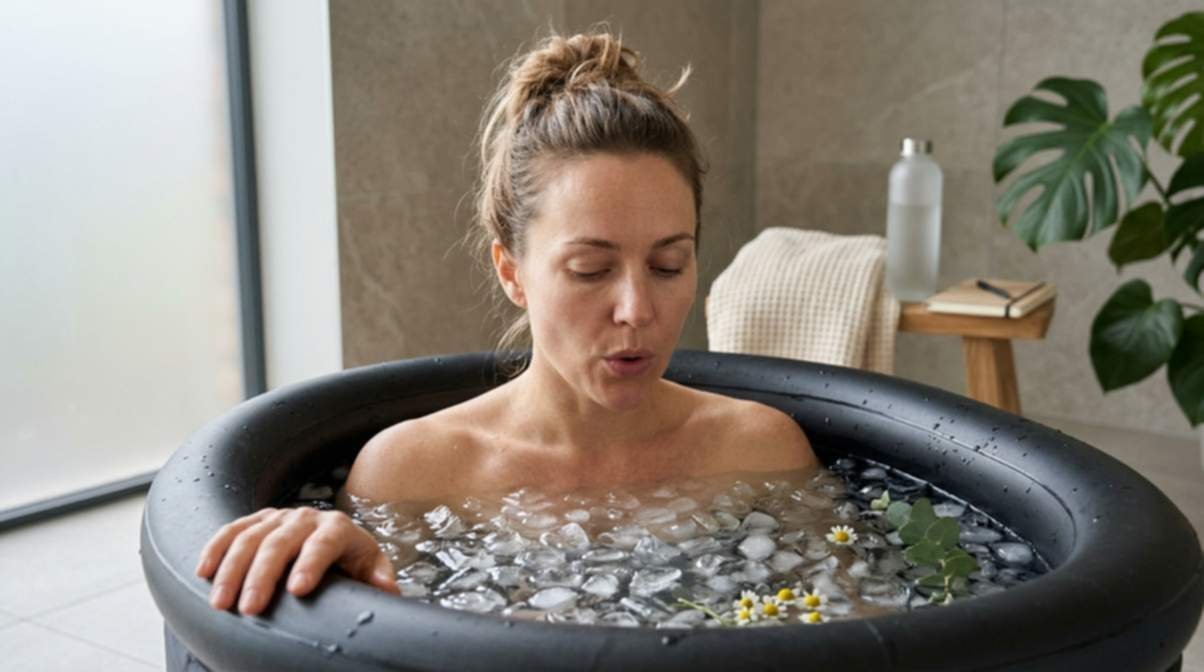
KEY TAKEAWAY: For beginners, the safest ice bath breathing technique is simple: breathe slowly before entry, expect the first 30-90 seconds to feel messy, then use a longer exhale than inhale until your breathing settles. Start at 12-15°C for 1-2 minutes, never hold your breath in the water, and never plunge alone.
The first breath in an ice bath is rarely elegant. Your ribs tighten. Your shoulders lift. Your mouth opens before you choose it. For a few seconds, the cold feels louder than your thoughts.
That reaction is not weakness. It is cold shock. Royal Life Saving Society Australia warns that cold water immersion can trigger hyperventilation, increased heart rate, increased blood pressure, gasping, panic and drowning risk, especially when breathing control is lost. That is why breathing matters: not because it makes you superhuman, but because it gives you one safe job while your body adjusts.
This guide gives you a beginner-safe protocol for breathing before, during and after an ice bath. It also draws a hard line around what not to do: no breath-holds, no forced hyperventilation and no head dunking while you are learning. If you are still choosing a tub, start with our comparison of the best ice baths in Australia. If you want the broader science first, read our guide to whether ice baths are good for you.
Breathing is only one part of safe cold exposure. Your temperature, duration and exit plan matter just as much. For timing by water temperature, see our how long in an ice bath guide.
SAFETY WARNING: Cold water immersion is not risk-free. Beginners should start around 12-15°C for 1-2 minutes, keep the head and neck out of the water, enter gradually, and have another person present. Avoid ice baths unless medically cleared if you are pregnant, over 50, have cardiovascular disease, uncontrolled blood pressure, Raynaud’s disease, cold urticaria, fainting history, serious illness, open wounds, or take medications that affect blood pressure or awareness. Royal Life Saving Society Australia lists pregnancy, chronic or serious illness, heart problems, circulatory issues, high blood pressure, autoimmune disorders and increased sensitivity to cold as elevated-risk situations.
| Stage | Beginner breathing cue | Use this count | Avoid this |
| Before entry | Stand beside the bath and practise quiet belly breathing. | Inhale 3-4 seconds, exhale 6-8 seconds for 60-90 seconds. | Fast breathing, breath-holds, psyching yourself up. |
| Step in | Enter slowly and keep your face above water. | One slow exhale as each foot goes in. | Jumping in, dunking your head, trying to “win” the shock. |
| First 30-90 seconds | Let the inhale happen, then make the exhale longer. | Inhale 2-4 seconds, exhale 4-8 seconds. | Holding your breath or forcing nose-only breathing. |
| After breathing settles | Use diaphragmatic breathing or a soft 4:6 pattern. | Inhale 4, exhale 6. Drop the count if air hunger rises. | Rigid counts that make you panic. |
| Exit | Breathe normally, stand slowly and warm up gently. | Three to five slow breaths before walking away. | Hot shower straight away if dizzy, rushing, staying in while shivering hard. |
What happens to your breathing in cold water
KEY TAKEAWAY: The first gasp is an involuntary cold shock response, not a mindset problem. Your first goal is not perfect calm; it is staying safe, keeping your face clear of the water and making each exhale slightly longer than the inhale.
Cold water hits the skin and your nervous system fires a protective alarm. The classic cold shock pattern is gasping, rapid breathing, elevated heart rate and a blood pressure spike. In a review of the initial responses to cold-water immersion, Tipton concluded that cold shock can incapacitate people before general hypothermia develops.
This is why “just relax” is poor advice. A beginner’s breathing may be choppy for the first 30 seconds even if they are doing everything right. A better cue is: keep the mouth above water, soften your shoulders, and extend the exhale one breath at a time.
Staged entry helps. In a 1989 study, Hayward and French tested a two-stage entry – waist immersion for 30 seconds before neck-level immersion – and found this behavioural technique reduced the hyperventilation response compared with non-staged immersion. In a home tub, that means step in, pause, sit lower only when your breathing is workable, and do not rush to collarbone depth.
Your body can adapt with repeated exposure. A 2024 systematic review and meta-analysis by Barwood and colleagues found that cold shock variables such as heart rate, respiratory frequency and minute ventilation habituated after repeated cold water immersion, with changes seen after about four immersions in some studies. That does not make the first plunge harmless. It means beginners should treat the first few sessions as skill practice, not a toughness test.
The safest beginner protocol: breathe before, exhale during, reset after
KEY TAKEAWAY: Use one protocol for your first month: 60-90 seconds of slow breathing before entry, long-exhale breathing through the first cold shock phase, and a slow exit with gentle rewarming. Keep sessions short enough that you leave while still in control.
Step 1: before entry, set the rhythm
Stand beside the tub. Put one hand on your belly and one hand on your ribs. Inhale gently through the nose for 3-4 seconds. Exhale through the mouth for 6-8 seconds, like fogging a mirror without force. Do that for 60-90 seconds.
This is not magic. Slow voluntary breathing is one of the few techniques you can practise before the cold arrives. A 2022 systematic review and meta-analysis by Laborde and colleagues found that voluntary slow breathing increased vagally mediated heart rate variability during sessions, immediately after sessions and after multi-session interventions. In plain English: slow breathing can shift the system towards a calmer state, which is useful before a cold shock.
Step 2: enter gradually and let the first inhale happen
When your first foot enters the water, exhale. When the second foot enters, exhale again. Sit down in stages. Keep your face out of the water. If the inhale becomes sharp, let it happen – then put all your attention on the next exhale.
The key is not suppressing the gasp. It is not letting the gasp turn into a panic loop. For most beginners, a simple count works: inhale for 2-4 seconds, exhale for 4-8 seconds. If 8 seconds feels forced, use 4. If 4 feels forced, use 3. Comfort beats ambition.
Step 3: settle into a repeatable pattern
After the first 30-90 seconds, many people feel the water become less chaotic. That is the time to use a steadier ratio, such as inhale 4, exhale 6. Keep the jaw soft. Drop the shoulders. Pick one still point to look at.
If you cannot get control within the first minute, get out. That is a successful safety decision, not a failed session. Try warmer water next time or use a cold shower progression before returning to full immersion.
Step 4: exit before your breathing falls apart
For your first sessions, 1-2 minutes is enough. Cleveland Clinic advises beginners to start around one to two minutes and build gradually, while also warning about hyperventilation, cardiovascular stress, hypothermia, numbness and loss of motor control during cold plunges. Cleveland Clinic also recommends checking with a doctor first if medical conditions are present.
Step out slowly. Take three to five normal breaths. Put on warm clothing. Do light movement. Do not sprint to a hot shower if you feel dizzy or wobbly.
Beginner breathing techniques that actually belong near an ice bath
KEY TAKEAWAY: The best beginner techniques are low-risk, low-drama and easy to abandon if they make you uncomfortable. Extended exhale and diaphragmatic breathing are the default; box breathing is mostly for pre-entry; breath-hold methods stay out of the water.
Technique 1: extended exhale breathing
This is the main in-water technique. Breathe in gently for 2-4 seconds. Breathe out for 4-8 seconds. Use pursed lips if it helps. Keep the exhale smooth, not strained.
Use it when: the water first hits, your breathing speeds up, or you feel the urge to tense. Stop or shorten the count if you feel air hunger, tingling, dizziness or panic.
Technique 2: diaphragmatic breathing
Diaphragmatic breathing means breathing low into the belly instead of high into the chest. Practise it on land first: one hand on the chest, one hand on the belly. The belly hand should move more than the chest hand.
Use it when: you are waiting beside the bath, sitting in the first minute, or recovering afterwards. If your belly cannot move much in the cold, do not force it. Return to the long exhale.
Technique 3: box breathing before entry
Box breathing uses a simple square: inhale, hold, exhale, hold. For beginners around water, keep this mostly on land before entry and keep holds short. A gentle 3-3-3-3 or 4-4-4-4 rhythm can give the brain a task before the cold begins.
Use it when: you are anxious before stepping in. Avoid it in the water if the holds create air hunger or panic. In cold water, breathing should stay available, not locked down.
Technique 4: the physiological sigh as a reset
A physiological sigh is a double inhale followed by a long exhale: inhale, top up with a second small inhale, then exhale slowly. Use one or two if breathing becomes choppy. Then return to slow belly breathing or extended exhale.
Use it when: you need a quick reset. Do not turn it into repeated hyperventilation. If you feel dizzy, exit.
| Technique | Best use | Beginner count | In-water safety note |
| Extended exhale | Default technique during cold shock. | 2-4 in, 4-8 out. | Safe when unforced; shorten if air hunger rises. |
| Diaphragmatic breathing | Before entry, during settling, after exit. | 3-4 in, 6 out. | Good anchor, but do not force belly movement. |
| Box breathing | Pre-entry focus. | 3-3-3-3 or 4-4-4-4. | Avoid holds in water if panicky or breathless. |
| Physiological sigh | Short reset when breathing is choppy. | Double inhale, long exhale. | Use 1-2 reps only, then return to slow breathing. |
| Wim Hof-style hyperventilation | Land-only breathwork, not required for beginners. | Not recommended in or near water. | Never do breath holds or hyperventilation in the bath. |
4. What not to do: the breathwork advice beginners should ignore
KEY TAKEAWAY: Do not combine water, cold shock, hyperventilation and breath-holds. That mix can cause dizziness, loss of consciousness and drowning risk. If a method includes intense breathing or retention, keep it on land, seated or lying down, away from water.
The biggest mistake in ice bath breathing content is treating every breathwork method as interchangeable. They are not. A slow exhale pattern in the bath is not the same as hyperventilating and holding your breath.
The official Wim Hof Method terms warn users to never conduct WHM-related activities where losing consciousness is extremely dangerous, including in water. Wim Hof Method lists water and driving as examples of settings where loss of consciousness is dangerous.
There is a research base around the Wim Hof Method, including a small 2014 PNAS trial by Kox and colleagues showing that trained participants influenced sympathetic activity and immune responses during an endotoxin experiment. That does not make breath-holds in an ice bath safe. It also does not mean beginners need advanced breathwork to get the basic benefits of cold exposure.
Hard no list
- Do not hold your breath in the bath.
- Do not do 30-40 fast breaths in the bath.
- Do not dunk your head while learning.
- Do not compete for longest time under cold stress.
- Do not stay in if you feel chest tightness, dizziness, confusion, numbness or loss of motor control.
- Do not plunge alone, especially during your first month.
5. What the research supports – and what it does not
KEY TAKEAWAY: Cold water immersion has better evidence for reducing soreness than for broad wellness claims. Breathing techniques can help you manage the cold shock response, but they do not remove the risks of cold exposure.
For recovery, the most consistent evidence is around muscle soreness. Machado and colleagues reviewed nine randomised controlled trials and found cold water immersion was slightly better than passive recovery for soreness, with the best results around 11-15°C for 11-15 minutes. Machado et al. also noted study quality limitations. More recently, Wang et al. analysed 55 RCTs and reported that 10-15 minutes at 11-15°C was best for delayed onset muscle soreness, while 10-15 minutes at 5-10°C performed best for some biochemical and jump outcomes.
That is not a beginner prescription. A beginner who is learning breathing control does not need 10-15 minutes. They need a safe exposure they can repeat without panic. For most first-timers, that means warmer water and a shorter session.
For general wellbeing, the claims are more mixed. A 2025 PLOS One systematic review from UniSA by Cain and colleagues included 11 studies and 3,177 participants. It found significant stress reduction at 12 hours post-CWI, but no immediate stress reduction and no clear immediate immune boost. The review also found an acute inflammatory response immediately and one hour after cold water immersion.
For muscle growth goals, timing matters. Roberts et al. found that post-exercise cold water immersion attenuated acute anabolic signalling and long-term strength training adaptations in men, and Peake et al. reported effects on inflammation and cell stress responses after resistance exercise. If your main goal is hypertrophy, do not treat an immediate post-lifting plunge as automatically helpful.
The honest takeaway: breathing can make the plunge safer and more tolerable, but it does not turn cold exposure into a cure-all. For inflammation claims, read our cold plunge inflammation guide.
6. Australian-specific setup: temperature, climate and supervision
KEY TAKEAWAY: In Australia, “cold” depends on season and city. A Melbourne winter tap-water bath can already feel like a true cold plunge, while northern summer tap water may be closer to a cool bath. Measure the water, not your ego.
Do not guess the temperature. Use a floating thermometer or a chiller display you trust. In southern Australia, winter tap water can be cold enough for a beginner session without adding much ice. In Brisbane, Darwin or Perth summer conditions, you may need a chiller or ice if the goal is true cold water immersion. That is one reason the “best” setup differs by climate, which we account for in our Australian ice bath comparison.
Home ice baths also need basic safety planning: non-slip flooring, easy exit, a dry towel within reach, warm clothing ready, and someone nearby. Open water adds extra hazards – currents, waves, distance from help, marine life and unpredictable temperature. This beginner breathing guide is for controlled tubs, not solo ocean plunges.
If you are pregnant or considering cold exposure during pregnancy, read our cold plunge while pregnant guide and speak with your GP or obstetrician. If you are chasing hormone claims, do not. Our testosterone guide covers why cold plunges are not a testosterone shortcut.
Frequently Asked Questions
How should beginners breathe in an ice bath?
Beginners should breathe slowly before entry, then focus on a longer exhale than inhale during the first 30-90 seconds in the water. A simple pattern is inhale for 2-4 seconds and exhale for 4-8 seconds, shortening the count if it feels forced.
Why can’t I breathe when I get into an ice bath?
You feel like you can’t breathe because cold water triggers an involuntary cold shock response. The response can include gasping, rapid breathing, elevated heart rate and a blood pressure spike, so your job is to stay upright, keep your face clear and extend the exhale.
Should you hold your breath in an ice bath?
No, beginners should not hold their breath in an ice bath. Breath-holds can increase panic and, if combined with dizziness or loss of consciousness, create a drowning risk.
Is Wim Hof breathing safe before an ice bath?
Wim Hof-style breathing should not be practised in or near water. If someone chooses to practise intense breathwork, it should be done seated or lying down on land, away from the bath, and it is not necessary for beginner cold plunging.
What is the best breathing technique for a cold plunge?
The best beginner cold plunge breathing technique is extended exhale breathing. It is simple, scalable and less risky than breath-hold methods: inhale gently, then make the exhale longer and slower.
How long should a beginner stay in an ice bath?
Most beginners should start with 1-2 minutes at around 12-15°C, then build gradually only if breathing stays controlled. For more detailed timing by temperature and goal, use IceBathLab’s duration guide. See how long in an ice bath for temperature-specific guidance.
Should I breathe through my nose or mouth in an ice bath?
Breathe through your nose if it feels calm and easy, but use your mouth if the cold makes nasal breathing feel restrictive. During the first minute, a mouth exhale through pursed lips is often easier and safer than forcing nose-only breathing.
What should I do if I panic in an ice bath?
If you panic in an ice bath, get out calmly and immediately. Do not stay in to prove a point. Next time, use warmer water, a shorter duration, staged entry and another person close by.
Can breathing techniques stop cold shock?
Breathing techniques can help you manage cold shock, but they do not stop it completely. Repeated safe exposure may reduce the intensity over time, but beginners should still expect the first 30-90 seconds to feel intense.
Should beginners dunk their head in an ice bath?
No, beginners should keep the head and neck out of the water. Royal Life Saving Society Australia specifically advises keeping the neck and head out in cold plunge pools to reduce risk.
What should I do after getting out of an ice bath?
After getting out, breathe normally, dry off, dress warmly and use gentle movement to rewarm. Avoid rushing, driving immediately while shaky, or taking a very hot shower if you feel dizzy.
Harvard Health Publishing. Cold plunges: Healthy or harmful for your heart? 2025.
Cleveland Clinic. The Benefits and Risks of Cold Plunges. 2024.
Mayo Clinic Health System. Can taking a cold plunge after your workout be beneficial? 2024.
Wim Hof Method. Terms and Conditions – safety advice on where not to conduct WHM-related activities.
Medical disclaimer: This guide is for general informational purposes only and is not medical advice. Cold water immersion can be dangerous. Speak with your GP or qualified health professional before starting if you have any health condition, are pregnant, are over 50, take medication, or are unsure whether cold exposure is safe for you.
