
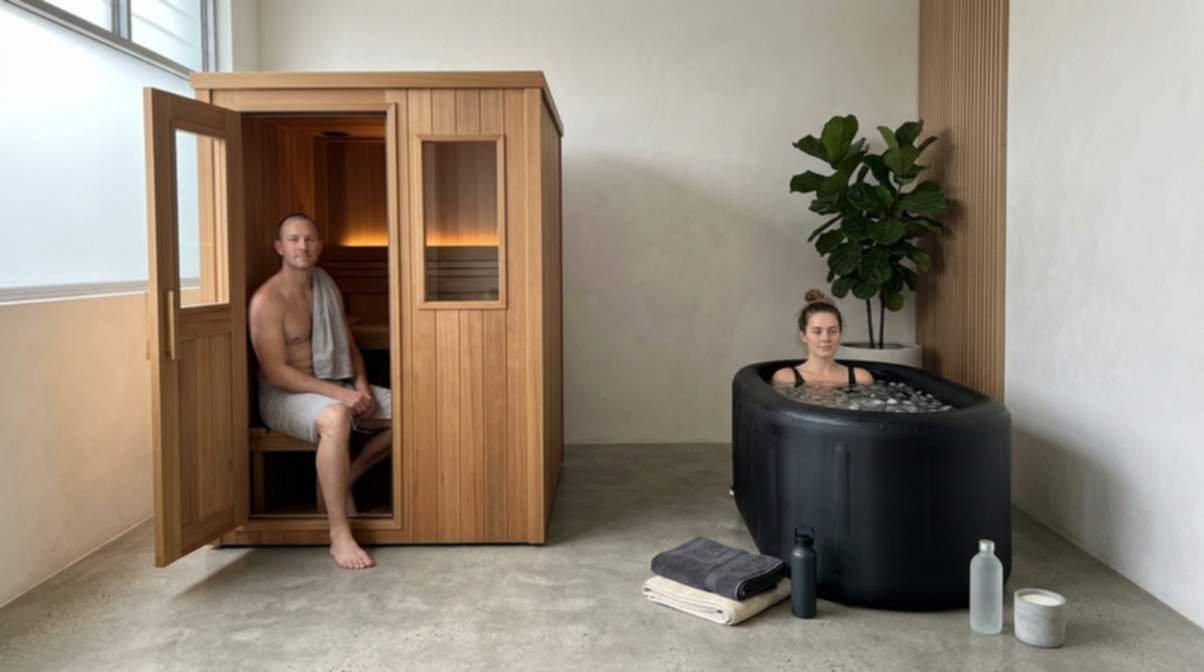
Cold plunge and sauna are different therapies, not interchangeable ones. Sauna has the stronger long-term evidence — the Finnish Kuopio cohort showed 4–7 sauna sessions per week was linked to a 40–63% lower risk of cardiac and all-cause mortality over 20 years. Cold plunge has stronger short-term evidence for mood, alertness, and recovery from acute soreness. Mechanisms are opposite: sauna dilates blood vessels and raises heart rate; cold plunge constricts vessels and triggers a sympathetic surge. For most people the answer isn’t “which one” — it’s contrast therapy: typically 15–20 min sauna at 80–100°C, then 2–5 min cold plunge at 10–15°C, repeated 1–3 cycles.
Most articles comparing cold plunge vs sauna treat them as alternatives — pick one. That framing doesn’t fit the evidence. Cold plunge and sauna are different tools with different mechanisms, different evidence bases, and different roles in a wellness routine. They’re not competing products; they’re complementary ones.
There is one fair comparison worth drawing, though: the long-term outcome evidence. Sauna has it, in volume, going back decades. The Finnish Kuopio cohort tracked 2,315 middle-aged men for over 20 years and found a strong dose-response relationship between sauna frequency and reduced risk of sudden cardiac death, cardiovascular mortality and all-cause mortality. Cold plunge has good short-term data on mood, recovery, and stress markers but nothing close to that 20-year mortality dataset. cold plunge vs ice bath
So this guide does two things. First, it compares cold plunge and sauna honestly across the benefits people actually care about recovery, mood, cardiovascular health, sleep, longevity. Second, it lays out how to use both together (contrast therapy), with Australian costs, sequencing protocols, and the trade-offs that matter when you’re actually buying gear. If you want our tested model rankings for cold plunges specifically, see our best ice baths in Australia guide. And if you’re still working out which kind of cold tub to start with, our cold plunge vs ice bath comparison covers the chiller-vs-DIY question first.
Safety First
Both modalities are stressors. Both are well-tolerated by most healthy adults; both can cause harm with the wrong dose or the wrong person.
Cold plunge safety: Start at 12–15°C, never plunge alone in your first month, never after alcohol. The Royal Life Saving Society Australia reports cold-water drowning is overwhelmingly an issue of unexpected immersion in water under 15°C cold shock response can incapacitate within seconds.
Sauna safety: Hydrate before and after. Limit single sessions to 15–20 minutes at 80–100°C. Don’t use sauna under the influence of alcohol the Kuopio data showed alcohol with sauna was the most common factor in the rare sudden deaths recorded. Don’t sauna with active illness, fever, dehydration, or in late pregnancy without medical clearance. cold plunging reduce inflammation cold shower vs cold plunge cryotherapy vs cold plunge
For both: Speak to your GP first if you’re over 50, pregnant, or have any cardiovascular condition (high blood pressure, arrhythmia, history of heart attack), Raynaud’s, or an active autoimmune issue. The combination of sauna then cold plunge produces sharper blood pressure swings than either alone worth flagging if you’re on antihypertensive medication.
Cold Plunge vs Sauna: At a Glance
Quick comparison of the two modalities. We’ll get into each row in detail below.
| Factor | Cold Plunge | Sauna (Traditional Finnish) |
| Mechanism | Vasoconstriction, sympathetic surge | Vasodilation, heart-rate elevation |
| Operating range | 3–15°C water immersion | 70–100°C dry heat (10–20% humidity) |
| Session length | 2–10 min | 10–20 min |
| Best-evidenced benefit | Acute mood lift, soreness recovery | Long-term cardiovascular & mortality |
| Mortality / longevity data | Limited mostly short-term studies | Strong 20+ year Finnish cohorts |
| Strongest acute effect | Norepinephrine surge, dopamine, alertness | Heart rate elevation similar to mod. exercise |
| AUD upfront cost | $2,500–12,000+ (chiller plunge) | $3,500–16,000+ (traditional or infrared) |
| Energy use | Cooling 200–500W cycling | Heating 4–9kW per session |
| Daily use safe? | Yes, with appropriate dosing | Yes Finnish data based on 4–7/week |
How Cold Plunge Works (Mechanism & Benefits)
KEY TAKEAWAY: Cold plunge constricts blood vessels and triggers a sympathetic nervous system surge a fast, sharp shock. Strong short-term effects on mood, alertness, recovery from acute muscle soreness. Limited long-term outcome data.
Cold water immersion drops skin and core temperature rapidly. The body responds with peripheral vasoconstriction (blood pulled away from the skin to keep the core warm), shivering thermogenesis (muscle activity to generate heat), and a sympathetic nervous system surge a sharp release of norepinephrine and dopamine.
The neurochemistry alone is striking. The often-cited noradrenaline figures from Šrámek et al. (2000) 530% increase in noradrenaline, 250% in dopamine came from a 1-hour immersion in 14°C water, not a typical 5-minute plunge. Even a brief exposure produces a meaningful catecholamine spike, which is why the alertness and mood lift after a cold plunge feels so distinct.
What the evidence supports for cold plunge:
- Reduced delayed-onset muscle soreness strongly supported. The Machado et al. (2016) meta-analysis of 9 RCTs found 11–15°C for 11–15 min was the optimal dose for reducing soreness 24–72 hours post-exercise.
- Acute mood and alertness boost strongly supported. Norepinephrine release drives the focus and energy effect.
- Stress and sleep markers the Cain et al. (2025) PLOS One meta-analysis out of UniSA (11 studies, 3,177 participants) found stress markers significantly reduced 12 hours post-immersion.
- Brown fat activation and modest metabolic effects supported, mild magnitude.
- Long-term cardiovascular outcomes not yet established. There are physiological reasons cold may help (improved insulin sensitivity, reduced visceral fat over time), but no 20-year mortality cohort like the sauna data.
The catch: cold plunge interferes with strength-training adaptation if used too soon after a hard lift. We cover this in our how long in an ice bath duration guide short version, wait 4–6 hours after strength training if hypertrophy is the goal.
How Sauna Works (Mechanism & Benefits)
KEY TAKEAWAY: Sauna dilates blood vessels and elevates heart rate to levels comparable with moderate exercise. The strongest evidence is long-term: regular sauna use is associated with substantial reductions in cardiovascular and all-cause mortality, hypertension, and dementia risk in 20-year cohort data.
Sauna heats your skin to 40–50°C and your core temperature to 38–39°C. The body responds with peripheral vasodilation (more blood to skin to dump heat), increased heart rate (often to 100–150 bpm similar to moderate aerobic exercise), and heavy sweating to lose heat by evaporation.
Importantly, the bulk of the long-term evidence is on traditional Finnish saunas hot, dry, 80–100°C, low humidity. Infrared saunas operate differently (lower temperatures, 50–60°C, infrared radiation directly heating the body rather than the air). The infrared evidence base is much smaller and shorter-term. Treat the two as related but not interchangeable when interpreting research claims.
What the evidence supports for traditional sauna:
- Cardiovascular mortality reduction the headline finding. The Laukkanen et al. (2015) JAMA Internal Medicine study tracked 2,315 Finnish men for a median 20.7 years. Compared with one sauna per week, men using the sauna 4–7 times per week had a 63% lower risk of sudden cardiac death, 48% lower fatal coronary heart disease, 50% lower fatal cardiovascular disease, and 40% lower all-cause mortality. Session length mattered too sessions over 19 minutes had a 52% lower SCD risk vs sessions under 11 minutes.
- Reduced hypertension and improved arterial compliance multiple Finnish cohort and short-term RCT data. Heat exposure improves vascular function similarly to aerobic exercise.
- Reduced dementia and Alzheimer’s risk the same Kuopio cohort showed 4–7 saunas/week vs 1/week was associated with 66% reduced dementia risk and 65% reduced Alzheimer’s risk over 20+ years. Association, not proven causation.
- Reduced inflammatory markers and improved endothelial function multiple short-term studies summarised in Laukkanen et al.’s 2018 review in Mayo Clinic Proceedings.
- Improved sleep quality most studies favour sauna for sleep onset and depth, particularly when used in the afternoon or early evening (not immediately before bed).
- Mood and stress acute parasympathetic boost post-session; some emerging evidence for depression symptom improvement.
Important caveat on the Kuopio data: These are observational findings. People who sauna 4–7 times a week in Finland may differ in important ways from people who don’t fitter, more affluent, more socially connected. The studies adjusted for many confounders and the dose-response curve is consistent, but observational evidence can’t fully establish causation. The size and consistency of the effect, replicated across multiple endpoints, is why these findings hold weight but the appropriate framing is “associated with” rather than “caused by.”
Cold Plunge vs Sauna: Benefits Head-to-Head
KEY TAKEAWAY: Cold plunge wins on acute recovery, mood lift, and metabolic markers. Sauna wins on long-term cardiovascular outcomes, sleep, and dementia risk. Most other benefits are roughly equal at appropriate doses.
| Benefit | Cold Plunge | Sauna | Winner |
| Reduced muscle soreness (DOMS) | Strong evidence 11–15°C, 11–15 min | Some evidence, smaller effect | Cold plunge |
| Acute mood / alertness | Strong norepinephrine 200–500% | Mild post-session calm | Cold plunge |
| Long-term cardiovascular health | Limited long-term data | Strong 40–63% mortality reduction | Sauna |
| Blood pressure (chronic) | Small / mixed effects | Reduced; helps in hypertension | Sauna |
| Dementia / Alzheimer’s risk | No solid data | 66% reduced risk in Kuopio cohort | Sauna |
| Stress reduction (acute) | Cortisol drops 12 hr post-immersion | Reduces sympathetic tone | Roughly equal |
| Sleep quality | Mixed timing matters | Improved in most studies | Sauna |
| Brown fat activation / metabolic | Strong evidence | Modest | Cold plunge |
| Strength training interference | Yes wait 4–6 hr post-lift | No interference | Sauna |
| Skin / circulation feel | Tightens; alertness boost | Relaxes; sweat clears pores | Personal preference |
The biggest single difference: time horizon. Cold plunge benefits show up in days to weeks (better mood, less soreness, better sleep that night). Sauna benefits show up across both timescales the same-day relaxation, plus accumulating cardiovascular and cognitive protection over years.
If you want a plain-language summary: cold plunge is closer to a strong cup of coffee plus an ice pack fast, intense, useful, short-acting. Sauna is closer to a 30-minute cardio session done in a warm room less acute punch, more long-term outcome leverage.
Should You Use Both? Contrast Therapy Explained
KEY TAKEAWAY: For most people, yes. Contrast therapy alternating sauna and cold plunge combines the long-term cardiovascular benefits of sauna with the acute mood and recovery benefits of cold. The standard sequence is sauna first (15–20 min), then cold plunge (2–5 min), repeated 1–3 cycles. Evidence for the combination specifically is thinner than for either modality alone, but the underlying mechanisms add up.
The traditional Nordic cycle hot sauna, cold immersion, repeat has been used in Scandinavia for centuries. Modern science doesn’t have head-to-head data showing contrast therapy is superior to sauna or cold plunge alone for most outcomes, but it does show that the two modalities work via complementary, not competing, mechanisms. Sauna dilates; cold constricts. Sauna parasympathetic-shifts; cold sympathetic-spikes. The vascular “pump” effect of switching between the two is plausible and well-described, even if not fully proven for specific health outcomes.
Standard contrast therapy protocol
- Sauna: 15–20 minutes at 80–100°C (traditional) or 50–60°C (infrared)
- Cold plunge: 2–5 minutes at 10–15°C
- Cycles: 1–3 rounds, ending in cold for an alertness boost or warm for a calm finish
- Frequency: 2–4 times per week is a sensible target for most people; daily is fine if you’re recovered and well-fuelled
- Time of day: Morning or afternoon. Avoid finishing on cold within 90–120 min of bedtime if it interferes with sleep onset
Sauna first or cold plunge first?
Sauna first is the standard recommendation, and it’s right for most goals. Heat first relaxes muscles, prepares the cardiovascular system gradually, and the cold finish leverages the contrast for the strongest sympathetic surge.
Cold first has a niche use case: pre-workout (cold to wake up the nervous system, then sauna later for recovery), or if you specifically want a calm finish (sauna is parasympathetic-leaning at the end). For everything else hot first, cold last.
What to skip if hypertrophy is the goal
If you’re strength training for muscle growth, the cold plunge step can blunt your adaptation if you do it within 4–6 hours of the session. Sauna doesn’t have the same effect there’s actually some evidence sauna may support hypertrophy via heat shock proteins. So on heavy strength days, sauna alone (no cold finish) is the smarter call. Cold plunge separately, the next morning.
Cost and Practical Comparison (AUD)
KEY TAKEAWAY: Saunas cost more upfront and run hotter on electricity. Cold plunges cost less to run but more in time if you’re using bagged ice. A combined home setup typically lands around AU$8,000–20,000+. Public access (gyms, wellness studios) is often the smarter starting point if you’re unsure how much you’ll use either.
| Setup type | Upfront (AUD) | Ongoing (AUD/yr) | Notes |
| DIY ice bath + bagged ice | $50–1,500 | $200–600 | Cheapest entry; time-intensive |
| Chiller cold plunge | $2,500–12,000+ | $200–500 | Set-and-forget convenience |
| Barrel / infrared sauna (1–2 person) | $3,500–7,000 | $300–800 | Lower running temp, electric |
| Traditional Finnish sauna (outdoor) | $6,000–16,000+ | $400–900 | Wood or electric; higher running cost |
| Combo (chiller plunge + sauna) | $8,000–20,000+ | $700–1,500 | Full contrast therapy at home |
A traditional sauna draws 4–9kW while heating, then less to maintain. A typical 60-minute heat-and-use session will cost AU$0.80–2 in electricity at current Australian rates. A chiller cold plunge cycles 200–500W during cooling and idles low expect AU$15–60 a month. Saunas are the more energy-hungry of the two by a clear margin.
Footprint matters too. A barrel sauna for two people takes roughly 2m × 1.5m outdoors. A traditional cabin sauna can be 2–4m². A single-person cold plunge is ~1.5m × 0.8m. A combined home setup typically wants a covered outdoor space of at least 4–6m².
Australian-Specific Considerations
- Climate-driven sauna desire: Sauna gets used more in cooler states (Vic, Tas, ACT) and tapers off in tropical climates. If you’re in Darwin or Cairns, the contrast therapy appeal of sauna often only really lands in winter. Cold plunge gets used year-round.
- Power supply: Most home electric saunas need 15–20A 240V circuits often a dedicated electrical run from the switchboard. Allow AU$300–1,500 for sparkie work depending on placement. Gas/wood-fired saunas avoid electrical complexity but raise installation, certification and bushfire-zone considerations.
- Bushfire and structural rules: Outdoor sauna cabins in BAL-rated bushfire zones need to comply with local council and BAL construction requirements. Check before installing.
- Public access pricing: Wellness studios, contrast therapy gyms and recovery centres in Sydney, Melbourne and Brisbane typically charge AU$30–60 per session for combined sauna + cold plunge access. Memberships AU$100–250/month. Worth using as a 3-month trial before spending AU$10,000+ on home gear.
- Open-water alternative for cold: Winter sea temps along the southern coast (Vic, Tas, southern NSW) sit around 12–15°C free, in the therapeutic range, and you don’t need a tub. Doesn’t replace sauna, but worth knowing if you’re leaning cold-only.
Cold Plunge or Sauna: Which Should You Choose?
KEY TAKEAWAY: If you can only pick one and you care about long-term cardiovascular and cognitive health, lean sauna. If you care about acute recovery, mood, and post-workout soreness, lean cold plunge. If budget allows, get both and run contrast therapy 2–4 times a week.
Choose cold plunge if:
- Your priority is post-workout recovery from acute soreness or athletic competition.
- You want a fast morning energy and focus boost.
- You value stress reduction and improved mood markers.
- You’re budget-constrained and want the cheaper modality (DIY ice bath at AU$50–1,500 vs sauna at AU$3,500+).
- You live in a hot climate where sitting in 90°C for 20 minutes feels redundant.
Choose sauna if:
- Your priority is long-term cardiovascular and cognitive health.
- You’re strength training seriously and don’t want post-lift cold interference.
- You sleep poorly and want a recovery tool that supports sleep onset.
- You have hypertension under medical management (and have GP clearance to use heat).
- You want a relaxation-leaning practice rather than an alertness-leaning one.
Choose both (contrast therapy) if:
- You can budget the combined upfront cost (AU$8,000–20,000+ for a home setup, or AU$30–60 per visit at a wellness studio).
- You want the long-term outcome data of sauna plus the acute mood and recovery benefits of cold.
- You enjoy the ritual contrast therapy is one of the few wellness practices people consistently keep doing for years because the experience itself is rewarding.
If you’re unsure, use a wellness studio for three months before buying anything. You’ll know whether you actually use both modalities or default to one. The biggest mistake people make is buying a combined setup, then only ever using the cold plunge or only ever using the sauna.
What the Science Doesn’t Support
Common claims about cold plunge vs sauna that don’t hold up:
- “Sauna detoxes the body through sweat.” Largely false. Sweat is mostly water and salt. The liver and kidneys handle detoxification sweating contributes a negligible amount. Sauna has many real benefits; this isn’t one of them.
- “Infrared saunas give the same benefits as Finnish saunas.” Not established. Almost all the long-term cardiovascular and dementia data comes from traditional Finnish sauna use. Infrared has plausibility but lacks the 20-year cohort evidence.
- “Cold plunge is better than sauna for fat loss.” Both have modest effects on metabolic rate and brown fat activation. Neither is a meaningful weight loss tool on its own. Diet and resistance training move the needle far more.
- “You must always sauna first, then cold.” Mostly true for the strongest sympathetic surge and mood lift, but not absolute. Cold-first works for pre-workout activation or if you want a calm finish.
- “Contrast therapy clears lactic acid faster.” Overstated. Lactate clears within minutes regardless of modality. The mechanism behind contrast therapy’s recovery benefit is more about vascular pumping and parasympathetic rebound than lactate flushing.
- “Sauna lowers blood pressure for everyone.” True on average, but acute sauna use does temporarily raise blood pressure during the session. People with uncontrolled hypertension or heart failure should clear sauna use with their doctor first.
Frequently Asked Questions
Is cold plunge or sauna better for muscle recovery?
Cold plunge has the stronger evidence for acute soreness reduction (DOMS) at 11–15°C for 11–15 minutes (Machado et al. 2016). Sauna helps with general circulation and may support hypertrophy via heat shock proteins. For pure soreness, cold plunge wins. For overall training recovery without compromising muscle gains, sauna alone is safer post-lift.
Should I do sauna or cold plunge first?
Sauna first is the standard it relaxes muscles, prepares the cardiovascular system gradually, and the cold finish creates the strongest mood and alertness boost. Cold-first has a niche for pre-workout activation or when you want a calm sauna finish at the end.
How long should I cold plunge after a sauna?
2–5 minutes at 10–15°C is standard for contrast therapy. Beginners can start at 30–60 seconds. The cold session doesn’t need to be long; the sauna primes you for a more potent shock response, so even short cold exposure produces strong effects.
Is sauna or cold plunge better for cardiovascular health?
Sauna has the stronger long-term evidence. The Finnish Kuopio cohort showed regular sauna use (4–7 sessions per week) was associated with up to 50% lower fatal cardiovascular disease and 40% lower all-cause mortality over 20 years (Laukkanen et al. 2015). Cold plunge has plausible cardiovascular mechanisms but no comparable long-term outcome dataset.
Can I do sauna and cold plunge every day?
Yes for most healthy adults, with appropriate dosing. The Finnish data is built on 4–7 sauna sessions per week, so daily sauna is well-tolerated. Daily cold plunge is also generally fine. The main caveat: avoid stacking heavy training load + daily contrast therapy + low energy intake the chronic stress can tip you into under-recovery, particularly in women.
Does sauna burn more calories than cold plunge?
Sauna burns slightly more during the session (elevated heart rate, sweating costs energy roughly 100–300 kcal per session). Cold plunge burns less acutely but may activate more brown fat over time. Neither is a meaningful weight loss tool on its own the calorie numbers are small relative to a normal day’s expenditure.
What are the benefits of sauna vs cold plunge for sleep?
Sauna usually wins for sleep. Heat exposure 1–2 hours before bed supports the natural drop in core body temperature that helps sleep onset. Cold plunge timing matters more the alertness boost can interfere with sleep if you do it too close to bedtime. If using both, end on warm (or sauna) for evening sessions.
Is infrared sauna as good as a traditional Finnish sauna?
Probably not for the long-term cardiovascular and dementia outcomes. Almost all of the 20-year cohort data is on traditional Finnish saunas at 80–100°C. Infrared saunas operate at lower temperatures (50–60°C) with a different heating mechanism. Plausible benefits, much less long-term evidence.
How much does a home cold plunge and sauna setup cost in Australia?
A combined home setup typically lands at AU$8,000–20,000+ chiller cold plunge AU$2,500–12,000, plus barrel or cabin sauna AU$3,500–16,000+. Add electrical work (AU$300–1,500) and any structural or plumbing changes. Public wellness studios charge AU$30–60 per visit and are a smarter starting point if you’re not yet sure how often you’ll use either.
Does sauna or cold plunge raise testosterone?
Both have modest, mixed effects. No robust RCT shows either meaningfully raises baseline testosterone in healthy men. Sauna may have small acute effects via heat-shock pathways; cold plunge may indirectly support testosterone via reduced visceral fat over time. Treat any “testosterone boost” marketing claims with scepticism.
Can women do contrast therapy the same way as men?
Same equipment, slightly different dosing. Women generally benefit from shorter, slightly warmer cold plunges (14–15°C for 2–5 minutes) than men. Sauna protocols are largely the same. We cover sex-specific dosing in detail in our cold plunge for men vs women guide.
Is it safe to sauna and cold plunge with high blood pressure?
Speak to your GP first. Sauna acutely raises blood pressure during the session (then lowers it long-term). Cold plunge produces sharp short-term BP spikes via vasoconstriction. The combination produces larger BP swings than either alone. Many people with controlled hypertension use both safely with medical clearance but it’s not a DIY decision.
Sauna research
- Laukkanen T, Khan H, Zaccardi F, Laukkanen JA. Association between sauna bathing and fatal cardiovascular and all-cause mortality events. JAMA Internal Medicine, 2015; 175(4):542–548. DOI: 10.1001/jamainternmed.2014.8187
- Laukkanen T, Kunutsor S, Kauhanen J, Laukkanen JA. Sauna bathing is inversely associated with dementia and Alzheimer’s disease in middle-aged Finnish men. Age and Ageing, 2017; 46(2):245–249. DOI: 10.1093/ageing/afw212
- Laukkanen JA, Laukkanen T, Kunutsor SK. Cardiovascular and other health benefits of sauna bathing: a review of the evidence. Mayo Clinic Proceedings, 2018; 93(8):1111–1121. URL: Mayo Clinic Proceedings review
- Laukkanen T, Kunutsor SK, Khan H, et al. Sauna bathing is associated with reduced cardiovascular mortality and improves risk prediction in men and women: a prospective cohort study. BMC Medicine, 2018; 16(1):219. DOI: 10.1186/s12916-018-1198-0
Cold water immersion research
- Machado AF, Ferreira PH, Micheletti JK, et al. Can water temperature and immersion time influence the effect of cold water immersion on muscle soreness? A systematic review and meta-analysis. Sports Medicine, 2016; 46(4):503–514. DOI: 10.1007/s40279-015-0431-7
- Wang Y, et al. Impact of different doses of cold water immersion on recovery from acute exercise-induced muscle damage: a network meta-analysis. Frontiers in Physiology, 2025. DOI: 10.3389/fphys.2025.1525726
- Cain CC, et al. The effects of cold-water immersion on health and wellbeing: a systematic review and meta-analysis. PLOS One, 2025. DOI: 10.1371/journal.pone.0317615
- Šrámek P, Šimečková M, Janský L, Šavlíková J, Vybíral S. Human physiological responses to immersion into water of different temperatures. European Journal of Applied Physiology, 2000; 81(5):436–442. DOI: 10.1007/s004210050065 (Note: 1-hour immersion at 14°C — always state the duration when citing the noradrenaline figures)
Authority sources
- Royal Life Saving Society Australia — Cold water safety research and guidance.
- Cleveland Clinic — Benefits and Risks of Cold Plunges, 2024.
- Mayo Clinic Health System — Cold plunges after workouts, 2024.
Medical disclaimer: This article is for educational purposes only and does not constitute medical advice. Both cold water immersion and sauna are stressors and are not appropriate for everyone. Speak to your GP before starting either, particularly if you are pregnant, over 50, or have any cardiovascular, autoimmune or hormonal condition.
