
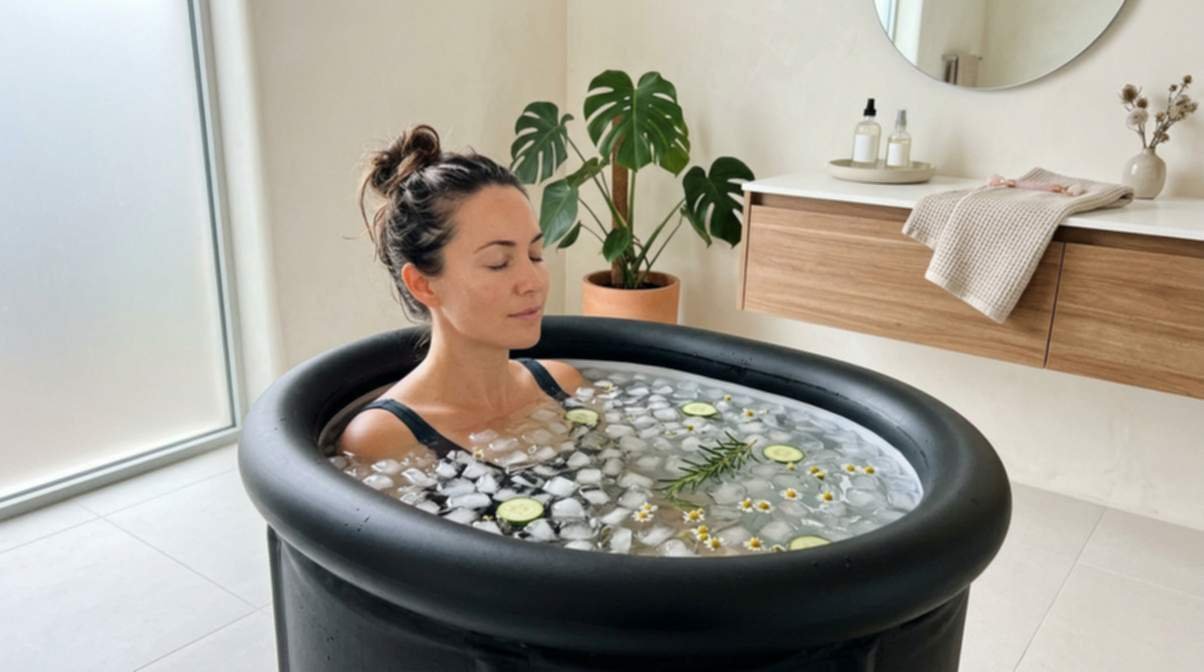
Somewhere between Bella Hadid dunking her face in a bowl of ice on TikTok and Kate Moss crediting an ice plunge for her glow, face icing stopped being a grandma hack and became a morning-routine staple. It’s now a genuine category: cold face plunges, ice globes, freezer-chilled jade rollers, silicone ice masks. The full-body cold plunge world collided with the skincare aisle and here we are.
The honest question — does a cold face plunge actually work — has two answers. Yes, for the short-term things the physiology can actually deliver. No, for most of the anti-aging and structural skin claims made around it. This guide separates those from each other, covers the same question for hair (where one of the most repeated beauty tips turns out to be unsupported), and explains how a cold plunge for the face differs from a full-body plunge — because they’re not the same intervention, even though they share the word “plunge.”
If you want the full-body science, start with our tested comparison of the best ice baths in Australia and our full science guide on whether ice baths are good for you. This page focuses on the beauty layer.
Key Takeaway: A cold face plunge works — but only for what dermatologists consistently agree it does: 10–30 seconds of face immersion in 10–15°C water temporarily de-puffs skin, reduces redness and tightens pores through vasoconstriction. It does not boost collagen, reverse wrinkles or permanently tighten skin. For hair, the popular “cold water closes the cuticle” claim has been directly disproven by TRI Princeton research — cold rinses produce no extra shine over warm ones. The face plunge and full-body cold plunge are physiologically different practices with different benefits, different risks and different use cases. cold plunging reduce inflammation
Before you start: who shouldn’t do this
Dermatology-informed safety notes: Skip face ice plunges if you have: rosacea, broken capillaries, eczema, active psoriasis, or very sensitive skin. The vasoconstriction-then-dilation cycle can worsen flushing and visible capillary damage. Dermatologists are broadly consistent on this. Don’t do it post-procedure: if you’ve recently had lasers, peels, filler, microneedling or cosmetic surgery, wait until your skin barrier has fully recovered. Never apply raw ice cubes: it can cause cold burns. Use chilled water in a bowl, or wrap ice in a thin cloth. Full-body cold plunge safety still applies: Royal Life Saving Society Australia, AUSactive and SPASA advise 10–15°C as a safe range for healthy adults, flag pregnancy, heart disease, circulatory issues, autoimmune conditions and Raynaud’s as elevated-risk categories, and say never plunge alone. risks of ice baths ideal ice bath temperature
The short answer in one table
Here’s where the beauty claims sit against the evidence — face plunge, body plunge, and hair, side by side.
| Claim | Does it work? | Best protocol | Evidence |
| De-puffs face and under-eye area | Yes, temporarily | Face plunge: 10–30 sec in 10–15°C water, or chilled tool | Strong (vasoconstriction — well-established clinical physiology) |
| Reduces redness, calms irritation acutely | Yes, temporarily | Face plunge or chilled compress | Strong (dermatologist-endorsed) |
| Tightens pores visibly | Short-term only | Face plunge 10–30 sec | Strong short-term; rebounds |
| Boosts collagen or reverses wrinkles | No | N/A | No clinical evidence |
| Permanently tightens facial skin | No | N/A | No clinical evidence |
| Closes the hair cuticle / adds shine | No (myth) | N/A | Directly disproven (TRI Princeton) |
| Reduces frizz | Partial (via pH/conditioner, not temperature) | Use acidic conditioner; avoid hot water | Mixed |
| Makes hair grow faster | No | N/A | No evidence |
| Reduces body-skin inflammation / improves glow (full-body plunge) | Brief post-plunge flush; no structural benefit | Full-body: 11–15°C × 10–15 min | Temporary only |
Cold plunge vs face plunge: why they’re not the same thing
Key Takeaway: A face plunge activates the mammalian dive reflex — cold water on the face triggers the trigeminal nerve, which activates the vagus nerve, slows the heart (bradycardia) and redirects blood to the core. A full-body cold plunge triggers a different response: cold shock, hyperventilation, sympathetic nervous system activation and a 530% noradrenaline spike. Same substance (cold water), different physiology, different applications. cold plunge vs ice bath
The face has more cold-sensitive nerve density than most of the body. When cold water contacts the area around your eyes, nose and forehead, branches of the trigeminal nerve fire and trigger a reflex cascade that aquatic mammals share with us and with diving birds. Divers Alert Network describes the mechanism: the trigeminal nerve signals the brain, the brain activates the vagus nerve, and within seconds your heart rate drops and peripheral blood flow narrows. This is the parasympathetic, “rest-and-digest” side of your nervous system switching on.
A full-body plunge without face submersion does something else. You get the cold shock response — involuntary gasping, hyperventilation, sharply raised heart rate and blood pressure for the first 1–4 minutes — as the sympathetic “fight-or-flight” system responds to skin cooling. The two responses can even pull in opposite directions: the dive reflex calms the heart, while peripheral cold-shock vasoconstriction makes it work harder.
| Face plunge | Full-body cold plunge | |
| Primary reflex | Mammalian dive reflex | Cold shock response |
| Nervous system | Parasympathetic (calming) | Sympathetic (activating) |
| Typical heart rate | Drops (bradycardia) | Rises sharply (first 1–4 min) |
| Main use case | De-puffing, calming, stress regulation, morning alertness | Muscle recovery, adaptation training, broader metabolic effects |
| Duration | 10–30 seconds for beauty; 5–10 sec for dive-reflex calming | 10–15 min at 11–15°C |
| Main risks | Broken capillaries, rosacea flare, frostbite if using raw ice | Cold shock, hypothermia, cardiac strain, drowning |
Practical upshot: if your goal is skincare, you want a face plunge — short, controlled, gentle. If your goal is muscle recovery or systemic cold adaptation, you want a full-body plunge with or without face submersion depending on what effect you’re chasing. Some people dunk the face during a full-body plunge specifically to pull the dive reflex in and calm the cold shock. That’s a sensible overlap but it’s still two different tools.
Does a cold face plunge work? What dermatologists actually say
Yes — for a narrow, short-lived set of effects. Every dermatologist quoted in the mainstream coverage of this trend describes more or less the same physiology, and the same limits on it.
1. De-puffing and reducing swelling
Dr Anetta Reszko, a board-certified New York dermatologist quoted by NBC Select, describes the mechanism plainly: submerging the face in ice water causes rapid constriction of blood vessels, which can temporarily reduce inflammation, puffiness and redness. It’s the same physiology behind putting a cold spoon on a tired eye or a cool pack on a bruise. Works, briefly, and rebounds when you rewarm.
2. Tightening pores (visually, not structurally)
Pores don’t have muscles. They don’t “open” or “close” on command. What cold does is reduce the swelling of the skin around each pore, which makes pores look smaller for a period of minutes to an hour or so. The effect is real enough for a before/after photo. It’s not a structural skin change.
3. Calming redness and irritation acutely
Cleveland Clinic’s guidance on facial icing sits here: for general puffiness and post-late-night recovery, keep the ice wrapped in a thin cloth, keep it moving, and moisturise after. For diagnosed inflammatory conditions — rosacea, eczema, broken capillaries, recent cosmetic procedures — their advice is to skip it entirely.
What the science doesn’t support (the anti-aging claims)
1. “Boosts collagen production”
This is one of the most repeated claims in beauty-blog content on cold plunging — and one of the clearest examples of where marketing has outpaced evidence. National Geographic asked multiple dermatologists to vet the claim; the response was consistent. Ice facials have not been validated in clinical studies, the effects are subjective, and there’s no reliable human trial showing that face immersion or facial icing increases collagen synthesis in the skin.
Collagen is produced by fibroblasts in the deeper dermal layer. The treatments that reliably stimulate new collagen — retinoids, microneedling, certain lasers, radiofrequency — do so by producing controlled injury that the skin repairs with new collagen. Surface-level cold exposure doesn’t penetrate to that layer and doesn’t create that stimulus.
2. “Reduces wrinkles and fine lines permanently”
West Dermatology puts it directly: cold plunges and ice baths don’t boost collagen or permanently tighten skin. What you can get is a short-term radiance boost as circulation rebounds after rewarming. That’s a temporary physiological response, not a structural skin change. For actual tightening, brightening or rejuvenation, clinical treatments are what deliver.
3. “Clears acne”
Cold can temporarily reduce the redness around an active breakout and blunt the inflammatory flare for an hour or two. It doesn’t treat acne. Acne is driven by excess sebum, follicular hyperkeratinisation and Cutibacterium acnes colonisation. Cold water addresses none of these. For a sustained anti-acne effect you need a treatment regimen — salicylic acid, benzoyl peroxide, retinoids, or prescription options for more stubborn presentations.
4. “Shrinks pores for good”
See above — pores are structural. The look of smaller pores is driven by reducing the swelling around them (short-term), reducing oil production inside them (medium-term, mostly with retinoids and niacinamide), and skin thickness in that area (longer-term). Cold water does the first of these, briefly.
Cold plunge for hair: the cuticle myth, gently debunked
Key Takeaway: The widely repeated claim that cold water “closes the hair cuticle” and adds shine is not supported by the research most often cited as its evidence base. TRI Princeton chemists directly tested this — rinsing hair above 37°C versus below 18°C — and found cold rinses produced no extra shine. Warm water rinses were actually slightly glossier. Hair is dead keratin with no muscles or active temperature response, unlike skin pores.
Walk into most hair salons and you’ll hear the theory: warm water opens the cuticle, cold water closes it, so finish your rinse cold for shine. It sounds legit — skin pores respond to temperature, so why wouldn’t hair? The answer is that pores have smooth muscle fibres that respond to nervous input. Hair doesn’t. Once hair grows past the scalp, the hair shaft is dead protein. No blood vessels, no nerves, no mechanism to actively “close” anything in response to temperature.
Chemists at TRI Princeton directly tested the cold-rinse claim — an independent hair research institute founded in 1930. They rinsed hair either above 37°C (98°F) or below 18°C (65°F) and measured shine. The cold-water group showed no improvement. If anything, the warm-water group was glossier, probably because warm water rinses away product residue more effectively.
What actually smooths a hair cuticle is pH, not temperature. Hair’s natural pH sits around 4.5–5.5. Shampoos tend to be slightly alkaline, which lifts cuticle scales; acidic conditioners flatten them back down. That’s the mechanism behind the “shine” of a good conditioner. Temperature is a minor factor.
1. What cold water does do for hair
- It’s gentler than hot water on your hair. Heat damage to hair cuticles is well-documented in the research on blow-dryers and heat styling — Lee et al. (2011) in Annals of Dermatology showed visible cuticle damage (cracks, lifting, holes) increasing with temperature on hair exposed to dryer heat at 47°C, 61°C and 95°C. The broader principle translates to shower water: scalding showers are worse for your hair than lukewarm or cool ones. Avoiding high heat is the part that matters, not specifically “going cold.”
- It helps preserve colour. Hot water accelerates dye fade. Cold or lukewarm rinses extend colour longevity. This is about avoiding heat more than about any active cold benefit.
- It may preserve natural oils on the scalp. Hot water strips sebum; cooler water leaves more in place. For dry-scalp types this is a practical advantage.
2. What cold water doesn’t do
- It doesn’t “close” or “seal” the cuticle in any mechanically meaningful way.
- It doesn’t make hair grow faster. There’s no reliable evidence that cold water on the scalp increases hair growth rate or active follicle count.
- It doesn’t clean as well as warmer water. Cold water is less effective at removing product buildup and sebum, so if you wash hair with cold water only, expect to need clarifying shampoos more often.
3. Practical routine that actually works
Most dermatologists and trichologists in the mainstream coverage of this question converge on the same routine: wash with lukewarm water (around body temperature), condition with an acidic conditioner that lowers pH and flattens cuticle scales, finish with a brief cool rinse if you enjoy it — but for comfort and colour protection, not because it does anything magical to your hair. Pat dry rather than rubbing; friction causes more cuticle damage than temperature.
Australian considerations
Sun damage is the bigger story. In Australia, UV-driven photoaging does vastly more structural damage to facial skin than anything cold water could counteract. If you’re committing to a morning face-ice routine, spend at least as much energy on broad-spectrum SPF 50+ every day. The face-icing benefit is measured in minutes; a sunscreen habit is measured in decades.
Tap water temperature. Tap water across most Australian capitals ranges from roughly 15°C in southern winter to 25°C+ in northern summer. For a proper face-plunge effect, add ice to a bowl — you’re aiming for around 10°C. For a full-body therapeutic plunge, you’ll realistically need a chiller year-round outside the southern winter months; our testing methodology weights summer performance heavily because of this.
Sensitive-skin conditions to watch. Rosacea prevalence is higher in fair-skinned populations, which describes a large proportion of Australian adults. If you flush easily, burn easily or have visible telangiectasia (spider veins on the cheeks and nose), the face-plunge trend is probably not for you — the vasoconstriction-dilation cycle can worsen both.
[INTERNAL LINK OPPORTUNITY: once the Ice Bath Risks and Safety Guide is published, link here. Also link to any future Face-Specific Cold Therapy or Ice Roller Review pages.]
Frequently asked questions
Does a cold face plunge actually work?
Yes, for short-term, temporary effects dermatologists agree on: de-puffing, reducing redness and making pores look smaller via vasoconstriction. It does not boost collagen, reverse wrinkles or produce permanent skin tightening.
What’s the difference between a cold plunge and a face plunge?
A face plunge triggers the mammalian dive reflex (parasympathetic nervous system, slowed heart rate). A full-body cold plunge triggers the cold shock response (sympathetic nervous system, increased heart rate and noradrenaline). They are physiologically distinct interventions.
Cold plunge face vs body — which is better for skin?
For skin-specific goals (de-puffing, temporary pore tightening, calming redness), a face plunge is the targeted tool. A full-body plunge provides a temporary post-plush glow from increased circulation but doesn’t offer structural skin benefits.
Is a cold face plunge good for wrinkles?
No. There is no clinical evidence that cold water immersion or facial icing increases collagen production or reverses wrinkles. The effect is purely temporary (reduced swelling and improved circulation), not structural.
How long should you keep your face in cold water?
For beauty benefits, 10–30 seconds in 10–15°C water is sufficient. For triggering the calming dive reflex, 5–10 seconds is enough. Never use raw ice cubes directly on skin; wrap in a thin cloth or use chilled water in a bowl.
What temperature should the water be for a face plunge?
Aim for 10–15°C. This is cool enough to trigger vasoconstriction without risking cold burns. Most Australian tap water in summer is warmer than this, so you’ll likely need to add ice to a bowl.
Does cold water really close hair cuticles?
No. The claim that cold water “closes” the hair cuticle for extra shine is a myth. Research from TRI Princeton found cold rinses produced no extra shine compared to warm rinses. Hair is dead keratin and lacks the muscles to actively respond to temperature. Shine comes from acidic conditioners that flatten the cuticle via pH.
Should I wash my hair with cold water for shine?
Not for shine. However, using lukewarm or cool water is gentler than hot water, helps preserve hair colour, and may help retain scalp oils. The key benefit is avoiding heat damage, not an active cold-water effect.
Is an ice face plunge good for acne?
It can temporarily reduce redness and inflammation around a breakout, but it does not treat the underlying causes of acne (excess sebum, bacteria, clogged pores). For acne treatment, proven actives like salicylic acid, benzoyl peroxide or retinoids are necessary.
Can face icing cause broken capillaries?
Yes, especially if you have rosacea, sensitive skin or a tendency towards telangiectasia. The rapid constriction and dilation of blood vessels can worsen visible capillaries. Dermatologists advise against facial icing for people with these conditions.
How often can I do a cold face plunge?
Daily is generally safe for healthy skin, provided you follow the safe protocol (10–30 seconds, 10–15°C, no raw ice). If you have sensitive skin or conditions like rosacea, it’s best to avoid it or consult a dermatologist first.
Is the cold plunge beauty trend safe in Australia?
With precautions, yes. The main Australian-specific considerations are: 1) UV damage is a far greater driver of skin aging, so daily SPF 50+ is non-negotiable; 2) tap water is often too warm for an effective plunge, so you’ll need to add ice; 3) those with fair skin and rosacea should be cautious due to higher prevalence here. Always follow the general safety advice from Royal Life Saving Australia.
Sources
Cleveland Clinic — Facial Icing: Is Ice Good for Your Face?
National Geographic — Do ice facials actually work? We asked experts
NBC Select — The Benefits of Ice Bath Facials (Dr Anetta Reszko, dermatologist)
West Dermatology — Do Ice Baths Really Benefit Your Skin? (2025)
Mona Dermatology — Ice Water Facials, as discussed in Glamour
Divers Alert Network — How the Dive Reflex Protects the Brain and Heart
Šrámek, P., Šimečková, M., Janský, L., et al. (2000). Human physiological responses to immersion into water of different temperatures. European Journal of Applied Physiology, 81(5), 436–442. (Noradrenaline and cold-shock response reference.) DOI: 10.1007/s004210050065
TRI Princeton cold-rinse vs warm-rinse shine study — summarised in The Healthy
Ethique’s analysis citing TRI Princeton (original experiment reference) — Is Cold Water Good for Your Hair? What the Science Actually Says
Lee, Y., Kim, Y. D., Hyun, H. J., Pi, L. Q., Jin, X., & Lee, W. S. (2011). Hair shaft damage from heat and drying time of hair dryer. Annals of Dermatology, 23(4), 455–462. DOI: 10.5021/ad.2011.23.4.455
Reverie Salon — Rinsing With Cold Water: Myth or Fact?
Mamamia (AU) — Does cold water actually make hair shiny? (ghd R&D lab, Dr Tim Moore)
About this article
Last updated: April 2026
Written by: Bobby Rawat, IceBathLab editorial team
Medical and skin-health disclaimer: This article is for general information only and isn’t medical or dermatological advice. If you have a skin condition, have had a recent cosmetic procedure, or have any underlying cardiovascular condition, speak to your GP or a dermatologist before starting any cold-therapy practice. Never plunge alone.
Affiliate disclosure: IceBathLab may earn a commission on products bought through our links, at no cost to you. It doesn’t influence which products we recommend. See our ethics policy for detail.
EDITORIAL NOTES — REMOVE BEFORE PUBLISHING
Content gaps filled vs competitors
- Most beauty-niche competitor pages (Plunsana, Professional Skincare Guide, many salon blogs) state “cold plunge boosts collagen” without evidence. We explicitly debunk this and explain the actual collagen mechanism (fibroblasts, controlled injury).
- Most beauty pages repeat the “cold water closes the hair cuticle” claim uncritically. We cite the TRI Princeton experiment that directly disproved it and explain the actual mechanism (pH, not temperature).
- Almost no competitor page explains the physiological difference between a face plunge and a body plunge. We add a side-by-side comparison table and explain the mammalian dive reflex vs cold shock response.
- Dermatologist contraindications (rosacea, broken capillaries, eczema, post-procedure skin) often buried in competitor content. We put this in the safety box at the top.
- AU-specific context — UV damage is the bigger driver of facial aging in Australia than anything cold water can counteract. Sunscreen framed as the higher-ROI habit.
- Specific protocols (10–30 sec, 10–15°C, wrap ice in cloth) rather than vague “a few minutes.”
Link summary
- Internal links used: /best-ice-baths-australia/ (pillar); /are-ice-baths-good-for-you/; /how-long-in-an-ice-bath/ (via linked how-we-test); /how-we-test/
- Flagged future links: Ice Bath Risks and Safety Guide; potential future Face-Specific Cold Therapy or Ice Roller Review pages.
- Bidirectional linking action: after publishing, add a link from /best-ice-baths-australia/ and from the inflammation guide back to this post.
- External links: all inline at the claim sentence; authority-source-focused (Cleveland Clinic, NatGeo, NBC Select, Divers Alert Network, Royal Life Saving AU).
LLMO features present
- Key Takeaway boxes after H1 and at start of two major sections — direct factual answers with specific numbers (10–30 sec, 10–15°C).
- Summary table near top with claim / verdict / protocol / evidence — highly extractable.
- Face plunge vs full-body plunge comparison table — directly answers secondary KWs “cold plunge face vs body” and “cold plunge vs face plunge”.
- FAQ first sentences are complete standalone answers.
- Numbered H3 subsections under major H2s.
- Explicit debunking section (“What the science doesn’t support”) for balance signal.
- Clear definition blocks — mammalian dive reflex, hair cuticle mechanism, vasoconstriction.
