
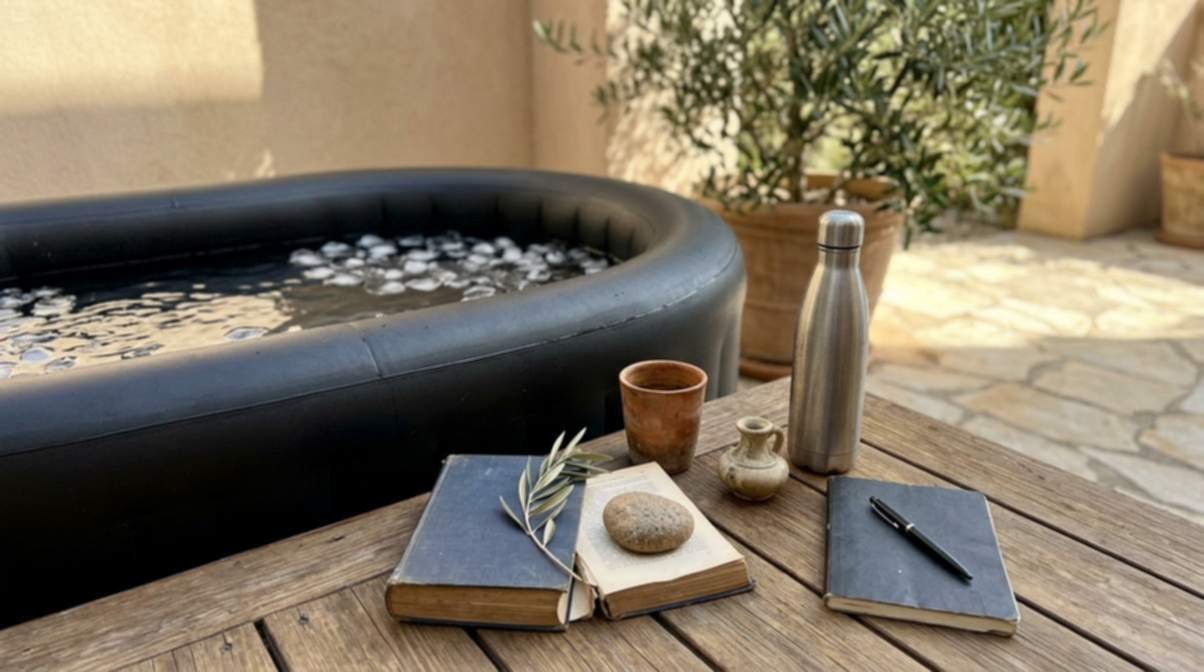
KEY TAKEAWAY: Cold water therapy has moved from public bathing and ritual purification to 19th-century hydrotherapy, sports recovery and at-home cold plunges. The modern evidence is narrower than the hype: the best-supported use is short-term soreness relief, usually around 10-15 minutes at 10-15°C, while claims about immunity, fat loss and mental health need more caution.
The first few seconds of cold water have probably felt the same for centuries: skin tightens, breath catches, and your body asks why you would do this on purpose. The answer has changed. For the Romans, cold water sat inside a social bathing system. For Shinto practitioners, water could be cleansing. For 19th-century Europeans, it became a formal “water cure”. For modern athletes and everyday Australians, it is usually framed as recovery, resilience or stress management.
This guide traces the history of cold water therapy from Roman bathhouses to today’s cold plunge tubs. It also separates the old story from modern evidence, because a practice being ancient does not automatically make every claim true.
If you are reading this because you are thinking about buying a tub, start with our tested comparison of the best ice baths in Australia. If you are more interested in what the science actually supports, pair this history guide with our evidence guide on whether ice baths are good for you.
SAFETY WARNING: Cold water immersion is a real physiological stressor, not a spa gimmick. Start around 12-15°C for 1-2 minutes, keep your head and neck out, never plunge alone, and stop immediately if you feel chest tightness, dizziness, numbness or confusion. People who are pregnant, over 50, taking blood pressure medication, or living with heart problems, circulatory issues, high blood pressure, autoimmune disease, Raynaud’s disease, cold urticaria or serious chronic illness should get GP advice first. Royal Life Saving Society Australia recommends pre-activity screening, medical guidance where needed, acclimatisation, supervision, and controlled water temperature.
Already know what you’re after? The PRODIGYX Ice Bath Tub is one of our top picks for bringing this history home, so feel free to check current pricing below.
Summary table: cold water therapy from Rome to now
| Era | Typical practice | What it meant then | What to take from it now |
| Ancient Rome | Frigidarium after warm/hot bathing | Part hygiene, part social life, part bodily contrast | Romans normalised cold water as part of a broader bathing routine, not as a standalone miracle cure. |
| Religious and cultural traditions | Misogi, cold-water cleansing, winter swimming | Purification, discipline, identity, community | Cold water often carried cultural meaning long before modern physiology tried to explain it. |
| 19th century Europe | Hydropathy and “water cure” clinics | A formal therapeutic system built around cold water, air, movement and simple living | This era shaped modern wellness language, but many claims outran evidence. |
| 20th century sport | Ice baths after training and competition | Recovery, soreness reduction, return-to-play support | The strongest evidence is still around soreness and short-term recovery, not every health claim. |
| 2020s home plunges | Chiller tubs, inflatable ice baths, cold showers | Convenience, routine, stress management, content culture | Modern gear helps consistency, but dose and safety matter more than the equipment. |
Roman baths made cold water normal
KEY TAKEAWAY: The Roman frigidarium was a cold room or cold-bath stage inside a larger bathing sequence. It was not the same thing as a modern standalone ice bath, but it shows that cold-water exposure has a long public-bathing history.
Ancient Roman bathhouses were not just places to wash. They were public spaces for exercise, conversation, oiling, scraping, sweating and bathing. Britannica describes Roman thermae as complexes for public bathing, relaxation and social activity, with major bath chambers including the frigidarium, caldarium and tepidarium (Britannica).
The cold-water step was usually the frigidarium. After heat exposure, bathers moved through warm and hot rooms before taking a bracing cold plunge or entering a cold room. Britannica notes that the bather moved from the tepidarium to the frigidarium, where there was frequently a swimming pool (Britannica).
The point is not that Romans were doing “biohacking”. That would be modern language pasted onto an ancient habit. The better lesson is simpler: cold water was already part of a structured routine. It worked alongside heat, movement, social contact and cleanliness. The Met also notes that Roman baths commonly included a hot room, warm room and cold room, and that public baths played hygiene and social roles across the Mediterranean (The Met).
Cold water was also ritual, identity and discipline
KEY TAKEAWAY: Not every historical cold-water practice was medical. In several traditions, cold water was about cleansing, discipline, spirituality or community before it was about muscle soreness.
Japan’s misogi tradition is a good example. Japan National Tourism Organization describes misogi as a traditional Shinto purification ritual involving cold water, nature and guided ceremony at Shirayama-Hime Shrine (Japan Travel).
Britannica describes harai as Shinto purification ceremonies, with similar misogi exercises using water to cleanse the individual before approaching a deity or sacred power (Britannica). That is a different frame from today’s recovery protocols. It is not about creatine kinase or delayed onset muscle soreness. It is about meaning.
This matters because modern cold plunge marketing often treats history as proof. “People have done this for centuries” is interesting, but it is not evidence that a five-minute plunge will boost immunity, burn fat or fix anxiety. History shows people found value in cold water. Science tells us which claims hold up under testing.
The 19th-century “water cure” turned cold water into a system
KEY TAKEAWAY: Modern hydrotherapy language owes a lot to 19th-century Europe, especially Vinzenz Priessnitz and the rise of hydropathy. This period shaped cold-water therapy as a formal health practice, but it also produced plenty of cure-all claims.
Hydropathy became fashionable in the 19th century. Britannica says hydropathy as a formal therapeutic system came into vogue through Vinzenz Priessnitz, a Silesian farmer who believed in the medicinal value of water from the wells on his land (Britannica).
The “water cure” was not only cold plunges. It could include cold compresses, douches, wet-sheet wraps, walking, fresh air, diet and rest. In other words, it looked less like a 2026 backyard chiller tub and more like a whole way of living. That is why some old hydrotherapy claims are hard to test today: the cold water was bundled with many other changes.
Sebastian Kneipp later helped spread water-based health practices through central Europe. Modern tourism and wellness sources still describe Kneipp therapy as a system built around water, movement, plants, nutrition and balance, with cold water serving as a major tool (Austria.info). The honest takeaway: 19th-century hydrotherapy matters historically, but it should not be treated as a substitute for modern evidence.
Sports science changed the question: what dose does what?
KEY TAKEAWAY: Modern research is less interested in whether cold water feels powerful and more interested in dose: temperature, duration, timing and outcome. The best-supported protocol range for soreness is roughly 10-15 minutes at 10-15°C, not “as cold as possible”.
Once cold water entered sports recovery, the question shifted. Athletes did not just ask whether cold water was traditional. They asked whether it reduced soreness, restored performance, altered inflammation or affected training adaptation.
A 2016 systematic review and meta-analysis by Machado et al. found that cold water immersion was slightly better than passive recovery for muscle soreness and reported a dose-response pattern, with 11-15°C for 11-15 minutes producing the best results for soreness (DOI). A 2025 network meta-analysis by Wang et al. found that 10-15 minutes at 11-15°C was best for reducing muscle soreness, while 10-15 minutes at 5-10°C performed best for some muscle-damage and neuromuscular markers (DOI).
That is why IceBathLab keeps coming back to dose. Colder is not automatically better. A plunge at 3°C might look impressive on Instagram, but for most beginners it increases discomfort and risk without proving a better result. For practical protocols, see our guide on how long to stay in an ice bath and our ice bath temperature guide.
Where the modern evidence is mixed
KEY TAKEAWAY: Cold water immersion has evidence for short-term soreness relief, but broader wellness claims are still limited. The strongest content should say what science does not support, not just what cold plunge brands want to sell.
A 2025 PLOS One systematic review and meta-analysis looked at health and wellbeing outcomes in healthy adults. It included 11 studies, 3,177 participants, CWI temperatures from 7-15°C and durations from 30 seconds to 2 hours. The review found a reduction in stress 12 hours after CWI, no immediate stress effect, no significant immune-function effect immediately or one hour after CWI, and limited evidence due to few RCTs, small sample sizes and low diversity (PLOS One).
That matters because modern content often jumps from “cold water changes your body” to “cold water fixes everything”. The first statement is true. Cold water can spike breathing, heart rate and blood pressure, and can activate the sympathetic nervous system. The second statement is not proven. Mayo Clinic Press puts the broader evidence bluntly: the science behind ice baths for recovery and wider benefits is still “on thin ice” (Mayo Clinic Press).
The same caution applies to strength training. Cold water after hard lifting may reduce soreness, but routine post-lifting CWI can interfere with some muscle-growth signals. Roberts et al. reported that post-exercise cold water immersion attenuated acute changes in satellite cell numbers and activity of kinases that regulate hypertrophy (DOI). If muscle growth is the goal, do not make immediate ice baths your default after every strength session.
The social media era made cold water convenient and noisy
KEY TAKEAWAY: Today’s cold plunge boom is driven by convenience, content and consistency. Chillers and inflatable tubs make cold exposure easier to repeat, but they do not change the basic physiology: your body responds to water temperature and time.
Modern cold water therapy looks different because the equipment is different. You can now buy inflatable tubs, cedar tubs, stainless tubs, chest-freezer-style builds, chiller systems and portable pods. That convenience matters. It makes consistency easier and temperature tracking more accurate.
But the body does not know whether the cold came from a Roman frigidarium, a mountain stream, a bag of servo ice or a WiFi chiller. It responds to dose. For buyers, the real differences are cost, hygiene, setup time and how reliably you can hold a target temperature. We cover those practical differences in our cold plunge vs ice bath guide.
There is also a safety problem. The more cold plunging becomes a social-media challenge, the more people skip the boring parts: screening, supervision, temperature control and slow progression. Royal Life Saving Society Australia advises pre-activity screening, medical guidance where needed, keeping the head and neck out of the water in cold plunge pools, and a generally safe range of 10-15°C for most people (Royal Life Saving Society Australia).
For a deeper risk breakdown, read our guide on whether ice baths are dangerous.
If you’d rather sort your own setup now, the PRODIGYX Ice Bath Tub is the pick we’d point you towards from this guide.
What history does and does not prove
KEY TAKEAWAY: History proves cold water has been meaningful across cultures. It does not prove every modern claim. The best approach is respect the tradition, use the science, and keep the dose boringly sensible.
Cold water therapy has always been bigger than one claim. It has been social, religious, medical, athletic, mental and commercial. That is exactly why it keeps coming back. The cold is simple. The story around it changes.
But the history of cold water therapy should not be used as a sales shortcut. Roman bathers were not testing 11-15°C protocols for delayed onset muscle soreness. Priessnitz was not running blinded RCTs. Modern influencers are not evidence just because they look calm in a tub.
The useful middle ground is this: cold water therapy is old, but modern cold plunging needs modern guardrails. Start warmer than your ego wants, keep sessions short, measure the water, avoid cold plunging alone, and use the practice for specific goals rather than vague promises.
Bring Cold Therapy Home

TOP PICK
PRODIGYX Ice Bath Tub
The PRODIGYX Ice Bath Tub is the top-rated tub from our full comparison for bringing a modern cold plunge routine home.
FAQ
What is the history of cold water therapy?
The history of cold water therapy runs from ancient public bathing and cultural purification practices to 19th-century hydropathy, 20th-century sports recovery and today’s home cold plunge tubs. The key shift is that modern practice is now measured by temperature, duration, timing and outcome rather than tradition alone.
Did Romans use ice baths?
Romans used cold baths, not modern ice baths as we know them. The frigidarium was the cold room or cold-bath stage in Roman thermae, usually used as part of a wider hot-warm-cold bathing sequence.
What was the Roman frigidarium?
The frigidarium was the cold room in a Roman bathhouse. Britannica describes it as one of the main chambers of Roman thermae, often reached after the warm tepidarium and hot caldarium.
Who invented cold water therapy?
No single person invented cold water therapy. Roman bathers, religious traditions, physicians and 19th-century hydropaths all shaped it, while Vinzenz Priessnitz is often linked with the 19th-century rise of formal hydropathy.
Is cold water therapy the same as hydrotherapy?
Cold water therapy is one branch of hydrotherapy. Hydrotherapy can use hot water, warm water, cold water, steam, compresses and contrast routines; cold water therapy specifically uses cold exposure through showers, baths, plunges or natural water.
When did ice baths become popular in sport?
Ice baths became common in modern sport during the late 20th and early 21st centuries as recovery science grew around soreness, inflammation and performance between sessions. Today, sports recovery remains the area with the clearest evidence base.
Is cold water therapy ancient?
Yes, cold water exposure has ancient roots, but the exact practices varied. Some were social, some were religious, some were medical, and only modern research tests specific protocols against measurable outcomes.
Does the history of cold water therapy prove it works?
No. History shows that people valued cold water, but it does not prove every health claim. Evidence is strongest for short-term soreness relief and more limited for immunity, fat loss, mood and long-term health outcomes.
Are cold plunges better than old-style ice baths?
Cold plunges are more convenient, but they are not physiologically magic. At the same temperature and duration, your body responds to the cold water dose, not whether the water was cooled by bagged ice or a chiller.
Did cold water therapy start with Wim Hof?
No. Wim Hof helped make cold exposure mainstream online, but cold water therapy is far older. Roman bathhouses, Shinto purification rituals, European hydropathy and sports recovery all came before the modern influencer era.
Britannica. Thermae – Roman baths and ancient heating systems.
Britannica. Roman Baths, Bath, England.
The Metropolitan Museum of Art. Baths and Bathing Culture in the Middle East: The Hammam.
Japan National Tourism Organization. Misogi purification ritual in cold water.
Mayo Clinic Press. Cold Plunge Benefits: The Science Behind Ice Baths for Recovery. 2024.
Harvard Health Publishing. Cold plunges: Healthy or harmful for your heart? 2025.
Medical disclaimer: This content is general information only and is not medical advice. Cold water immersion can be risky, especially for people with cardiovascular, circulatory, blood pressure, autoimmune, cold-sensitivity or chronic health conditions. Speak with a GP before starting if you are unsure, over 50, pregnant, taking medication, or managing any medical condition.
