
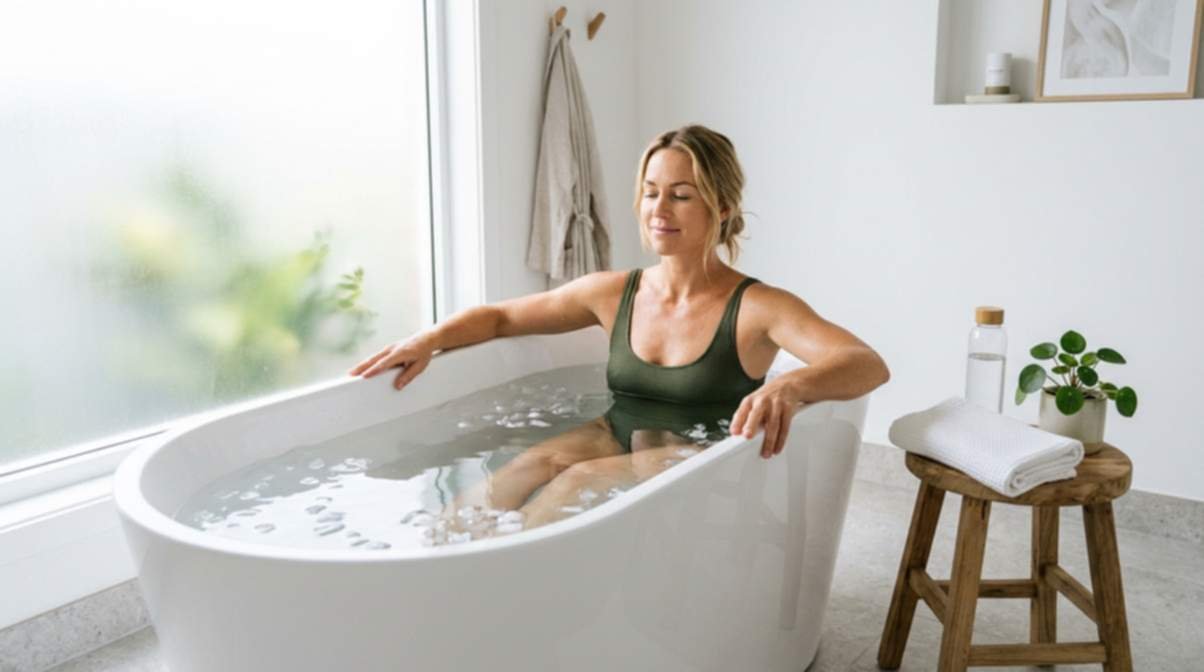
If you’ve been told ice baths are “bad for women,” you’ve only heard half the story. If you’ve been told they’re exactly the same as for men, you’ve heard the other wrong half. The truth, as usual, is more nuanced and the science is finally starting to catch up.
In 2025, exercise physiologist Dr Stacy Sims went viral for suggesting women shouldn’t do ice baths. Around the same time, a Swiss RCT found that cold water immersion didn’t improve muscle recovery in women. Headlines declared cold plunges “useless” for females. But that’s not what the research actually said.
This guide covers what the female-specific evidence actually shows including where cold exposure helps, where it doesn’t, how the menstrual cycle changes the equation, and what protocols make sense for women. If you’re new to cold exposure, start with our complete science guide to ice bath benefits for the foundations.
Key Takeaway: Yes, ice baths can benefit women but the protocols that work for men don’t always translate. A landmark 2025 RCT (Wellauer et al., 30 women) found that neither cold nor hot water immersion accelerated muscle recovery in female participants. However, cold exposure at 10–16°C still offers mood, stress reduction, and potential hormonal benefits for women when tailored to menstrual cycle phase and individual response. Women are not small men and the dose needs adjusting.
Safety First: Women-Specific Considerations
Cold water immersion carries real risks for everyone. For women, there are additional considerations:
- Start at 15–16°C, not the 3–5°C protocols popular on social media. Dr Stacy Sims recommends women begin at ~16°C to ensure shivering occurs (where metabolic benefits begin).
- Pregnancy is a contraindication. There is no evidence that CWI is safe during pregnancy, and some evidence suggests extreme cold may increase preterm birth risk.
- Never plunge alone. Cold shock can cause involuntary gasping and cardiac stress in anyone.
- If you have Raynaud’s, cardiovascular conditions, endometriosis, or are on hormonal medications, consult your GP first.
- The Royal Life Saving Society Australia advises against unsupervised cold water immersion. • Monitor your menstrual cycle response. If cramps worsen during or after cold exposure, adjust timing or skip that cycle.
Ice Baths and Women: What the Evidence Says
| Claim | Evidence for Women | Key Source |
|---|---|---|
| Accelerates muscle recovery | Not supported in women | Wellauer 2025 RCT (30 women): no recovery benefit vs control |
| Reduces muscle soreness (subjective) | Limited/mixed | Huang 2025 (18 women): CWI improved hamstring MVC by days 4–5. Wellauer found no DOMS difference. |
| Boosts mood and reduces stress | Supported (but limited female data) | Cain/UniSA 2025 meta-analysis: stress reduction at 12h. Yankouskaya 2022 (33 adults, 16 female): increased alertness, reduced distress after 5 min at 20°C. |
| Increases dopamine/noradrenaline | Supported (data mostly from men) | Šrámek 2000: 530% noradrenaline at 14°C. Similar mechanisms expected in women, though dose may differ. |
| Reduces menstrual/menopause symptoms | Preliminary self-reported support | Survey of 1,114 women (Pound et al. 2024): reduced anxiety (46.7%), mood swings (37.7%), hot flashes (30.3%). Self-reported, not RCT. |
| Harms female reproductive health | Animal evidence only | PMC12014596 (Sun 2025): mice at 4°C daily for 21 days showed uterine inflammation. Not replicated in humans. |
| Women should avoid ice baths entirely | Not supported | Absence of recovery benefit ≠ harm. The Wellauer authors explicitly noted this distinction. |
1. What the Female-Specific Research Actually Found
| Key Takeaway: The Wellauer 2025 RCT is the strongest women-specific recovery study to date. It found no recovery benefit from CWI in women but the authors stressed that “absence of objective benefits does not imply that cold water immersion is harmful.” This distinction matters. |
Wellauer et al. (2025) conducted a randomised controlled trial with 30 women (mean age 23.3 years) at the University of Applied Sciences and Arts of Southern Switzerland. Each participant performed 5 sets of 20 drop-jumps, then was randomly assigned to cold water immersion (10°C for 10 minutes), hot water immersion (40°C for 10 minutes), or no immersion (control).
The results were clear: neither cold nor hot water immersion improved recovery outcomes compared to doing nothing. Specifically, there were no significant differences in swelling, muscle soreness ratings, creatine kinase levels, or maximal voluntary isometric contraction across the three groups at 24, 48, or 72 hours post-exercise.
This is a critical finding because most of the evidence supporting CWI for recovery comes from male-dominated studies. When women are studied specifically, the recovery benefits don’t hold up. However and this is the part the headlines missed recovery is only one of several reasons people cold plunge. The mood, stress, and hormonal effects may operate through different mechanisms entirely.
2. Why Women Respond Differently to Cold
| Key Takeaway: Women vasoconstrict faster, lose core heat more rapidly, and may not shiver at extreme temperatures missing the metabolic response. Hormonal fluctuations across the menstrual cycle change cold tolerance significantly. |
The physiological differences aren’t small. Women and men differ in how the autonomic nervous system and thermoregulatory processes respond to cold:
- Women generally vasoconstrict faster than men, reducing blood flow to the skin more aggressively. This means core temperature can drop more rapidly during immersion.
- At extreme cold (below ~10°C), Dr Stacy Sims argues that women may not begin shivering. Without shivering, you miss the metabolic cascade the increased glucose tolerance, fat metabolism, and calorie burn that drive many of the claimed benefits.
- Progesterone, which rises during the luteal phase (second half of the menstrual cycle), raises baseline core temperature by about 0.3–0.5°C. This makes women more sensitive to cold in the week before their period.
- A 2021 study published in Molecular and Cellular Endocrinology found that women’s cold-induced thermogenesis significantly declined during the luteal phase, reducing heat production capacity.
The takeaway isn’t that cold exposure doesn’t work for women. It’s that the dose temperature, duration, and timing relative to the menstrual cycle needs to be different.
3. Can You Cold Plunge on Your Period?
| Key Takeaway: Yes, most women can cold plunge during their period. A 2022 meta-analysis of 78,068 women flagged cold exposure during menses as a potential risk factor for dysmenorrhea (period cramps), but the risk is discomfort, not danger. Monitor your individual response. |
This is one of the most-searched questions, and the answer depends on your body. Here’s what the evidence says:
- A 2022 meta-analysis covering 78,068 female students found cold exposure during menses listed among potential risk factors for primary dysmenorrhea (period cramps without an underlying condition). Cold wasn’t the only factor it was one of 10+ identified risk factors.
- Conversely, a survey of 1,114 women (Pound et al. 2024, Post Reproductive Health) found that cold water immersion reduced menstrual-related symptoms, particularly psychological ones: anxiety (46.7%), mood swings (37.7%), and irritability (37.6%). This was self-reported, not an RCT.
- The practical advice: try it. If your cramps get worse after cold plunging during your period, stop for that phase of your cycle. If they don’t, there’s no evidence-based reason to avoid it. Many women report feeling better after a plunge during menstruation, likely due to the endorphin and noradrenaline response.
4. Cold Exposure and Menopause: What We Know
| Key Takeaway Preliminary survey data suggests cold water immersion may reduce hot flashes (30.3% reported improvement) and anxiety (46.9%) in perimenopausal and menopausal women. This is self-reported and needs RCT validation, but the mechanism is plausible. |
For women in perimenopause or menopause, cold exposure is particularly interesting because the hormonal shifts that cause hot flashes, night sweats, and mood instability may respond to the thermoregulatory challenge of cold water.
The survey of 1,114 women (Pound et al. 2024) found that 30.3% reported a reduction in hot flashes and 46.9% reported improvements in anxiety symptoms. While this is promising, it’s self-reported data from a non-randomised survey not the same as a controlled trial.
The mechanism is plausible: cold water immersion activates the sympathetic nervous system and triggers noradrenaline release, which may help recalibrate the thermoregulatory set-point that becomes dysregulated during menopause. Improved sleep quality from cold exposure (Chauvineau 2021) could also address menopause-related insomnia indirectly.
We need RCTs in menopausal women before making strong claims, but the anecdotal evidence is consistent enough that it’s worth trying if your GP clears you.
5. The “Ice Baths Are Bad for Women” Debate: What’s Actually Being Said
| Key Takeaway: The viral claim that ice baths are “bad for women” oversimplifies the evidence. The more accurate statement is: extreme cold (below 10°C) may not produce the same metabolic benefits in women as in men, and women may benefit from warmer protocols (12–16°C). |
Dr Stacy Sims’s argument isn’t that cold exposure is harmful for women it’s that the intensity needs adjusting. She recommends water around 15–16°C for women, where they’ll vasoconstrict and then shiver, triggering the metabolic response. At extreme cold (3–5°C), she argues women vasoconstrict so severely that shivering doesn’t occur, and the sympathetic stress response can become counterproductive elevating cortisol without the metabolic benefits.
On the other side, Australian Olympic gold medallist Lauren Burns PhD has researched female sports performance and found that higher-achieving female athletes ice bath more frequently than less accomplished ones (Burns et al. 2022).
Both perspectives have merit. The resolution isn’t “ice baths are bad for women” or “ice baths are great for women.” It’s that women likely benefit from a different dose warmer temperature, shorter duration, and timing that accounts for the menstrual cycle.
6. A Women’s Protocol: Temperature, Timing, & Cycle Phase
| Cycle Phase | Temp Range | Duration | Notes |
| Menstrual (days 1–5) | 13–16°C | 2–5 min | Monitor cramps. Skip if symptoms worsen. Many women report mood benefits. |
| Follicular (days 6–13) | 10–15°C | 5–10 min | Oestrogen rising, cold tolerance typically highest. Best window for longer or colder sessions. |
| Ovulatory (day ~14) | 12–15°C | 3–8 min | Localised cold (not full immersion) may help ovulatory discomfort. |
| Luteal (days 15–28) | 14–16°C | 2–5 min | Progesterone raises core temp; cold feels harder. Reduce intensity. Prioritise comfort. |
| Perimenopause/Menopause | 12–16°C | 2–8 min | May help hot flashes and anxiety. Start conservatively. Consult GP. |
For recovery specifically, remember that the Wellauer 2025 RCT found no benefit for women. If you’re plunging for muscle recovery after strength training, the evidence doesn’t support it for women. However, the mood, stress, and sleep benefits operate through different pathways and remain relevant.
The Søeberg principle applies to women too: let your body rewarm naturally rather than jumping into a hot shower. This extends the metabolic stimulus. If you’re interested in how long to stay in an ice bath, our duration guide covers the evidence in detail.
7. What About Reproductive Health?
| Key Takeaway: A 2025 mouse study (PMC12014596) found cold exposure caused uterine and ovarian inflammation in rodents. This has not been replicated in humans. The study used extreme conditions (4°C daily for 21 days) that don’t reflect typical ice bath protocols. Don’t ignore it, but don’t panic either. |
Sun et al. (2025) immersed female mice in 4°C water for 6 minutes daily for 21 consecutive days and found inflammatory changes in the uterus and ovaries, along with altered reproductive hormone levels (AMH, E2, FSH, LH all elevated).
This is concerning at first glance, but critical context is needed: this was a mouse model with daily extreme cold exposure at 4°C far colder and more frequent than any recommended human protocol. The authors themselves noted that clinical validation in humans is lacking.
For women trying to conceive or concerned about reproductive health, the conservative approach is: avoid daily extreme cold exposure, keep temperatures at 10°C or above, limit sessions to 2–3 times per week, and consult your GP if you have fertility concerns.
8. Australian-Specific Advice for Women
If you’re in Australia, the warmer protocols recommended for women may actually work in your favour. As we covered in our comparison of the best ice baths in Australia, tap water in southern states during winter can sit around 8–12°C which is already within the therapeutic range without a chiller.
For women using the 12–16°C range, you may not need a chiller at all for much of the year in Sydney, Melbourne, or Perth. In warmer climates (Brisbane, Darwin), a chiller set to 14–15°C provides a consistent, comfortable starting point.
The growing community of women cold plunging in Australia includes ocean swimming groups in every coastal city. If you prefer social cold exposure, these communities offer supervision, accountability, and shared experience which aligns with the Nordic tradition of cold water immersion as a communal practice.
Frequently Asked Questions
Are ice baths good for women?
Yes, ice baths can benefit women but the protocols that work for men don’t always translate. The 2025 Wellauer RCT found no recovery benefit for women, but cold exposure at 10–16°C still offers mood, stress reduction, and potential hormonal benefits when tailored to menstrual cycle phase and individual response.
Are cold plunges good for women’s hormones?
Preliminary evidence suggests cold exposure may help regulate hormonal symptoms. A 2024 survey of 1,114 women found cold water immersion reduced anxiety (46.7%), mood swings (37.7%), and hot flashes (30.3%) symptoms often linked to hormonal fluctuations. However, this is self-reported data; we need RCTs for confirmation.
Can you cold plunge on your period?
Yes, most women can cold plunge during their period. A 2022 meta-analysis flagged cold exposure during menses as a potential risk factor for worse cramps, but the risk is discomfort, not danger. Monitor your individual response if cramps worsen, skip that cycle phase. Many women report mood benefits from plunging during menstruation.
Is cold plunging good for menopause symptoms?
Early survey data is promising. In the 2024 survey, 30.3% of perimenopausal and menopausal women reported reduced hot flashes and 46.9% reported less anxiety after cold water immersion. The mechanism noradrenaline release recalibrating the thermoregulatory set-point is plausible, but RCTs are needed for confirmation.
Should women use warmer water than men for ice baths?
Yes, according to exercise physiologist Dr Stacy Sims. She recommends women start at ~15–16°C to ensure shivering occurs, triggering the metabolic response. At extreme cold (3–5°C), women may vasoconstrict so severely they don’t shiver, missing the metabolic benefits and potentially elevating cortisol unnecessarily.
Do ice baths affect fertility in women?
A 2025 mouse study found daily extreme cold (4°C) caused uterine inflammation, but this hasn’t been replicated in humans. The study used conditions far beyond typical ice bath protocols. For women trying to conceive, the conservative advice is to avoid daily extreme cold, keep temps ≥10°C, limit to 2–3 sessions/week, and consult a GP.
Is cold plunge good for women’s mental health?
Yes. The 2025 Cain/UniSA meta-analysis found cold water immersion reduced stress at 12 hours post-immersion. A 2022 study (Yankouskaya) with 33 adults (16 female) found increased alertness and reduced distress after 5 minutes at 20°C. The dopamine and noradrenaline release provides a measurable mood boost.
How often should women take ice baths?
2–3 times per week is a sensible starting point for most women, following the cycle-phase protocol in Section 6. Avoid daily extreme cold exposure, especially given the lack of recovery benefit and potential for counterproductive stress response. Consistency over intensity is key.
Do ice baths help women recover from exercise?
The strongest women-specific study to date (Wellauer 2025, 30 women) found no recovery benefit from cold water immersion compared to doing nothing. For muscle recovery specifically, the evidence doesn’t support ice baths for women. However, the mood and stress benefits operate through different pathways and remain relevant.
Are ice baths bad for women’s cortisol levels?
They can be if the dose is wrong. Dr Stacy Sims argues that at extreme cold (below 10°C), women may not shiver, leading to a sympathetic stress response that elevates cortisol without the metabolic benefits. Using warmer water (12–16°C) where shivering occurs is recommended to avoid this counterproductive effect.
Sources
1. Wellauer V, Clijsen R, Bianchi G, Riggi E, Hohenauer E. No acceleration of recovery from exercise-induced muscle damage after cold or hot water immersion in women: A randomised controlled trial. PLOS One. 2025;20(5):e0322416. DOI: 10.1371/journal.pone.0322416
2. Sun Y et al. Effects of cold environment exposure on female reproductive health and its regulatory mechanisms. Frontiers in Immunology. 2025;16:1573017. PMC: PMC12014596
3. Cain T, Brinsley J, Bennett H, Nelson M, Maher C, Singh B. Effects of cold-water immersion on health and wellbeing: a systematic review and meta-analysis. PLOS One. 2025. DOI: 10.1371/journal.pone.0317615
4. Šrámek P et al. Human physiological responses to immersion into water of different temperatures. European Journal of Applied Physiology. 2000;81:436–442. DOI: 10.1007/s004210050065
5. Huang YH et al. Effect of cold-water immersion treatment on recovery from exercise-induced muscle damage in the hamstring. European Journal of Sport Science. 2025;25(1):e12235. DOI: 10.1002/ejsc.12235
6. Chauvineau M et al. Effect of cold water immersion on sleep architecture. Frontiers in Sports and Active Living. 2021;3:659990. DOI: 10.3389/fspor.2021.659990
7. Roberts LA et al. Post-exercise cold water immersion attenuates acute anabolic signalling. Journal of Physiology. 2015;593(18):4285–4301. DOI: 10.1113/JP270570
8. Machado AF et al. Can water temperature and immersion time influence the effect of CWI on muscle soreness? Sports Medicine. 2016;46(4):503–514. DOI: 10.1007/s40279-015-0431-7
9. Wang H, Wang L, Pan Y. Impact of different doses of CWI on recovery: a network meta-analysis. Frontiers in Physiology. 2025;16:1525726. DOI: 10.3389/fphys.2025.1525726
10. Mayo Clinic Health System. Can taking a cold plunge after your workout be beneficial? 2024. mayoclinichealthsystem.org
11. Harvard Health. Research highlights health benefits from cold water immersions. 2025. health.harvard.edu
12. Royal Life Saving Society Australia. Position Statement on Cold Water Immersion Safety. 2024. royallifesaving.com.au
Last updated: April 2026 | Author: Bobby Rawat, IceBathLab Editorial Team
Medical Disclaimer: This article is for informational purposes only and does not constitute medical advice. Cold water immersion carries risks. Consult your GP before starting any cold exposure routine, especially if you are pregnant, have cardiovascular conditions, or concerns about reproductive health.
