
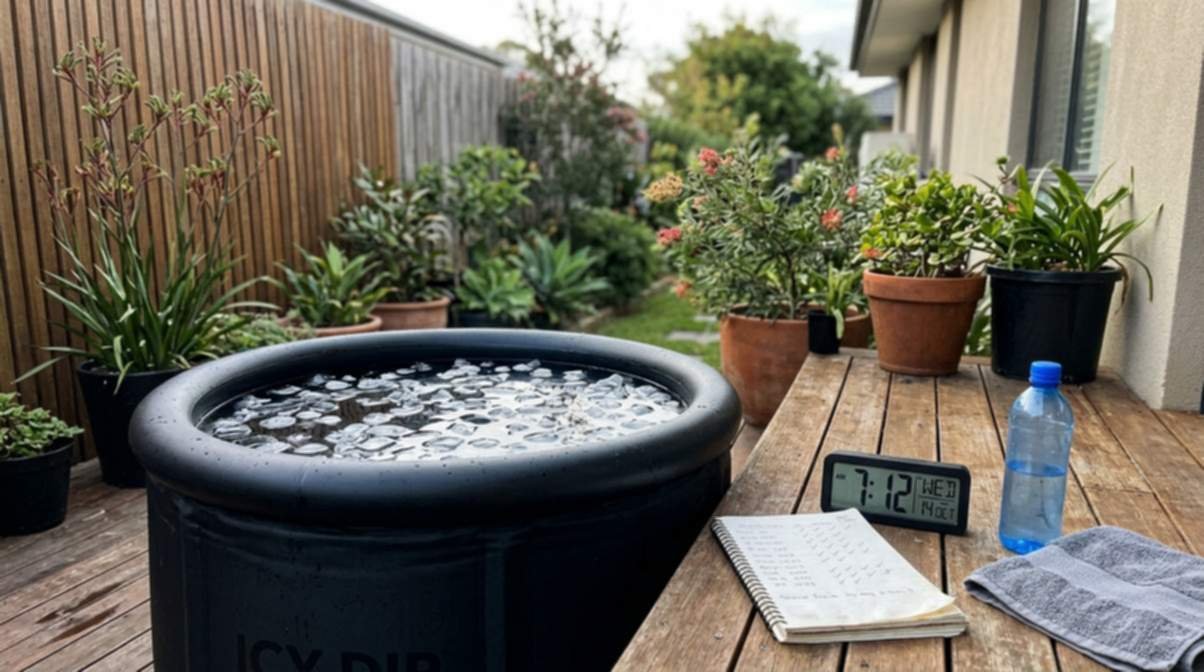
KEY TAKEAWAY For most people, 2-4 cold plunge sessions per week at 10-15°C is the evidence-backed sweet spot, aiming for roughly 11 minutes of total weekly cold exposure. Søberg et al. (2021) studied winter swimmers practising 2-3 times per week and found enhanced thermogenesis and metabolic adaptation. More isn’t always better daily plunging without rest can lead to accumulated stress and diminishing returns. Strength athletes should limit sessions to rest days or wait 4-6 hours after lifting (Roberts et al., 2015).
While 2-4 sessions per week is ideal for most, it’s worth noting that cold plunging’s anti-inflammatory effects appear only after consistent adaptation over weeks, not from any single session—so sticking to a routine is key.
You’ve bought the tub, dialled in the temperature, survived your first few plunges, and now you’re wondering: how often should I actually be doing this? Once a day? Twice a week? Every time you feel like punishing yourself?
Here to buy, not read? Our full range is below.
It’s a fair question, and the answer is more nuanced than the “do it every day!” advice you’ll find on most cold plunge brand websites. Cold water immersion is a hormetic stressor a controlled stress that triggers beneficial adaptations. But like all stressors, there’s a dose-response curve. Too little and you don’t adapt. Too much and you overload your system.
In this guide, we’ll break down how often to cold plunge based on your specific goals, what the research says about frequency, the risks of overdoing it, and practical weekly schedules you can actually follow. If you’re still dialling in the basics, start with our science guide to ice bath benefits, our temperature guide, and our duration guide.
SAFETY WARNING Never cold plunge alone. The Royal Life Saving Society Australia lists cold water immersion as an elevated-risk activity. Water below 15°C triggers the cold shock response involuntary gasp, blood pressure spike, rapid heart rate. Enter gradually. If you have heart conditions, high blood pressure, Raynaud’s disease, or are pregnant, consult your GP before any cold water immersion. Start conservatively: 1–2 sessions per week at 15°C for 1–2 minutes. Build frequency and intensity over weeks, not days. If your sleep worsens, training performance declines, or you feel persistently fatigued, you’re likely plunging too often. Back off.
How Many Cold Plunges a Week?
| Goal | Frequency | Session | Weekly Total | Key Evidence |
| General health & mood | 2–3x/week | 3–5 min at 10–15°C | ~9–15 min | Cain et al. 2025 (stress reduction at 12h); Šrámek et al. 2000 (dopamine/noradrenaline) |
| Endurance recovery | 3–5x/week | 10–15 min at 10–15°C | ~30–75 min | Machado et al. 2016 (DOMS); Wang et al. 2025 (dose-response) |
| Strength / hypertrophy | 2–3x/week | 5–10 min at 10–15°C | ~10–30 min | Rest days only. Roberts et al. 2015 (muscle growth interference) |
| Fat loss / metabolism | 3–4x/week | 3–5 min at 10–15°C | ~9–20 min | Søberg et al. 2021 (enhanced thermogenesis in 2–3x/week swimmers) |
| Immune support | 2–3x/week | 3–5 min at 10–15°C | ~6–15 min | Buijze et al. 2016 (29% fewer sick days with cold showers, n=3,018) |
| Beginner | 1–2x/week | 1–3 min at 15°C | ~2–6 min | Build tolerance gradually. Consistency over intensity. |
What the Research Says About Cold Plunge Frequency
KEY TAKEAWAY No single RCT has directly compared different cold plunge frequencies (e.g. 2x vs 4x vs daily) head-to-head. The best evidence comes from observational studies of habitual cold water swimmers and from interpreting dose-response data from meta-analyses. The most-cited targets 11 minutes per week across 2–4 sessions come from exercise physiologists synthesising multiple sources, not from one definitive trial.
Søberg et al. (2021) Winter swimmers and brown fat
This study, published in Cell Reports Medicine, examined 8 experienced male winter swimmers who practised cold water immersion combined with sauna 2–3 times per week, compared with 8 matched controls (Søberg et al., 2021).
The winter swimmers showed enhanced cold-induced thermogenesis they burned significantly more calories during cooling than the controls, despite similar brown fat glucose uptake. The researchers proposed that regular cold exposure led to both heat and cold acclimation, with winter swimming acting as a potential strategy for increasing energy expenditure.
Important caveats: this was an observational study with a small sample (n=8 per group), all male, and the swimmers also used sauna. We can’t isolate cold exposure from heat exposure in this design. And the 2–3x/week frequency was what these swimmers happened to do the study didn’t test whether 2x or 4x would produce different outcomes.
The “11 minutes per week” guideline
This target has been popularised by Dr. Andrew Huberman and is widely cited in the cold plunge community. It’s derived from synthesising multiple research findings on noradrenaline response, mood benefits, and metabolic effects not from a single study that tested 11 minutes specifically.
The practical interpretation: aim for roughly 11 minutes of total deliberate cold exposure per week at 10–15°C, distributed across 2–4 sessions. This could be 3 sessions of ~4 minutes, 4 sessions of ~3 minutes, or any similar combination. The distribution matters more than the single-session duration.
Buijze et al. (2016) Cold showers and sick days
This large Dutch RCT (n=3,018) found that participants who took cold showers for 30, 60, or 90 seconds daily for 30 days had 29% fewer self-reported sick days than controls (Buijze et al., 2016). The effect was similar across all three cold duration groups suggesting that even brief, frequent cold exposure may support immune function.
Important: this study used cold showers, not ice bath immersion. The participants self-reported sick days, not objective immune markers. And 29% fewer sick days doesn’t mean “29% better immune system” the mechanism is unclear.
Machado et al. (2016) & Wang et al. (2025) Recovery dose-response
For those using cold plunging primarily for exercise recovery, the meta-analyses provide the best frequency guidance. Machado et al. found that CWI at 11–15°C for 11–15 minutes was optimal for reducing DOMS (Machado et al., 2016). Wang et al. (2025) confirmed a dose-response relationship across 55 RCTs (Wang et al., 2025).
The practical implication: plunge after hard training sessions, not after every session. If you train hard 3–4 times per week, that’s 3–4 recovery plunges. Easy sessions don’t need cold water recovery.
Cain et al. (2025) Health and wellbeing
This UniSA meta-analysis (11 studies, 3,177 participants) found that cold water immersion produced stress reduction benefits measurable at 12 hours post-exposure (Cain et al., 2025). This supports a frequency of every 2–3 days (i.e. 2–4 times per week) to maintain consistent wellbeing benefits.
Can You Cold Plunge Too Often? Signs of Overdoing It
KEY TAKEAWAY Yes. Cold plunging is a stressor, and overdoing it can lead to accumulated cortisol, disrupted sleep, blunted adaptation, and declining training performance. If your plunging routine makes you feel worse rather than better, reduce frequency.
Cold water immersion triggers a sympathetic nervous system response noradrenaline, cortisol, adrenaline. In the right dose, this is beneficial (hormesis). But stacking cold stress on top of training stress, work stress, and poor sleep creates a cumulative burden your body may not be able to recover from.
Signs you’re plunging too often
- Persistent fatigue that doesn’t resolve with sleep
- Declining training performance (weaker, slower, less endurance)
- Poor sleep quality or difficulty falling asleep
- Frequent illness (the opposite of the immune benefit you’re chasing)
- Dreading the plunge rather than feeling challenged by it
- Elevated resting heart rate or reduced HRV (if you track these)
The fix
Cut back to 2 sessions per week for 2–3 weeks. If symptoms resolve, gradually increase. If not, take a full week off. Cold plunging should make you feel better, not worse. If it’s becoming a source of stress rather than stress relief, your frequency is too high for your current recovery capacity.
This is especially relevant during high-stress life periods (poor sleep, work deadlines, illness, heavy training blocks). Cold plunging isn’t an obligation it’s a tool. Use it when it serves you.
How Often to Cold Plunge If You Lift Weights
KEY TAKEAWAY If hypertrophy is your goal, limit cold plunging to 2–3 times per week on rest days only. Roberts et al. (2015) showed that immediate post-exercise CWI attenuated type II muscle fibre growth by 17% over 12 weeks. Peake et al. (2017) confirmed blunted satellite cell activity. The interference effect is timing-dependent waiting 4–6 hours or using rest days avoids it.
This is the single most important frequency consideration for anyone who strength trains, and it’s the one most articles either bury or ignore. We covered this in detail in our cold plunge workout timing guide, but here’s the frequency-specific summary:
- Roberts et al. (2015) tested 10 minutes of CWI at 10°C immediately after every strength session over 12 weeks. The CWI group gained less muscle than the active recovery group (Roberts et al., 2015).
- Peake et al. (2017) from the same QUT lab confirmed CWI blunts satellite cell activity post-strength exercise (Peake et al., 2017).
- Fyfe et al. (2019) found CWI blunted hypertrophy but not maximal strength, adding nuance.
- The interference appears to be timing-dependent. Plunging on rest days (24–48 hours after your last lift) completely avoids the issue.
Practical recommendation: if you lift 3–4 times per week, plunge 2–3 times per week on non-lifting days. If you absolutely must plunge on a lifting day, wait at least 4–6 hours.
Practical Weekly Schedules
KEY TAKEAWAY Consistency matters more than perfection. Pick a schedule that fits your life and stick with it for 4–6 weeks before adjusting. The person who plunges 3 times per week for a year gets more benefit than the person who plunges daily for a month and burns out.
Schedule A: Beginner (building tolerance)
Week 1–2: 1 session/week — 1–2 min at 15°C
Week 3–4: 2 sessions/week — 2–3 min at 15°C
Week 5–6: 2–3 sessions/week — 3–4 min at 12–15°C
Week 7+: Progress to an intermediate schedule below
Total: Building from ~2 min to ~12 min weekly exposure over 6 weeks.
Schedule B: General wellness (non-athlete)
Mon / Wed / Fri: 3–5 min at 10–15°C (morning preferred for dopamine boost)
End cold don’t jump in a hot shower. Let your body reheat naturally (the Søberg principle).
Total: ~9–15 min/week across 3 sessions.
Schedule C: Strength athlete
Mon: Lift — no plunge
Tue: Lift — no plunge
Wed: Rest — cold plunge 4–5 min at 10–15°C
Thu: Lift — no plunge
Fri: Lift — no plunge
Sat: Rest — cold plunge 4–5 min at 10–15°C
Sun: Off
Total: ~8–10 min/week. Rest days only.
Schedule D: Endurance athlete
After each hard session (intervals, tempo, long run): 10–15 min at 10–15°C within 30–60 min
Skip after easy/recovery sessions.
Typical: 3–4 plunges per week following hard days.
Total: ~30–60 min/week.
If frequency is sorted for you, our full range is worth a look next.
Schedule E: Mental health focus
Mon / Wed / Fri / Sat: 2–4 min at 10–15°C (morning)
Focus on the post-plunge mood boost. Šrámek et al. (2000) showed noradrenaline increased by 530% and dopamine by 250% during cold immersion (1-hour protocol at 14°C; briefer plunges produce a smaller but meaningful response).
Total: ~8–16 min/week across 4 sessions.
What Most Articles Get Wrong About Cold Plunge Frequency
KEY TAKEAWAY Most competitor content either recommends daily plunging (good for brand revenue, not necessarily for you) or cites the 11 min/week target without explaining where it comes from or its limitations. None cite the actual Søberg study, Roberts interference data, or the Cain meta-analysis.
We reviewed the top-ranking pages for “how often should you cold plunge” and found:
- Most recommend 2–4x/week (correct) but without citing any specific study or mechanism.
- Several recommend daily plunging for “advanced users” without discussing the risks of accumulated cortisol or diminishing adaptation.
- None cite Søberg et al. (2021) by name or explain the study’s limitations (small sample, all male, combined cold + sauna, observational design).
- None cite Roberts et al. (2015) in a frequency context meaning strength athletes reading those articles would have no idea they should reduce frequency or avoid post-lift plunging.
- The 11 min/week guideline is repeated as gospel without acknowledging it’s a popularised synthesis, not a single study’s finding.
- Most are published by cold plunge brands. More sessions = more tub usage = more product appeal.
7. Australian-Specific Considerations
Your cold plunge frequency may need seasonal adjustment in Australia. In a Melbourne or Hobart winter, your unheated outdoor tub might sit at 8–12°C significantly colder than the 10–15°C research sweet spot. At those temperatures, you’ll need shorter sessions and may find 2–3 times per week is plenty. In a Brisbane or Darwin summer, tap water can be 22–26°C, barely qualifying as a cold plunge. You’ll need a chiller to get therapeutic temperatures, or increase duration to compensate.
If you’re shopping for a setup that maintains consistent temps year-round, our comparison of the best ice baths in Australia covers every option from basic tubs to chiller units with AU pricing.
Women may also find their cold tolerance varies across the menstrual cycle some report being more sensitive to cold during the luteal phase. Adjusting frequency (e.g. 2x/week during luteal, 3–4x during follicular) is a reasonable approach, though no study has directly tested this. See our female-specific ice bath guide for more.
For details on how cold plunging fits into weight management, including the brown fat activation mechanism from the Søberg study, see our ice bath weight loss guide.
Frequently Asked Questions
How often should you cold plunge?
2–4 times per week is the evidence-backed sweet spot for most people, aiming for roughly 11 minutes total weekly exposure at 10–15°C. Beginners should start with 1–2 sessions. Frequency should match your goals and recovery capacity.
How often should you do a cold plunge for recovery?
After hard training sessions only typically 3–4 times per week for endurance athletes. Strength athletes should limit to 2–3 times per week on rest days to avoid blunting muscle growth (Roberts et al., 2015).
How often to cold plunge for mental health?
3–4 times per week. Cold exposure triggers noradrenaline and dopamine release with effects lasting several hours. The Cain et al. (2025) meta-analysis found stress reduction benefits at 12 hours post-exposure, supporting an every-other-day pattern.
How many cold plunges a week is too many?
Benefits plateau at 4–5 sessions per week for most people. Daily plunging can lead to accumulated cortisol, disrupted sleep, and diminishing returns. If your sleep worsens or training drops, reduce to 2–3 sessions.
Can you cold plunge every day?
You can, but it’s not necessary for most and may be counterproductive. Daily plunging works better for experienced users with shorter sessions (1–2 min). Rest days allow complete hormonal response cycles. The research supports frequency, not obsession.
Is 3 times a week enough for cold plunging?
Yes. Three sessions per week of 3–5 minutes at 10–15°C provides 9–15 minutes of total weekly exposure meeting or exceeding the commonly cited 11 min/week target. This is sufficient for mood, immune, and general health benefits.
How often should beginners cold plunge?
Start with 1–2 times per week at 15°C for 1–2 minutes. Build gradually over 4–6 weeks before increasing to 3+ sessions. Consistency matters more than intensity a sustainable routine beats an aggressive one that leads to burnout.
Should I cold plunge on rest days or training days?
For strength athletes: rest days. Immediate post-lift CWI can blunt muscle growth. For endurance athletes: after hard training sessions, within 30–60 minutes. For general wellness: whichever day fits your schedule.
How long should each cold plunge session be?
3–5 minutes at 10–15°C for general wellness. 10–15 minutes at 10–15°C for post-exercise recovery (Machado et al., 2016). Beginners: 1–2 minutes at 15°C. See our full duration guide for detailed protocols.
Does cold plunge frequency affect weight loss?
Søberg et al. (2021) found that winter swimmers who practised 2–3 times per week had enhanced cold-induced thermogenesis. The “Søberg principle” suggests ending cold (not warming up in a hot shower) to maximise brown fat activation. But cold plunging alone is not a weight loss strategy it’s a minor metabolic tool at best. See our weight loss guide.
Søberg S, Löfgren J, Philipsen FE, Jensen M, Hansen AE, Ahrens E, et al. Altered brown fat thermoregulation and enhanced cold-induced thermogenesis in young, healthy, winter-swimming men. Cell Rep Med. 2021;2(10):100408. doi:10.1016/j.xcrm.2021.100408
Roberts LA, Raastad T, Markworth JF, et al. Post-exercise cold water immersion attenuates acute anabolic signalling and long-term adaptations in muscle to strength training. J Physiol. 2015;593(18):4285–4301. doi:10.1113/JP270570
Peake JM, Roberts LA, Figueiredo VC, et al. The effects of cold water immersion and active recovery on inflammation and cell stress responses in human skeletal muscle after resistance exercise. J Physiol. 2017;595(3):695–711. doi:10.1113/JP272881
Machado AF, Ferreira PH, Micheletti JK, et al. Can water temperature and immersion time influence the effect of cold water immersion on muscle soreness? A systematic review and meta-analysis. Sports Med. 2016;46(4):503–514. doi:10.1007/s40279-015-0431-7
Wang Y, et al. Dose-response relationship for cold water immersion duration and temperature. Front Physiol. 2025. doi:10.3389/fphys.2025.1525726
Cain AE, et al. (UniSA). Health and wellbeing effects of cold water immersion. PLOS One. 2025. doi:10.1371/journal.pone.0317615
Šrámek P, Simecková M, Jansky L, Savlíková J, Vybiral S. Human physiological responses to immersion into water of different temperatures. Eur J Appl Physiol. 2000;81(5):436–442. doi:10.1007/s004210050065
Buijze GA, Sierevelt IN, van der Heijden BCJM, Dijkgraaf MG, Frings-Dresen MHW. The effect of cold showering on health and work: A randomized controlled trial. PLOS One. 2016;11(9):e0161749. doi:10.1371/journal.pone.0161749
Leeder J, Gissane C, van Someren K, Gregson W, Howatson G. Cold water immersion and recovery from strenuous exercise: a meta-analysis. BJSM. 2012;46(4):233–240. PubMed: 21297080.
Royal Life Saving Society Australia, AUSactive, SPASA. Position Statement: Cold Water Immersion Therapy. 2024. royallifesaving.com.au
Cleveland Clinic. Benefits and Risks of Cold Plunges. 2024. clevelandclinic.org
Medical Disclaimer: This article is for informational purposes only and does not constitute medical advice. Cold water immersion carries inherent risks. Always consult your GP before starting a cold plunge practice, especially if you have cardiovascular conditions.
