
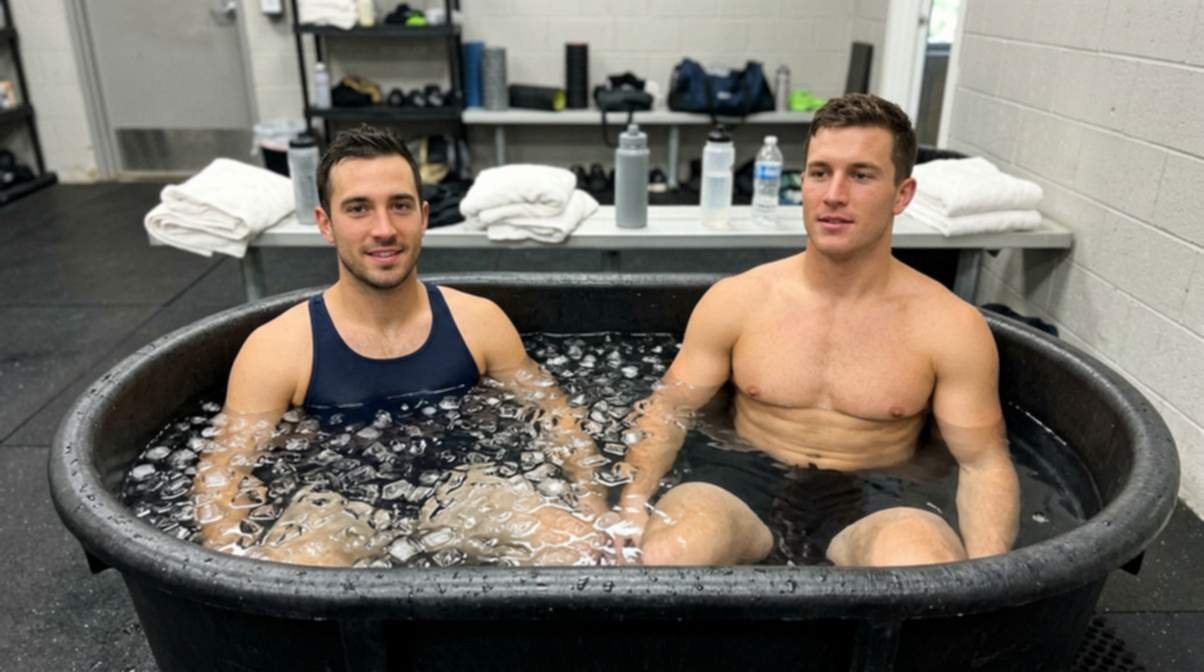
KEY TAKEAWAY: For AFL and NRL recovery, ice baths are most useful when the goal is short-term readiness: reducing soreness and feeling fresher after a match, heavy contact session, or short turnaround. Use 10-15°C for 10-15 minutes once you are experienced, start warmer and shorter at 12-15°C for 1-3 minutes, and avoid routine ice baths straight after strength or hypertrophy training if adaptation is the main goal.
The first 20 seconds after a hard footy match are never graceful. Your breathing jumps, your quads bite, and every cork, tackle and repeat sprint from the game seems to report in at once. That cold shock is why players hate ice baths. The quieter legs afterwards are why they keep coming back.
But here is the part that gets missed in most recovery advice: an ice bath is not automatically good or bad. For AFL and NRL players, the answer depends on the job you want the cold to do. If you need to feel better and be ready again in 24-48 hours, cold water immersion can be useful. If you have just finished a gym session designed to build muscle, strength, or long-term adaptation, jumping straight into freezing water can be the wrong move.
This guide gives you a practical protocol for post-game AFL and NRL recovery, explains where the evidence is strong, where it is mixed, and where the marketing gets carried away. For product-specific options, pair this with our comparison of the best ice baths. For a deeper general science guide, see are ice baths good for you? and our duration guide for how long to stay in an ice bath.
Safety warning: Cold water immersion is a real physiological stress, not a recovery toy. Royal Life Saving Society Australia says CWI carries risks including cold shock, hyperventilation, increased heart rate and blood pressure, arrhythmias, gasping, drowning risk, cramps, hypothermia and panic. Royal Life Saving recommends screening, gradual acclimatisation, monitoring water temperature, and treating 10-15°C as a generally safe range for most people. Start at 12-15°C for 1-3 minutes, never plunge alone, keep your head and neck out, and get GP advice first if you are over 50, pregnant, on blood pressure medication, or have cardiovascular disease, high blood pressure, Raynaud’s disease, cold urticaria, diabetes, poor circulation, open wounds, or any serious medical condition.
| Recovery situation | Use ice bath? | Protocol | Why |
| After AFL/NRL match with short turnaround | Yes, if safe | 10-15°C for 10-15 min; beginners 12-15°C for 1-3 min | Best fit: soreness relief, perceived freshness and next-session readiness. |
| After heavy contact or repeat-sprint session | Maybe | 10-15°C for 8-12 min, especially in season | Collision-sport evidence supports faster neuromuscular and soreness recovery, but studies are small. |
| After strength/hypertrophy gym session | Usually no | Wait 4-6+ hours or skip | Post-strength CWI can blunt anabolic signalling and muscle adaptation pathways. |
| During pre-season development block | Use sparingly | Reserve for unusually high soreness or very short turnarounds | Adaptation matters more than feeling fresh after every session. |
| After acute injury, cork, strain or suspected concussion | Do not DIY as treatment | Follow club physio/doctor advice | CWI is not a substitute for injury assessment or return-to-play protocols. |
| Home recovery for general soreness | Yes, cautiously | 12-15°C for 3-8 min; build gradually | Enough cold to train the response without chasing extreme temperatures. |
What an Ice Bath Can Actually Do for AFL & NRL Recovery
KEY TAKEAWAY: Cold water immersion is best supported for reducing perceived muscle soreness after hard exercise. The evidence for improving next-day performance is more mixed, and the evidence does not support using ice baths as a cure-all for inflammation, injury healing, immunity, or fitness gains.
For footy players, the most useful effect is simple: cold water can turn down soreness. A 2016 Sports Medicine meta-analysis found cold water immersion was slightly better than passive recovery for muscle soreness, with 11-15°C for 11-15 minutes giving the best overall result. Machado et al., 2016
Newer evidence broadly points in the same direction but adds nuance. A 2025 network meta-analysis of 55 randomised controlled trials found 10-15 minutes at 11-15°C ranked best for DOMS reduction, while 10-15 minutes at 5-10°C ranked best for creatine kinase and jump recovery markers. Wang et al., 2025 That does not mean every weekend player should chase 5°C water. It means experienced, supervised athletes may use colder protocols strategically, while most home users are better served by 10-15°C.
The most relevant collision-sport study used male rugby athletes performing intermittent sprint exercise with tackling, then either 20 minutes of cold water immersion or passive recovery. Cold water immersion improved immediate maximal voluntary contraction, voluntary activation and perceptions of soreness, but it did not lower blood markers of muscle damage. Pointon and Duffield, 2012 That is the AFL/NRL lesson in one sentence: you may feel and function better sooner, but the tissue damage does not magically disappear.
A 2026 network meta-analysis looked across resistance training, endurance exercise and team sports. It reported that ideal protocols vary by exercise type, that passive recovery appears preferable when the goal is resistance-training strength adaptation, and that team sport effects are inconsistent enough to require individualised use. Yu et al., 2026 That supports the smarter club approach: use cold to solve a specific recovery problem, not as an automatic ritual after every session.
The Best Ice Bath Protocol After an AFL or NRL Match
KEY TAKEAWAY: For most AFL and NRL players, the practical in-season protocol is 10-15°C for 10-15 minutes after matches or heavy contact sessions. Beginners should start at 12-15°C for 1-3 minutes and build over several weeks.
| Experience level | Temperature | Duration | Frequency | Notes |
| First 2-4 weeks | 12-15°C | 1-3 min | 1-2x/week | Learn breathing control. Exit if dizzy, numb, panicked, or chest-tight. |
| Regular club player | 10-15°C | 6-10 min | After matches or heavy contact only | Good balance of soreness relief and safety. |
| Experienced athlete | 10-12°C | 10-15 min | In-season as needed | Best for repeatable post-game recovery protocol. |
| Supervised elite setting | 5-10°C | 10-15 min | Selected short-turnaround cases | Evidence-supported for markers, but higher cold stress. Not a default home protocol. |
For AFL and NRL recovery, your target should be repeatable, not heroic. The player who can calmly sit in 12°C water for eight minutes and recover well has a better protocol than the player who lasts 60 seconds in 3°C water, spikes their breathing, and dreads doing it again.
A good post-match sequence is: cool down, rehydrate, start refuelling, shower if needed, then use the ice bath once your breathing is settled. If you are using it at home after a night match, do not delay sleep just to squeeze in cold exposure. Sleep still wins the recovery hierarchy.
For more exact time ranges, see IceBathLab’s how long in an ice bath guide. If you are deciding between a chiller tub and a DIY ice setup, the body cares about water temperature and duration, not whether the cold came from a compressor or servo ice. The practical differences are cost, hygiene, speed and repeatability. We break that down in our cold plunge vs ice bath comparison.
AFL vs NRL: How the Recovery Goal Changes
KEY TAKEAWAY: AFL and NRL both punish the legs, but NRL adds heavier repeated collision demands. In both sports, ice baths make the most sense when soreness and neuromuscular readiness are the bottleneck for the next session.
AFL match play is built around high running loads that are intermittent in nature, with repeated accelerations, decelerations, contests and long ground coverage. NRL and rugby league place a heavier collision layer over repeated high-intensity efforts. Rugby league research describes the sport as repeated high-intensity exercise with frequent collisions, and tackling can significantly increase physiological strain compared with repeated sprints alone. Johnston and Gabbett, 2011
That matters because cold water immersion is not only about “muscle soreness” in a gym sense. After footy, players are also managing contact soreness, central fatigue, joint irritation, sleep disruption, travel, hydration, and the mental load of backing up. Cold water can help one slice of that picture. It cannot fix the whole picture.
| Sport context | Likely recovery bottleneck | Cold water use |
| AFL match or hard running session | Leg soreness, repeat-sprint fatigue, lower-body heaviness | Lower-body immersion can be useful after games or running-heavy blocks. |
| NRL match or contact session | Collision soreness, neuromuscular fatigue, general heaviness | CWI may help perceived soreness and short-term function, but not tissue repair itself. |
| Strength/power gym session | Adaptation signal is the goal | Avoid immediate CWI unless short-term readiness beats adaptation. |
| Hot-weather training or travel | Thermal load, sleep disruption, perceived freshness | Use cautiously with hydration and medical oversight. |
When AFL & NRL Players Should Not Use an Ice Bath
KEY TAKEAWAY: Skip the ice bath when the main goal of the session is muscle growth, strength adaptation, or injury healing. Cold water may reduce soreness, but it can also blunt some signals that help the body adapt to training.
This is the part brands tend to bury. Post-exercise cold water immersion after resistance training has been shown to attenuate acute anabolic signalling and long-term muscle adaptations. Roberts et al., 2015 A related QUT-led study found cold water immersion was no more effective than active recovery for reducing inflammatory and cellular stress responses in skeletal muscle after resistance exercise. Peake et al., 2017
For a footy player, that does not mean “never cold plunge.” It means match-day and gym-day have different jobs. After a game, readiness matters. After a strength session, adaptation matters. If you are in a hypertrophy or strength block, keep cold water away from the immediate post-lift window where possible. A simple rule is to wait at least 4-6 hours after strength training, or save the ice bath for non-lifting days and post-match recovery.
Do not use a home ice bath to treat acute injuries, suspected concussion, serious corks, muscle strains, or post-contact symptoms that need assessment. A 2025 Journal of Physiology study on simulated muscle injury found hot water immersion improved some regeneration-related outcomes while cold water immersion did not improve chronic perceived muscle pain or reduce circulating damage markers. Dablainville et al., 2025 That does not make heat the answer for every injury. It does mean cold water is not a magic repair tool.
The 4 Best Use Cases for Ice Baths in Footy Season
KEY TAKEAWAY: Use ice baths in season when the recovery question is “how do I feel and move better before the next session?” not “how do I maximise every training adaptation?”
1. After a bruising match
Best fit: 10-15°C for 8-12 minutes once breathing is calm. This is the classic post-game use case. You are not trying to get fitter in the tub. You are trying to reduce soreness enough to move well, sleep well and start the next recovery day in better shape.
2. After heavy contact training
Best fit: 10-15°C for 6-10 minutes. If the session included repeated tackles, contested work, wrestling or high deceleration volume, cold water can be useful. Keep it away from key gym adaptation sessions unless the next 24 hours matter more than the training signal.
3. During short turnarounds
Best fit: 10-12°C for 10-15 minutes if you are experienced. This is where the soreness trade-off makes most sense: finals, tournaments, travel weeks, or a match followed by a demanding skills session. Junior soccer tournament research found post-match cold water immersion improved perceptions of fatigue and soreness and helped restore some match-running measures across a 4-day tournament. Rowsell et al., 2011
4. After hot-weather running or conditioning blocks
Best fit: 10-15°C for 8-12 minutes, with hydration sorted first. Pointon and colleagues also studied intermittent-sprint exercise in 32°C heat, followed by 20 minutes of CWI or passive recovery. Pointon et al., 2012 In Australian conditions, heat, hydration and sleep often matter as much as the cold itself.
What Science Does Not Support
KEY TAKEAWAY: Cold water can help some recovery outcomes, but it does not flush lactic acid, guarantee better performance, build immunity on command, or replace sleep, food, hydration and sensible training loads.
| Claim | Verdict | Better wording |
| “Ice baths flush lactic acid.” | Overstated | Lactate clears naturally after exercise; soreness is not simply lactate stuck in the legs. |
| “Colder is always better.” | False | Most useful protocols sit around 10-15°C; colder increases stress and discomfort. |
| “Use ice baths after every session.” | Bad advice | Use after matches or short turnarounds; avoid routine immediate use after strength blocks. |
| “Cold plunging boosts immunity.” | Weak evidence | UniSA 2025 found no significant immediate immune effect; cold showers showed fewer self-reported sick days in one large study. |
| “Ice baths heal injuries.” | Unsupported | Cold may reduce pain short-term but is not a repair protocol or return-to-play plan. |
| “If elite players do it, everyone should.” | Wrong frame | Elite players have supervision, screening, controlled dosing and different recovery priorities. |
The 2025 UniSA review is useful here because it looked beyond sport recovery. It included 11 studies with 3,177 participants and found time-dependent effects: inflammation increased immediately and one hour after CWI, stress was lower at 12 hours, no significant immune effect was detected immediately or one hour after CWI, and mood did not significantly differ in the RCT evidence. Cain et al., 2025 So when someone claims cold plunging fixes everything, be sceptical.
Australian Setup Tips for AFL & NRL Players
KEY TAKEAWAY: In Australia, the best setup is the one that lets you hit the right temperature safely and consistently. Southern winter tap water may be cold enough for beginners; Queensland summer usually needs serious ice or a chiller.
If you are recovering after footy at home, a thermometer matters more than the brand of tub. Do not guess the temperature with your hand. A 12°C plunge and a 5°C plunge can feel similar in the first 10 seconds but produce very different cold stress.
| Setup | Best for | Watch out for |
| Bath + bagged ice | Testing the habit cheaply | Temperature drift, mess, repeated ice cost, hygiene. |
| Portable insulated tub | Renters, local club players, backyard use | Still needs ice unless paired with a chiller. |
| Chiller cold plunge | Regular 3x/week users and athletes wanting repeatability | Higher upfront cost, power, water maintenance. |
| Club recovery station | Teams, short turnarounds, supervised protocols | Needs screening, documented supervision and emergency plan. |
For practical buying guidance, use our best ice baths in Australia guide. If you need something movable for garage, balcony, away games or club rooms, compare options in our best portable ice baths in Australia guide. The protocol is still the same: hit the right temperature, control duration, keep the water clean, and never treat “as cold as possible” as a goal.
FAQ: Ice Baths for AFL & NRL Recovery
Is an ice bath good after an AFL game?
Yes, an ice bath can be useful after an AFL game when the goal is short-term soreness relief and next-session readiness. Use 10-15°C for 10-15 minutes if experienced, or start at 12-15°C for 1-3 minutes if new to cold water immersion.
Should NRL players use ice baths after games?
NRL players can use ice baths after games, especially after heavy contact or short turnarounds, but they should not use them automatically after every training session. Save cold water for match recovery, contact soreness and readiness, not every strength block.
How long should a football player stay in an ice bath?
Most football players should stay in an ice bath for 6-15 minutes depending on experience, temperature and recovery goal. Beginners should start with 1-3 minutes at 12-15°C and build gradually.
What temperature should an AFL or NRL ice bath be?
A practical AFL or NRL ice bath temperature is 10-15°C. Evidence supports 11-15°C for soreness reduction, while colder 5-10°C protocols may help some recovery markers but should be reserved for experienced or supervised athletes.
Should I ice bath after weights?
You should usually avoid an ice bath immediately after weights if your goal is strength, muscle growth or long-term adaptation. Wait at least 4-6 hours, or use cold water after matches and conditioning sessions instead.
Is a cold plunge better than an ice bath for footy recovery?
A cold plunge is not physiologically better than an ice bath if water temperature and duration are matched. The main advantage of a cold plunge is convenience, temperature consistency, filtration and repeatability.
Do junior AFL or rugby league players need ice baths?
Junior players usually do not need ice baths unless supervised by a qualified coach, physio or medical professional. Sleep, food, hydration, smart training load and gradual return after soreness matter more.
Can I cold plunge before training or a match?
Cold plunging right before training or a match is usually not the best choice because it can make muscles feel stiff and reduce readiness if you do not rewarm properly. Use cold water after the session unless a professional has programmed a specific pre-cooling strategy.
Is colder better for AFL and NRL recovery?
No, colder is not automatically better for AFL and NRL recovery. The useful range is usually 10-15°C, and going much colder mainly increases cold shock, discomfort and risk.
How often should footy players use ice baths in season?
Most footy players should use ice baths after matches, heavy contact sessions or short turnarounds, not every day by default. Two to three sessions per week can be plenty during demanding blocks, and less is better when adaptation is the priority.
Sources
Medical disclaimer: This article is general education only and is not medical advice. Cold water immersion is not suitable for everyone. Speak to a GP, sports doctor or physiotherapist before starting if you have a medical condition, are pregnant, are over 50, take blood pressure medication, or have any cardiovascular, circulation, neurological or cold-sensitivity concerns.
