
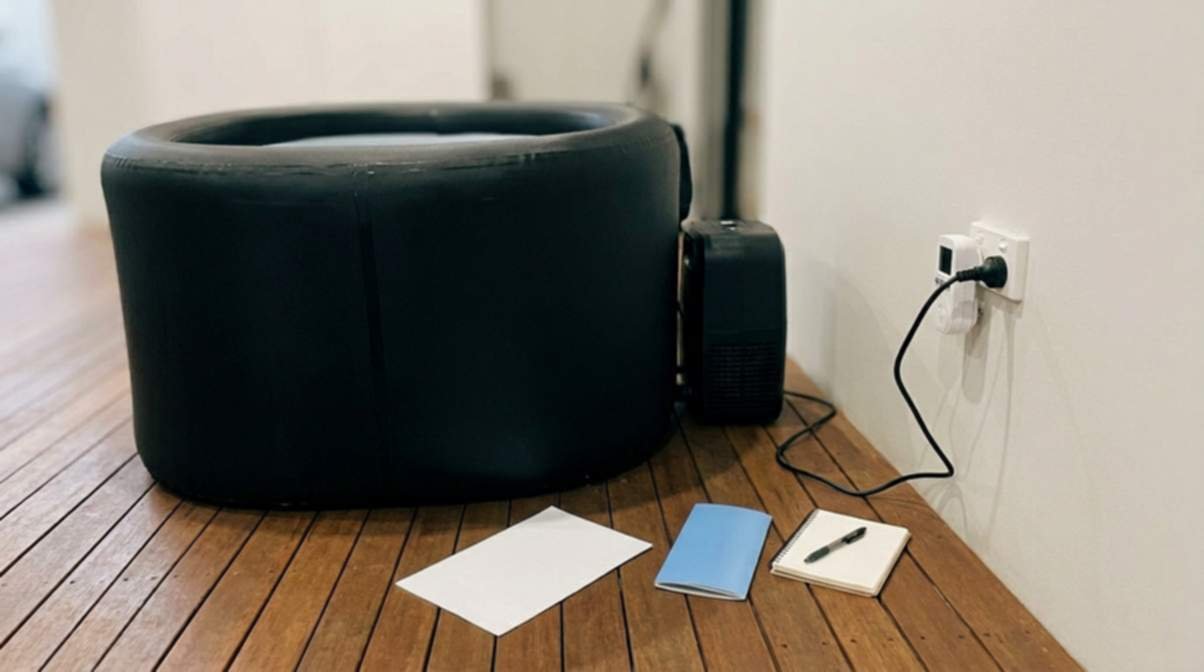
KEY TAKEAWAY: Most home ice bath chillers cost roughly AUD $0.35-$1.40 per day once the water is already cold, assuming 1-4 kWh/day and a $0.35/kWh electricity rate. Use the calculator below with your actual tariff, chiller watts, compressor run time and pump hours before trusting any brand’s ‘$0.50/day’ claim.
A cold plunge feels simple once you own one: set the temperature, shut the lid, and let the chiller do its thing. The bill is where the confusion starts. Is your ice bath electricity cost number closer to $15 a month, $60 a month, or the scary $200+ figures you see in forums?
The honest answer: it depends on how many kilowatt-hours your setup uses, not on the horsepower badge printed on the chiller. A small, insulated tub in Melbourne winter can sip power. A big outdoor tub in Brisbane summer, sitting in the sun with the lid off, can chew through far more.
This guide gives you the running cost formula, realistic Australian examples, and a simple way to check whether a chiller, chest-freezer setup, or bags of ice make sense. For product context, compare this with our tested guide to the best ice baths in Australia, our science guide to ice bath benefits and our ice bath duration guide.
Safety Warning: Electricity Cost Is Not the Only Risk
Cold water immersion is not risk-free. Royal Life Saving Society Australia warns that CWI can trigger shock responses such as hyperventilation, increased heart rate, increased blood pressure, gasping, cramps, panic and hypothermia. Its advice also flags higher risk for pregnant women and people with chronic illness, heart problems, circulatory issues, high blood pressure, autoimmune disorders or Raynaud’s disease.
If you’re new, start around 15-16°C for 1-2 minutes and build slowly. Don’t plunge alone. If you’re over 50, on medication that affects heart rate or blood pressure, pregnant, or have cardiovascular, neurological or circulation concerns, speak to your GP first. Keep the chiller, extension leads and any power boards away from splash zones, and use a weather-safe outdoor power setup installed to Australian electrical standards.
Ice Bath Running Cost: Quick Summary
| Setup | Typical electricity use | Approx cost at $0.35/kWh | Best for | Watch-outs |
| No-chiller portable tub + bags of ice | Near-zero electricity | $0 electricity, but ice may cost $5-$40/session | Occasional plunges, low upfront cost | Inconsistent temperature, ice logistics, waste |
| Small home chiller in maintenance mode | 1-2 kWh/day | $0.35-$0.70/day or $11-$21/month | Regular home use in an insulated tub | Warm weather and no lid can double run time |
| Standard 1HP home chiller | 2-4 kWh/day in many real-world setups | $0.70-$1.40/day or $21-$43/month | Daily or near-daily cold plunge users | Max watts are not the same as 24/7 energy use |
| Large 1.5HP to 2HP chiller | 5-15 kWh/day depending on duty cycle | $1.75-$5.25/day or $53-$160/month | Large tubs, two-person tubs, hot/cold units, commercial use | Heating mode usually costs more than chilling maintenance |
| Chest-freezer style ice bath | Under 2 kWh/day in one AU product test | Under $0.70/day or about $21/month | DIY-style or semi-permanent cold storage | Electrical safety, condensation and water treatment need care |
These are planning ranges, not guarantees. The Australian Government’s appliance method is to find the wattage, convert watts to kilowatts, multiply by hours used, then multiply by your cents-per-kWh rate from your bill. That method is published by energy.gov.au.
Ice Bath Electricity Cost Calculator
KEY TAKEAWAY: Use kWh/day if the manufacturer provides it. If they only give watts, estimate compressor hours per day, then add pump or filtration watts. Your actual electricity tariff matters more than the brand’s marketing number.
Formula A – when you know kWh/day
Daily cost = kWh per day x electricity price per kWh
Monthly cost = daily cost x 30.4
Yearly cost = daily cost x 365
Formula B – when you know watts
Daily kWh = (chiller watts ÷ 1000 x compressor hours) + (pump watts ÷ 1000 x pump hours)
Daily cost = daily kWh x electricity price per kWh
Use the c/kWh on your bill. Energy Made Easy explains that time-of-use plans can have peak, shoulder and off-peak periods, with off-peak usually cheaper overnight and on weekends. That matters if you schedule your chiller.
Copy This Calculator Into the Blog
| Input | Your number | Example | Notes |
| Electricity tariff | _____ $/kWh | $0.35/kWh | Use your bill. Divide c/kWh by 100. |
| Chiller power draw | _____ W | 1,070 W | Use input watts, not cooling capacity. |
| Compressor run time | _____ h/day | 3 h/day | After water reaches set temp, it cycles on/off. |
| Pump/filter draw | _____ W | 30 W | Only include if pump runs separately. |
| Pump/filter run time | _____ h/day | 24 h/day | Many systems filter continuously. |
| Daily kWh | _____ kWh | (1070/1000 x 3) + (30/1000 x 24) = 3.93 kWh | This is the number that drives cost. |
| Daily cost | _____ AUD | 3.93 x $0.35 = $1.38/day | Multiply by 30.4 for monthly. |
Daily, Monthly and Yearly Cost by kWh/day
| Energy use | At $0.25/kWh | At $0.35/kWh | At $0.45/kWh |
| 1 kWh/day | $0.25/day | $8/mo | $91/yr | $0.35/day | $11/mo | $128/yr | $0.45/day | $14/mo | $164/yr |
| 1.5 kWh/day | $0.38/day | $11/mo | $137/yr | $0.52/day | $16/mo | $192/yr | $0.68/day | $21/mo | $246/yr |
| 2 kWh/day | $0.50/day | $15/mo | $182/yr | $0.70/day | $21/mo | $255/yr | $0.90/day | $27/mo | $328/yr |
| 3 kWh/day | $0.75/day | $23/mo | $274/yr | $1.05/day | $32/mo | $383/yr | $1.35/day | $41/mo | $493/yr |
| 4 kWh/day | $1.00/day | $30/mo | $365/yr | $1.40/day | $43/mo | $511/yr | $1.80/day | $55/mo | $657/yr |
| 6 kWh/day | $1.50/day | $46/mo | $548/yr | $2.10/day | $64/mo | $766/yr | $2.70/day | $82/mo | $986/yr |
| 8 kWh/day | $2.00/day | $61/mo | $730/yr | $2.80/day | $85/mo | $1022/yr | $3.60/day | $109/mo | $1314/yr |
| 12 kWh/day | $3.00/day | $91/mo | $1095/yr | $4.20/day | $128/mo | $1533/yr | $5.40/day | $164/mo | $1971/yr |
Real Australian Chiller Examples
KEY TAKEAWAY: A ‘$0.50/day’ ice bath running cost can be realistic for a small efficient chiller in maintenance mode, but it is not a universal number. Bigger chillers, hotter weather, colder set points and poor insulation can push costs much higher.
Primal Ice gives one of the clearer Australian examples: its chiller page lists 280 W power usage and says that at 25°C room temperature with the water set to 8°C, it uses about 1.4-1.8 kWh per 24 hours. At $0.35/kWh, that works out to $0.49-$0.63 per day. Source: Primal Ice chiller page.
Kiva Wellness lists higher maximum input numbers: 1,070 W for its 1HP option and 1,380 W for 1.5HP. It also states the unit reduces power draw after it reaches temperature, which is exactly why a max-watt label should not be treated as continuous 24-hour use. Source: Kiva Wellness chiller page.
For chest-freezer style setups, Proactive Recovery’s Plunge City page claims a 71 W power rating and reports less than 2 kWh/day in a month-long test at 1°C with filtration on 24/7, with typical running costs around $15-$20/month depending on settings. Source: Proactive Recovery.
The high-end cautionary example is continuous 24-hour use. Luxo Living says its 1.5HP Denman chiller uses about 1.1 kWh per hour and would cost $7.92-$10.56 for 24 hours at $0.30-$0.40/kWh. That is useful as a worst-case-style calculation, but most home users should focus on the number of hours the compressor actually runs after the water reaches set temperature. Source: Luxo Living.
| Example | Published input or claim | Calculator check | What it means |
| Primal home chiller | 1.4-1.8 kWh/day at 25°C room temp, 8°C set point | 1.4-1.8 x $0.35 = $0.49-$0.63/day | A $15-$20/month home figure is plausible in mild conditions. |
| Kiva 1HP chiller | 1,070 W max input, reduced draw after reaching set temp | If compressor runs 3 h/day + 30 W pump 24 h: about 3.93 kWh/day = $1.38/day | Max watts help estimate pull-down cost, not average daily cost. |
| Kiva 1.5HP chiller | 1,380 W max input | If compressor runs 4 h/day + 30 W pump 24 h: about 6.24 kWh/day = $2.18/day | Large tubs and hot weather can move the cost into $60+/month territory. |
| Plunge City chest freezer | <2 kWh/day in month-long test | 2 x $0.35 = $0.70/day maximum from the stated test | Efficient, but DIY/freezer setups need careful electrical and hygiene management. |
| Luxo 1.5HP 24h example | 1.1 kWh/hour continuous | 1.1 x 24 x $0.30-$0.40 = $7.92-$10.56/day | Good for worst-case maths, not a typical maintenance-mode assumption. |
Why Your Cold Plunge Running Cost Changes So Much
KEY TAKEAWAY: The big cost drivers are heat load, insulation, lid quality, set temperature, water volume, ambient temperature, compressor efficiency and pump schedule. Your suburb and setup matter as much as the chiller brand.
| Cost driver | Why it matters |
| Set temperature | Holding 6°C costs more than holding 12°C, especially in a warm garage or courtyard. |
| Ambient temperature | Brisbane, Darwin and Perth summers create more heat gain than a Melbourne winter. |
| Insulation and lid | An insulated tub with a tight lid needs fewer compressor cycles. An open inflatable tub in sun is a power leak. |
| Water volume | A 650 L two-person tub needs more energy to pull down than a 300 L one-person tub. |
| Pull-down vs maintenance | The first cool-down can cost much more than the days that follow. |
| Pump and ozone schedule | A 20-60 W pump running 24/7 can add 0.48-1.44 kWh/day before the compressor starts. |
| Hot/cold mode | Heating to 38-42°C usually changes the economics. This guide is about cold-running cost, not spa heating. |
For temperature planning, read our ice bath temperature guide. For build decisions, our DIY cold plunge guide is the better place to map tub type, insulation and filtration before you spend money.
Chiller vs Bags of Ice: Which Is Cheaper?
KEY TAKEAWAY: For one-off plunges, ice is cheaper upfront. For regular use, the chiller usually wins on convenience and per-session cost, but it only pays off if you actually use it often enough.
A bag-of-ice setup has almost no electricity cost, but it has a repeat cost every time you plunge. Competitor pages commonly quote ice costs anywhere from $5-$40 per session depending on the amount and source. The more honest comparison is not ‘$0 electricity vs chiller electricity’. It is ice cost, water waste and prep time versus electricity, filtration and upfront chiller cost.
As a rough break-even test, multiply your ice cost per session by sessions per year. If you spend $15 per session and plunge 3 times a week, ice is about $2,340/year. If your chiller costs $35/month to run, electricity is about $420/year. That does not mean the chiller pays for itself instantly, but it explains why daily users get sick of servo ice quickly.
How to Lower Ice Bath Electricity Cost
KEY TAKEAWAY: The easiest savings are boring: use the lid, keep the tub shaded, insulate exposed surfaces, schedule cooling off-peak or during solar generation, and avoid colder-than-needed set points.
| Saving move | Why it works |
| Use a proper insulated lid | Most heat gain happens through the surface. Close the lid as soon as you finish. |
| Keep it out of direct sun | Shade cuts the heat load and protects plastics, PVC and electronics. |
| Pre-cool during cheaper windows | On a time-of-use tariff, overnight/off-peak cooling may reduce cost. Check your retailer’s time windows. |
| Use solar self-consumption | If you have rooftop solar, daytime cooling can use more of your own generation instead of exporting it at a lower feed-in tariff. |
| Set 10-15°C for most goals | Colder is not automatically better. A 2025 network meta-analysis supports specific 10-15 minute protocols around 11-15°C for soreness, not ‘as cold as possible’. |
| Clean the filter | A clogged filter can reduce flow, increase run time and stress the pump. |
| Don’t chase 0°C marketing | Unless you have a niche reason, holding water near freezing adds cost and risk without stronger general-wellness evidence. |
Energy.gov.au notes that solar bill savings are strongest when households self-consume their solar generation. Read the Australian Government solar guide.
For the training side, don’t use electricity savings as an excuse to leave the tub dangerously cold. Wang et al. 2025 and Machado et al. 2016 support cold water immersion for soreness in specific dose ranges, not extreme cold for bragging rights.
What Most Running-Cost Claims Get Wrong
KEY TAKEAWAY: A good running-cost claim should show kWh/day, tariff, set temperature, ambient temperature, water volume and whether the compressor is cycling. If a page gives only ‘$0.50/day’, treat it as a marketing estimate.
Some Australian pages give a single monthly figure without the formula. VERVE’s chiller guide says chiller-equipped ice baths cost $5-$15/month in electricity, but the article does not show the kWh/day calculation behind that number. Source: VERVE.
Ritual Recovery says a chiller-equipped cold plunge consumes about 1-2 kWh/day, which is plausible, but then converts it to roughly $1.50-$3/day. At $0.35/kWh, 1-2 kWh/day is $0.35-$0.70/day, so the dollar estimate does not follow a standard residential per-kWh calculation unless other costs are being included. Source: Ritual Recovery.
Proactive Recovery’s industrial iCoolSport page is clearer about assumptions: $2.50 per 24 hours at 50% duty cycle and $0.25/kWh. That implies around 10 kWh/day. Different setup, very different power class. Source: Proactive Recovery iCoolSport.
The cut-the-BS rule: if the page won’t tell you the watts, kWh/day, tariff and test conditions, don’t treat its running-cost claim as a fact. Treat it as a sales estimate.
Recommended Calculator Defaults for Australian
KEY TAKEAWAY: For a quick estimate, use $0.35/kWh, 1-2 kWh/day for small efficient home systems, 2-4 kWh/day for standard 1HP home chillers, and 5-15 kWh/day for large, commercial, hot/cold or poorly insulated setups.
| User type | Suggested default | Use this when | Better input if available |
| Beginner with portable tub + compact chiller | 1.5 kWh/day | Small tub, shaded, lid on, 8-12°C set point | Manufacturer kWh/day test |
| Daily home user with 1HP chiller | 3 kWh/day | Normal insulated home setup | Watts + compressor hours from smart plug |
| Warm-climate outdoor setup | 4-6 kWh/day | Brisbane, Darwin, Perth summer or sunny courtyard | Smart plug kWh/day reading over 7 days |
| Large two-person or commercial tub | 8-12 kWh/day | High water volume, repeated use, 1.5HP+ | Dedicated energy meter reading |
| Chest freezer style unit | 1-2 kWh/day | Freezer/converted setup with lid closed | Plug-in energy meter |
The best way to stop guessing is a plug-in energy meter or a smart plug with energy monitoring, checked over a full week. That catches the pull-down day, the maintenance days and your real pump schedule.
Frequently Asked Questions
How much does an ice bath cost to run in Australia?
Most home ice bath chillers cost between $0.35 and $1.40 per day in electricity once the water is already cold, assuming 1-4 kWh/day and a $0.35/kWh tariff. This translates to roughly $11-$43 per month. However, costs can range from near-zero for ice-only setups to over $5/day for large, poorly insulated tubs in hot climates. Use the calculator above with your specific setup for a more accurate estimate.
How do I calculate ice bath chiller electricity cost?
Use the Australian Government’s appliance method: 1) Find the chiller’s input wattage (not cooling capacity). 2) Estimate how many hours per day the compressor runs after reaching set temperature. 3) Add any pump/filter wattage and run time. 4) Convert watts to kilowatts (divide by 1000). 5) Multiply kilowatts by hours to get kWh/day. 6) Multiply kWh/day by your electricity price per kWh (from your bill).
Is a 1HP ice bath chiller expensive to run?
Not necessarily. A 1HP chiller might have a maximum input of around 1,070 watts, but it doesn’t run at that wattage 24/7. In a typical insulated home setup, the compressor might only run for 2-4 hours per day in maintenance mode, leading to an energy use of 2-4 kWh/day. At $0.35/kWh, that’s $0.70-$1.40 per day or $21-$43 per month. The key is the duty cycle, not the horsepower rating.
Does an ice bath chiller run 24/7?
No, a properly functioning chiller should not run continuously. Once the water reaches the set temperature, the compressor cycles on and off to maintain it. The compressor run time depends on heat load (sun, ambient temperature, insulation, lid use). In maintenance mode, a chiller might only run for 1-4 hours per day. Continuous running indicates a problem (e.g., insufficient cooling capacity, extreme heat gain, or a fault).
What is cheaper, ice or a chiller?
For one-off or occasional plunges, buying bags of ice is cheaper upfront (though ice can cost $5-$40 per session). For regular use (e.g., 3+ times per week), a chiller becomes more cost-effective over time. Example: Ice at $15/session, 3x/week = ~$2,340/year. A chiller at $35/month electricity = ~$420/year. The chiller also offers consistent temperature, convenience, and integrated filtration.
How many kWh does a cold plunge use per day?
Typical daily energy use varies widely: Small efficient home chillers: 1-2 kWh/day. Standard 1HP home chillers: 2-4 kWh/day. Large or poorly insulated setups in warm climates: 5-15 kWh/day. Chest-freezer style units: Often under 2 kWh/day. Always check manufacturer test data (kWh/day at specific conditions) or measure with an energy meter for your exact setup.
Can solar panels reduce cold plunge running cost?
Yes, significantly. If you have rooftop solar, running your chiller during daylight hours uses your own generated electricity, reducing reliance on grid power. This is called solar self-consumption and is more valuable than exporting excess solar at a lower feed-in tariff. Scheduling cooling during peak solar generation can effectively make the running cost near-zero on sunny days.
Should I switch my chiller off between plunges?
Generally, no. Switching the chiller off completely means it must work harder (and use more energy) to cool the water from ambient temperature back down to your set point—a process called ‘pull-down.’ It’s more efficient to let the chiller maintain the temperature, cycling on/off as needed. The exception might be if you’re going away for an extended period.
Does colder water use more electricity?
Yes. Holding water at 3°C requires significantly more energy than holding it at 12°C, especially in warm environments. The chiller must work against a greater temperature differential. Research supports benefits (like reduced muscle soreness) at 11-15°C, so there’s little need for most users to chase near-freezing temperatures, which add cost and risk.
How can I test my ice bath power consumption?
Use a plug-in energy meter (available from hardware stores) or a smart plug with energy monitoring. Plug your chiller into it for at least a full week to capture different conditions (pull-down day, maintenance days, varying weather). This will give you an accurate kWh/day reading. Multiply this by your electricity tariff for your true running cost.
Do pumps and filters add much to ice bath running cost?
They can. A small pump (20-60W) running 24/7 adds 0.48 to 1.44 kWh per day. At $0.35/kWh, that’s an extra $0.17-$0.50 per day or $5-$15 per month. This is often overlooked in running cost estimates. If your system allows, consider running the pump on a timer (e.g., a few hours per day) rather than continuously, provided water quality is maintained.
Is a chest freezer ice bath cheaper to run?
Often, yes. Chest freezers are designed for efficient, well-insulated cold storage. Some Australian-converted models report using less than 2 kWh/day. However, they require careful attention to electrical safety (GFCI/RCD protection, outdoor-rated setup), condensation management, and water treatment. They are not inherently ‘plug-and-play’ like purpose-built chillers.
Australian Government. Energy ratings and appliance running cost calculation. energy.gov.au.
Energy Made Easy. Which type of energy tariff is right for you? energymadeeasy.gov.au.
Australian Government. How solar pays for itself and batteries reduce bills. energy.gov.au.
Royal Life Saving Society Australia, AUSactive and SPASA. Position Statement: Cold Water Immersion Therapy, 2024. Royal Life Saving.
Primal Ice. Ice Bath Chiller, power usage and example kWh/day claim. Primal Ice.
Kiva Wellness. Ice Bath Chiller Unit, 1HP/1.5HP input power and energy-saving claims. Kiva Wellness.
Proactive Recovery. Plunge City Chest Freezer Ice Bath, power consumption and running cost FAQ. Proactive Recovery.
Luxo Living. Denman 2-Person Outdoor Ice Bath with 1.5HP Chiller, 24-hour cost example. Luxo Living.
Proactive Recovery. iCoolSport Turbo Mini Ice Bath Chiller, 50% duty-cycle running cost claim. Proactive Recovery.
VERVE Fitness. Best Ice Bath with Chiller Australia 2026, competitor running-cost claim. VERVE Fitness.
Ritual Recovery. Cold Plunge vs Ice Bath, competitor kWh/day and cost claim. Ritual Recovery.
Wang H, Wang L, Pan Y. Impact of different doses of cold water immersion on recovery from acute exercise-induced muscle damage: a network meta-analysis. Frontiers in Physiology. 2025;16:1525726. DOI: 10.3389/fphys.2025.1525726.
Machado AF et al. Can water temperature and immersion time influence the effect of cold water immersion on muscle soreness? Sports Medicine. 2016;46(4):503-514. DOI: 10.1007/s40279-015-0431-7.
Cain T, Brinsley J, Bennett H, Nelson M, Maher C, Singh B. Effects of cold-water immersion on health and wellbeing: a systematic review and meta-analysis. PLOS One. 2025;20(1):e0317615. DOI: 10.1371/journal.pone.0317615.
Mayo Clinic Health System. Cold-water plunging health benefits, 2024. Mayo Clinic Health System.
Medical disclaimer: This article is for informational purposes only and does not constitute medical advice. Cold water immersion carries risks. Speak with a GP before starting, especially if you have heart, blood pressure, circulation, neurological or pregnancy-related concerns.
