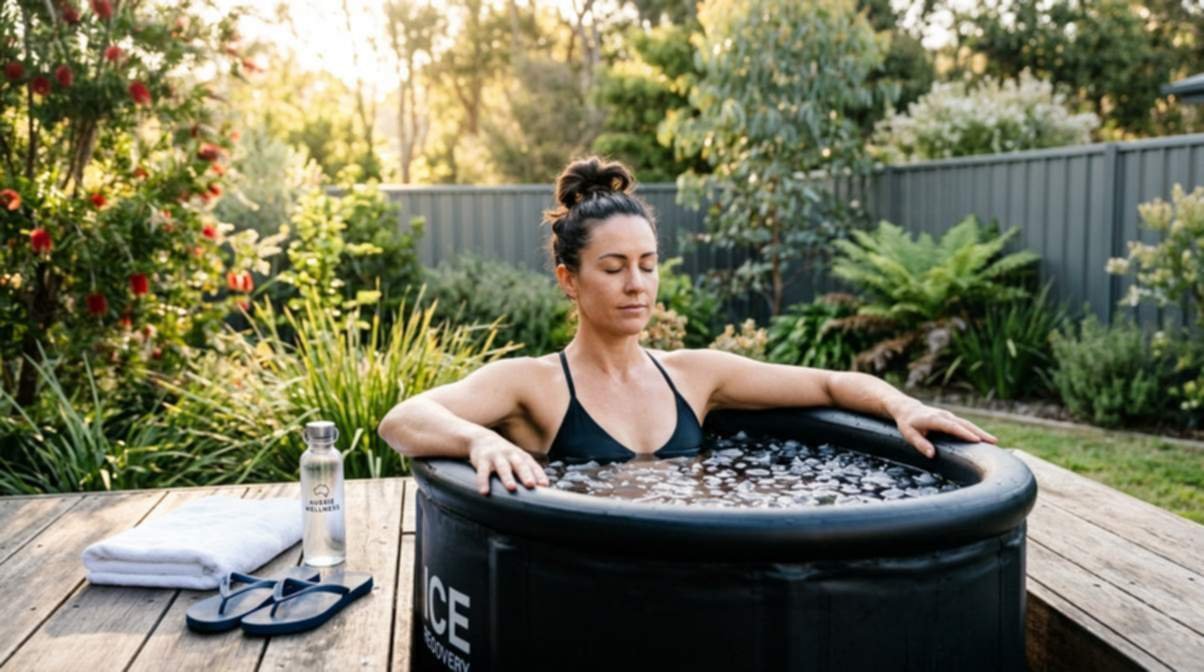
You’ve seen the reels: someone drops into a tub of ice water, gasps, and claims they’re burning fat while sitting still. It’s a compelling pitch especially when it comes with a six-pack and a sunset backdrop. But can ice baths actually help you lose weight, or is this just cold-water hype?
As Australians, we’re no strangers to jumping into cold water. From winter ocean dips at Bondi to backyard plunge tubs in Melbourne, cold exposure is having a moment. And with more brands marketing ice baths as “metabolism boosters” and “fat burners,” it’s worth separating what the research actually supports from what’s just good marketing.
This guide breaks down the 2024–2026 evidence on ice baths and weight loss including what works, what doesn’t, and what the brands won’t tell you. If you’re new to cold water immersion, start with our complete science guide to ice bath benefits before diving in.
Key Takeaway : Ice baths can increase calorie burn modestly through cold thermogenesis and brown fat activation, but the effect is small roughly 50–200 extra kilojoules per session. A 2024 narrative review in Nutrients found that intermittent cold exposure does not consistently lower body weight or fat mass. Cold plunging may support weight management as part of a broader routine (diet, exercise, sleep), but it’s not a standalone fat-loss tool.
Safety First: Read Before You Plunge
Cold water immersion carries real risks. Before starting any ice bath routine for weight loss or otherwise:
- Start at 15–16°C and work down to 10–15°C over several sessions.
- Limit sessions to 2–10 minutes, especially as a beginner.
- Never plunge alone. Cold shock can cause involuntary gasping and loss of motor control.
- If you’re over 50, have cardiovascular conditions, Raynaud’s disease, or are pregnant, talk to your GP first.
- The Royal Life Saving Society Australia advises against unsupervised cold water immersion, particularly in natural waterways.
Contraindications: uncontrolled hypertension, heart arrhythmias, epilepsy, open wounds, active infection.
Ice Baths and Weight Loss
| Claim | Evidence Level | What Research Actually Shows |
| Burns significant calories | Weak | ~50–200 extra kJ per session. A 2025 Coventry University study found participants ate 231 more calories after CWI, negating the burn. |
| Activates brown fat | Moderate | Cold does activate BAT and promote WAT-to-beige conversion. But a 2024 Nutrients review found this doesn’t consistently reduce body weight. |
| Boosts metabolism long-term | Limited | Metabolic rate rises during and shortly after immersion. No strong evidence for sustained resting metabolic increase in humans. |
| Improves insulin sensitivity | Moderate | Repeated CWI may increase adiponectin and improve glucose tolerance. Potential anti-diabetic benefit, not direct fat loss. |
| Standalone weight loss tool | Not supported | No meta-analysis or RCT shows CWI alone produces meaningful weight loss. Diet and exercise remain essential. |
| Supports recovery (indirect) | Strong | Machado 2016 meta-analysis (9 RCTs): 11–15°C for 11–15 min reduces DOMS. Faster recovery = more consistent training. |
How Cold Water Immersion Affects Your Body
| Key Takeaway When you immerse yourself in cold water, your body mounts a stress response vasoconstriction, noradrenaline release, and increased metabolic activity to maintain core temperature. This is called cold thermogenesis. |
The moment you step into water below about 15°C, your body shifts into survival mode. Blood vessels near your skin constrict to preserve core heat. Your sympathetic nervous system fires, flooding your bloodstream with noradrenaline and adrenaline. Your muscles may start shivering an involuntary response that burns glucose to generate warmth.
This cascade of responses is what makes cold water immersion (CWI) interesting for weight loss researchers. Your body is genuinely working harder burning energy to stay warm. But the key question is: does it burn enough to make a real difference?
A landmark early study by Šrámek et al. (2000) found that cold water immersion at 14°C increased noradrenaline by 530% and dopamine by 250%. However and this is a detail most ice bath blogs leave out that was a 1-hour immersion. Nobody is recommending you sit in 14°C water for an hour. At practical durations of 2–15 minutes, the hormonal response is real but considerably smaller.
An earlier study by Johnson (1977) demonstrated that norepinephrine increases can occur in as little as 2 minutes at 10°C, which is encouraging for short protocols. But elevated noradrenaline alone doesn’t equal fat loss it’s one piece of a much larger metabolic puzzle.
Brown Fat Activation: The Mechanism Behind the Hype
| Key Takeaway Cold exposure activates brown adipose tissue (BAT) and may convert some white fat to a metabolically active “beige” form. However, a 2024 review in Nutrients concluded this does not consistently reduce body weight or fat mass in humans. |
Your body has two main types of fat. White adipose tissue (WAT) stores energy this is the fat you’re thinking of when you think about weight loss. Brown adipose tissue (BAT) does the opposite: it burns energy to generate heat, a process called non-shivering thermogenesis.
Cold exposure activates existing BAT and may stimulate the conversion of white fat into a hybrid “beige” fat that behaves more like brown fat. This is well-established in the literature and represents a genuine physiological response.
Here’s where the marketing runs ahead of the science. A 2024 narrative review published in Nutrients examined the effects of intermittent cold exposure (ICE) on adipose tissue across multiple studies. Their conclusion was direct: “As a mechanism for weight loss, the evidence does not support ICE.” The review found that while cold exposure consistently increases BAT activity and promotes WAT beiging, body weight effects in human studies were generally null. Some rodent studies actually showed increased body weight and fat mass the opposite of what you’d expect.
The review did note a more promising finding: cold exposure may improve metabolic outcomes like glucose tolerance and insulin signalling, suggesting potential as an anti-diabetic intervention rather than a weight loss tool.
How Many Calories Do Ice Baths Actually Burn?
| Key Takeaway The calorie burn from a typical ice bath session is modest roughly 50-200 extra kilojoules and a 2025 Coventry University study found that increased appetite after CWI may completely offset it. |
This is the question everyone wants answered, and the honest answer is: not many.
Cold thermogenesis does increase energy expenditure during and after immersion. Your body burns fuel to shiver, maintain core temperature, and rewarm itself. Various estimates suggest an additional 50–200 calories (roughly 200–840 kJ) per session, depending on water temperature, duration, and individual factors like body composition.
But here’s a finding that most ice bath brands won’t mention. A 2025 study from Coventry University (published in Physiology & Behaviour) tested 15 healthy adults in three conditions: 30 minutes in 16°C water, 35°C water, or ambient air. The cold water group did burn about 21 more calories during immersion but they ate an average of 231 more calories in the hours afterward. The researchers concluded that “there is the potential to increase unwanted body mass due to potential overeating in the immediate hours after cold-water immersion.”
In other words, the ice bath made people hungrier even though they didn’t report feeling hungrier. They just ate more. If you’re plunging for fat loss, what you eat after the session may matter more than the plunge itself.
Where the Evidence Is Mixed: Insulin, Metabolism, & Hormones
| Key Takeaway Cold exposure may improve insulin sensitivity and increase adiponectin, offering metabolic health benefits. But these are distinct from direct fat loss, and the evidence comes mostly from small studies. |
Not all the weight-related science on cold exposure is negative. There are some promising signals they just don’t point where the marketing suggests.
A 2022 review of 104 studies in the International Journal of Circumpolar Health found that cold water swimming was associated with increased adiponectin a hormone produced by fat tissue that helps prevent insulin resistance. Repeated cold water immersion also appeared to improve insulin sensitivity and reduce fasting insulin concentrations.
The Cain et al. (UniSA) 2025 meta-analysis in PLOS One reviewed 11 studies covering 3,177 participants and found that cold water immersion produced a significant reduction in self-reported psychological stress at 12 hours post-immersion. While the review focused on health and wellbeing rather than weight, the stress reduction finding is relevant chronic stress elevates cortisol, which is linked to abdominal fat storage.
These are genuine benefits, but they’re metabolic health improvements not direct fat loss. Framing cold exposure as a weight loss tool when the evidence better supports it as a metabolic health intervention is where a lot of content gets it wrong.
What the Science Does NOT Support
| Key Takeaway No meta-analysis or RCT shows that ice baths alone cause meaningful weight loss. Several common claims are exaggerated, unsupported, or missing critical context. |
If a brand or influencer tells you ice baths are a “game-changer” for weight loss, that’s a red flag. Here’s what the research doesn’t support:
Ice baths burn hundreds of calories per session
The extra burn is modest and, as the Coventry 2025 study showed, may be offset by post-immersion appetite increases. You’d burn more calories going for a brisk 30-minute walk.
Cold exposure converts white fat to brown fat and melts away body fat
BAT activation and WAT beiging are real, but the 2024 Nutrients review was explicit: this does not consistently translate to lower body weight in humans. Some studies even showed increased fat mass.
Ice baths are just as effective as exercise for weight loss
Not remotely. The energy expenditure from cold exposure is a fraction of what structured exercise produces. And critically, ice baths may actually blunt muscle growth if used immediately after strength training. Roberts et al. (2015) found that CWI after resistance exercise attenuates anabolic signalling, and Peake et al. (2017) from the same QUT lab showed CWI blunts satellite cell activity. A 2024 meta-analysis by Piñero et al. confirmed CWI likely diminishes muscle hypertrophy compared to resistance training alone.
More muscle = higher resting metabolism, so why would you blunt it?
Exactly. If you’re doing strength training for body composition, plunging right after your session may actually work against your weight loss goals. Wait at least 4–6 hours, or save your cold plunge for rest days.
Best Time to Cold Plunge for Weight Loss
| Key Takeaway The best time to cold plunge for weight loss is on rest days or at least 4–6 hours after strength training. Morning sessions may offer a metabolic and alertness boost without interfering with muscle adaptation or sleep. |
Timing matters more than most people realise. Here’s what the research suggests:
| Timing | Rationale | Best For |
| Morning (fasted or light meal) | Noradrenaline spike enhances alertness; cold thermogenesis adds to daily expenditure early. | General metabolic support, energy |
| Rest days | No interference with muscle protein synthesis or hypertrophy signalling. | Strength trainees, body composition goals |
| 4–6 hours post-workout | Allows initial anabolic signalling window. Roberts 2015 protocol. | Athletes who want both recovery and gains |
| 90–120 min before bed | May improve slow-wave sleep (Chauvineau 2021). Let core temp recover first. | Sleep quality, indirect recovery |
| Immediately post-strength workout | Blunts anabolic signalling, satellite cell activity, and possibly hypertrophy. | Avoid if muscle gain is a goal |
For sleep timing, Chauvineau et al. (2021) found CWI improved slow-wave sleep in athletes, but timing matters plunging too close to bedtime can be stimulating. Allow 90–120 minutes for your body to rewarm naturally (the Søeberg principle: let your body do the work of rewarming rather than jumping into a hot shower).
Want to understand how long you should stay in an ice bath? Our duration guide covers the full evidence.
7. Australian-Specific Considerations
If you’re cold plunging in Australia, there are a few things worth knowing that international guides won’t cover:
Tap water temperature varies widely across the country. In southern states (Victoria, Tasmania) during winter, tap water can sit around 8-12°C cold enough for a meaningful cold plunge without any ice or chiller. In Queensland or the Northern Territory, summer tap water can exceed 25°C, making a chiller unit essential if you want consistent therapeutic temperatures.
This is worth considering before investing in equipment. If you’re in Melbourne and mainly plunging in winter, you may not need a chiller at all. If you’re in Cairns, you almost certainly do. Our tested comparison of the best ice baths in Australia covers what’s available at different price points.
If you’re plunging in natural waterways, be aware that the Royal Life Saving Society Australia recommends against unsupervised cold water immersion. Coastal rock pools and rivers carry additional risks including currents, marine life, and limited access to emergency services.
A Practical Protocol If You Want to Try It
If you’re going to use cold water immersion alongside your weight management routine, here’s a sensible approach based on the current evidence:
| Parameter | Recommendation |
| Temperature | 10–15°C. Colder isn’t necessarily better for metabolic outcomes. |
| Duration | 2–10 minutes. Beginners start at 2 min. The Wang et al. (2025) meta-analysis suggests 11–15 min is optimal for recovery, but shorter is fine for metabolic stimulus. |
| Frequency | 2–3 sessions per week. Dr Susanna Søeberg recommends 11 minutes of total cold exposure per week spread across multiple sessions. |
| Timing | Morning or rest days preferred. Avoid immediately after strength training. |
| Post-plunge | Let your body rewarm naturally (Søeberg principle). Avoid hot showers immediately after. Monitor what you eat the Coventry study suggests CWI increases appetite. |
| Track | Log temperature, duration, and how you feel. Consistency matters more than intensity. |
Frequently Asked Questions
Do ice baths help you lose weight?
Ice baths can modestly increase calorie burn through cold thermogenesis, but the effect is small roughly 50–200 extra kilojoules per session. A 2024 review in Nutrients concluded that intermittent cold exposure does not consistently lower body weight or fat mass. While cold plunging may support weight management as part of a broader routine (diet, exercise, sleep), it is not a standalone fat-loss tool.
Does ice baths help with weight loss if combined with exercise?
Ice baths can support recovery, allowing for more consistent training, which indirectly aids weight loss. However, timing is critical. Using ice baths immediately after strength training can blunt muscle growth (hypertrophy), which may lower your resting metabolism over time. For best results, use ice baths on rest days or at least 4–6 hours after a strength session to avoid interfering with muscle adaptation.
How many calories does an ice bath burn?
Estimates suggest an ice bath burns an additional 50–200 calories (200–840 kJ) per session, depending on temperature, duration, and individual factors. However, a 2025 Coventry University study found that while cold water immersion burned about 21 more calories, participants ate an average of 231 more calories afterward, potentially negating the calorie deficit. The net effect on weight may be minimal or even positive if appetite increases.
Does cold water immersion activate brown fat?
Yes, cold exposure activates brown adipose tissue (BAT) and may promote the conversion of some white fat to metabolically active “beige” fat. This is a genuine physiological response. However, a 2024 narrative review in Nutrients found that this activation does not consistently translate to reduced body weight or fat mass in human studies. BAT activation is more relevant for metabolic health (e.g., improving glucose tolerance) than for direct fat loss.
What is the best time to cold plunge for weight loss?
The best time is on rest days or at least 4–6 hours after strength training to avoid blunting muscle growth. Morning sessions may provide a metabolic and alertness boost. Avoid plunging immediately after a strength workout if muscle gain is a goal. For sleep benefits, finish 90–120 minutes before bed to allow natural rewarming.
Can ice baths help lose weight by boosting metabolism?
Cold water immersion increases metabolic rate during and shortly after the session (cold thermogenesis). However, there is no strong evidence for a sustained increase in resting metabolic rate over the long term in humans. The temporary metabolic boost is modest and unlikely to cause significant weight loss on its own.
Are ice baths safe for weight loss?
Ice baths are safe for most healthy adults when done correctly, but they are not without risk. Key safety rules: start at 15–16°C, limit sessions to 2–10 minutes, never plunge alone, and consult a GP if you are over 50, have cardiovascular conditions, Raynaud’s disease, or are pregnant. The Royal Life Saving Society Australia advises against unsupervised immersion in natural waterways.
Does ice baths help you lose weight better than cold showers?
Both ice baths and cold showers trigger cold thermogenesis, but full-body immersion typically produces a stronger physiological response due to greater surface area exposure. However, neither method is a potent standalone weight loss tool. The calorie burn difference is marginal. Consistency and safety are more important than the method.
How cold should an ice bath be for fat loss?
Research suggests 10–15°C is effective for metabolic stimulus. Colder temperatures are not necessarily better for fat loss outcomes and increase risks. Beginners should start warmer (15–16°C) and gradually work down. The key is consistency within a safe, tolerable range rather than extreme cold.
Why do I feel hungrier after an ice bath?
A 2025 study from Coventry University found that cold water immersion increased subsequent calorie intake by an average of 231 calories, even though participants did not report feeling hungrier. The cold stress may trigger subconscious appetite signals or a drive to replenish energy. If weight loss is your goal, be mindful of your food intake after plunging.
1. Machado AF et al. Can water temperature and immersion time influence the effect of cold water immersion on muscle soreness? A systematic review and meta-analysis. Sports Medicine. 2016;46(4):503–514. DOI: 10.1007/s40279-015-0431-7
2. Wang Y et al. Dose-response effects of cold water immersion duration and temperature. Frontiers in Physiology. 2025;16:1525726. DOI: 10.3389/fphys.2025.1525726
3. Cain T, Brinsley J, Bennett H, Nelson M, Maher C, Singh B. Effects of cold-water immersion on health and wellbeing: a systematic review and meta-analysis. PLOS One. 2025. DOI: 10.1371/journal.pone.0317615
4. The Effects of Intermittent Cold Exposure on Adipose Tissue. Nutrients. 2024;16(1):89. PMC: PMC10778965
5. Grigg MJ, Thake CD, Allgrove JE, Broom DR. Effects of cold-water immersion on energy expenditure, ad-libitum energy intake and appetite in healthy adults. Physiology & Behaviour. 2025;296:114930. ScienceDirect
6. Šrámek P et al. Human physiological responses to immersion into water of different temperatures. European Journal of Applied Physiology. 2000;81:436–442. DOI: 10.1007/s004210050065
7. Roberts LA et al. Post-exercise cold water immersion attenuates acute anabolic signalling and long-term adaptations in muscle to strength training. Journal of Physiology. 2015;593(18):4285–4301. DOI: 10.1113/JP270570
8. Peake JM et al. The effects of cold water immersion and active recovery on inflammation and cell stress responses in human skeletal muscle after resistance exercise. Journal of Physiology. 2017;595(3):695–711. DOI: 10.1113/JP272881
9. Piñero A et al. Throwing cold water on muscle growth: a systematic review with meta-analysis of the effects of postexercise cold water immersion on resistance training–induced hypertrophy. European Journal of Sport Science. 2024;24(2):177–189. DOI: 10.1002/ejsc.12074
10. Chauvineau M et al. Effect of cold water immersion on sleep architecture. Frontiers in Sports and Active Living. 2021;3:659990. DOI: 10.3389/fspor.2021.659990
11. Esperland D, de Weerd L, Mercer JB. Health effects of voluntary exposure to cold water – a continuing subject of debate. International Journal of Circumpolar Health. 2022;81(1):2111789. DOI: 10.1080/22423982.2022.2111789
12. Royal Life Saving Society Australia. Position Statement on Cold Water Immersion Safety. 2024. royallifesaving.com.au
Last updated: April 2026 | Author: Bobby Rawat, IceBathLab Editorial Team
Medical Disclaimer: This article is for informational purposes only and does not constitute medical advice. Cold water immersion carries risks. Consult your GP before starting any cold exposure routine, especially if you have pre-existing health conditions.
