You’ve bought the tub. You’ve filled it with water. Now you’re staring at a thermometer wondering: how cold does this actually need to be? Too warm and you’re just sitting in a cold bath. Too cold and you’re flirting with hypothermia. The sweet spot matters and the research is more specific than most guides let on.
The good news: we now have a major 2025 network meta-analysis that compared different temperature and duration combinations across 55 randomised controlled trials. For the first time, there’s real dose-response data not just “aim for 10–15°C” as a blanket recommendation, but specific temperature–duration pairings matched to specific outcomes.
This guide breaks down what the research says about ice bath temperature for recovery, mood, metabolic health, and sleep plus Australian-specific advice on tap water temps, chiller decisions, and thermometer recommendations. If you’re new to cold exposure, start with our science guide to ice bath benefits for the full picture.
Key Takeaway: The optimal ice bath temperature for most people is 10–15°C (50–59°F). A 2025 network meta-analysis of 55 RCTs found that 10–15 minutes at 11–15°C was the most effective protocol for reducing muscle soreness, while 10–15 minutes at 5–10°C ranked highest for reducing muscle damage markers. Colder isn’t always better protocols longer than 15 minutes actually ranked lowest for recovery.
Safety First: Temperature Risks Are Real Incorrect water temperature is one of the most common causes of ice bath injuries. Before adjusting your temperature:
- Always use a thermometer. Guessing water temperature is unreliable studies show perceived coldness is heavily influenced by air temp, wind, and individual tolerance.
- Start at 15–16°C if you’re a beginner. Work down by 1–2°C per week as your body adapts.
- Never go below 5°C without experienced supervision. A 2025 study in PLOS One found that immersion below 4°C (with air temperature at −15°C) caused moderate hypothermia (core temp dropping to 31.55°C) within 2–3 minutes in young males. No major meta-analysis supports going below 5°C for general wellness.
- Never plunge alone. Cold shock can cause involuntary gasping, loss of motor control, and cardiac arrhythmia.
- If you’re over 50, have cardiovascular conditions, Raynaud’s disease, or are pregnant, talk to your GP first.
Safety First: Temperature Risks Are Real
Incorrect water temperature is one of the most common causes of ice bath injuries.
- Always use a thermometer. Guessing water temperature is unreliable studies show perceived coldness is heavily influenced by air temp, wind, and individual tolerance.
- Start at 15-16°C if you’re a beginner. Work down by 1-2°C per week as your body adapts.
- Never go below 5°C without experienced supervision. A 2025 study in PLOS One found that immersion below 4°C (with air temperature at -15°C) caused moderate hypothermia (core temp dropping to 31.55°C) within 2-3 minutes in young males. No major meta-analysis supports going below 5°C for general wellness.
- Never plunge alone. Cold shock can cause involuntary gasping, loss of motor control, and cardiac arrhythmia.
- If you’re over 50, have cardiovascular conditions, Raynaud’s disease, or are pregnant, talk to your GP first.
The Royal Life Saving Society Australia advises against unsupervised cold water immersion, particularly in natural waterways.
Temperature by Goal: Quick Reference
| Goal | Temp Range | Duration | Evidence Source |
| Muscle soreness (DOMS) | 11–15°C | 10–15 min | Wang 2025 (55 RCTs), Machado 2016 (9 RCTs) |
| Muscle damage (CK markers) | 5-10°C | 10–15 min | Wang 2025 – highest SUCRA ranking (75.7%) |
| Dopamine / noradrenaline | 14°C | Varies (2 min+) | Šrámek 2000, Johnson 1977 |
| Stress reduction | 10-15°C | Weekly total: 11 min | Cain/UniSA 2025 (3,177 participants) |
| Sleep (slow-wave) | 10-15°C | Brief session, 90–120 min before bed | Chauvineau 2021 |
| Beginner adaptation | 15-20°C | 2-5 min | Clinical consensus, Mayo Clinic |
| Below 5°C | Extreme risk zone | Minutes only | Hypothermia documented. Not recommended. |
1. What the Research Actually Says About Temperature
Key Takeaway : The 2025 Wang et al. network meta-analysis is the strongest evidence to date on CWI dose-response. It found that 10-15 minutes at 11-15°C was the top-ranked protocol for soreness reduction (DOMS), while 10-15 minutes at 5-10°C ranked highest for biochemical recovery markers (creatine kinase).
Until recently, the standard advice was simply “10–15°C for 10–15 minutes.” That came largely from the Machado et al. (2016) meta-analysis of 9 RCTs, which found that sweet spot optimal for delayed onset muscle soreness (DOMS). It’s solid research and still holds up.
But the Wang et al. (2025) network meta-analysis in Frontiers in Physiology moved the conversation forward significantly. By comparing 55 RCTs across different temperature–duration combinations using network analysis, they found that the optimal protocol depends on what you’re measuring:
- For muscle soreness (DOMS): 10–15 min at 11–15°C ranked best. This is the “moderate temp, moderate time” protocol and it aligns with what most people find tolerable.
- For creatine kinase reduction (a marker of muscle damage): 10-15 min at 5-10°C ranked highest (SUCRA 75.7%). Colder water does reduce muscle damage markers more effectively but at the cost of comfort and increased risk.
- For jump performance recovery: again, 10-15 min at 5-10°C was top-ranked, suggesting colder protocols better restore neuromuscular function.
Critically, protocols longer than 15 minutes ranked lowest across all outcomes. More time in the water does not equal better recovery. This is a finding that contradicts the “stay as long as you can handle” advice that floats around ice bath communities.
2. Temperature for Mood, Dopamine, and Mental Clarity
Key Takeaway : Cold water at 14°C produces a 530% increase in noradrenaline and 250% increase in dopamine. Norepinephrine increases can occur in as little as 2 minutes at 10°C. For mood and alertness, you don’t need to go as cold as you might think.
The hormonal effects of cold exposure are among the most well-established findings in the literature. Šrámek et al. (2000) found that immersion in 14°C water produced large increases in both noradrenaline and dopamine. However and this is a detail most temperature guides skip that study used a 1-hour immersion. Nobody is recommending you sit in 14°C water for an hour.
For practical purposes, an earlier study by Johnson (1977, PubMed: 911386) showed that norepinephrine increases significantly after just 2 minutes at 10°C. This means that for mood and alertness benefits, relatively short sessions at moderate cold temperatures (10–15°C) are sufficient.
The Cain et al. (UniSA) 2025 meta-analysis (11 studies, 3,177 participants) found a significant reduction in self-reported psychological stress at 12 hours post-immersion. The studies in this review used temperatures in the 10–15°C range suggesting you don’t need extreme cold for mental health benefits.
Bottom line: if your goal is mood, alertness, and stress resilience, 10–15°C for 2–10 minutes is your zone. Going colder adds risk without strong evidence of additional mental health benefit.
3. Why “Colder Is Better” Is Wrong (and Risky)
Key Takeaway : Going below 5°C provides no additional recovery benefit and significantly increases the risk of hypothermia, cardiac stress, and cold shock. The Wang 2025 meta-analysis found that longer, colder protocols were the least effective for recovery.
There’s a macho culture around ice baths that equates suffering with effectiveness. Some influencers plunge at 1–2°C and imply you should too. Here’s why that’s bad advice:
- The Wang 2025 meta-analysis found that protocols exceeding 15 minutes regardless of temperature ranked lowest for recovery outcomes. The dose-response relationship plateaus and then reverses.
- A 2025 study published in PLOS One examined immersion below 4°C in young males (in a controlled setting with air temperature at -15°C) and found core body temperature dropped to 31.55°C (moderate hypothermia) within 2–3 minutes of immersion. Even in less extreme air conditions, water below 5°C carries significant risk.
- Mayo Clinic Health System recommends water at 10°C (50°F) or colder and sessions of 30 seconds to 10 minutes. They explicitly caution about frostbite risk in extremely cold water and warn against plunging into moving or natural ice water.
- Harvard Health, Cleveland Clinic, and the Royal Life Saving Society Australia all advise against extreme cold protocols for general wellness users.
If a brand tells you their tub goes to 0°C and markets that as a feature, ask yourself: who actually needs water that cold? The answer is almost nobody. For most goals, 10-15°C gets you the evidence-backed benefits with a fraction of the risk.
4. Temperature and Strength Training: The Timing Caveat
Key Takeaway : CWI after strength training may blunt muscle growth regardless of temperature. If you’re strength training, wait at least 4–6 hours before plunging or save it for rest days.
Roberts et al. (2015) from QUT found that cold water immersion after resistance exercise attenuates anabolic signalling. Peake et al. (2017) from the same lab showed CWI blunts satellite cell activity a key driver of muscle repair and growth. These are different studies from the same research group, measuring different things; don’t conflate them.
This interference effect appears to be consistent across typical CWI temperatures (10–15°C). The issue isn’t the temperature specifically it’s the cold-induced suppression of inflammation that your muscles need for adaptation.
Mayo Clinic Health System notes that “cold water may turn down the molecular signalling pathways that are normally activated after exercise,” potentially hindering long-term strength and hypertrophy gains. However, they add that cold water immersion doesn’t appear to negatively affect endurance training in the same way.
Want more detail? Our full duration guide covers how long to stay in at each temperature.
5. A Beginner’s Progression Protocol
Key Takeaway : Start at 15–16°C for 2 minutes and work down by 1–2°C per week. The minimum effective dose for weekly cold exposure is approximately 11 minutes total, spread across 2–4 sessions.
| Week | Temperature | Duration | Sessions/Week |
| 1–2 | 15–16°C | 2 min | 2–3 |
| 3–4 | 13–15°C | 3–5 min | 2–3 |
| 5–6 | 11–13°C | 5–8 min | 2–4 |
| 7+ | 10–12°C | 8–12 min | 2–4 |
| Experienced | 5–10°C | 2–5 min | 2–3 |
This is a conservative progression based on clinical consensus and the Dr Susanna Søeberg recommendation of 11 minutes total cold exposure per week. Note that the experienced range (5–10°C) uses shorter durations the colder the water, the less time you need.
The Søeberg principle also applies here: let your body rewarm naturally after the plunge rather than jumping into a hot shower. This extends the metabolic stimulus and teaches your body to self-regulate temperature.
6. Australian-Specific Temperature Considerations
If you’re in Australia, your tap water temperature and whether you need a chiller depends entirely on where you live and what season it is.
| Region | Winter Tap (°C) | Summer Tap (°C) | Chiller Needed? |
| Melbourne / Hobart | 8–12 | 18–22 | Summer only (or ice) |
| Sydney / Canberra | 12–16 | 20–24 | Most of the year |
| Brisbane / Gold Coast | 16–20 | 24–28 | Year-round |
| Perth | 14–18 | 22–26 | Most of the year |
| Darwin / Cairns | 22–26 | 28–32 | Definitely year-round |
In Melbourne during winter, your tap water may already be cold enough for a therapeutic plunge without any equipment. In Cairns, summer tap water can exceed 30°C you’ll need a chiller or a lot of ice to get anywhere near therapeutic range.
This matters for equipment decisions. If you’re considering a chiller, check our comparison of the best ice baths in Australia to see which models suit your climate and budget.
If you’re using ice instead of a chiller, expect to need 5–10 kg of ice per session in warm climates to bring water into the 10–15°C range. Ice melts faster in warm ambient air and direct sunlight position your tub in shade and use a lid between sessions.
7. How to Measure Temperature Accurately
This might seem obvious, but a surprising number of ice bath users don’t use a thermometer and guessing is genuinely unreliable. Your perception of cold is influenced by air temperature, wind, humidity, whether you’ve just exercised, and even your mood.
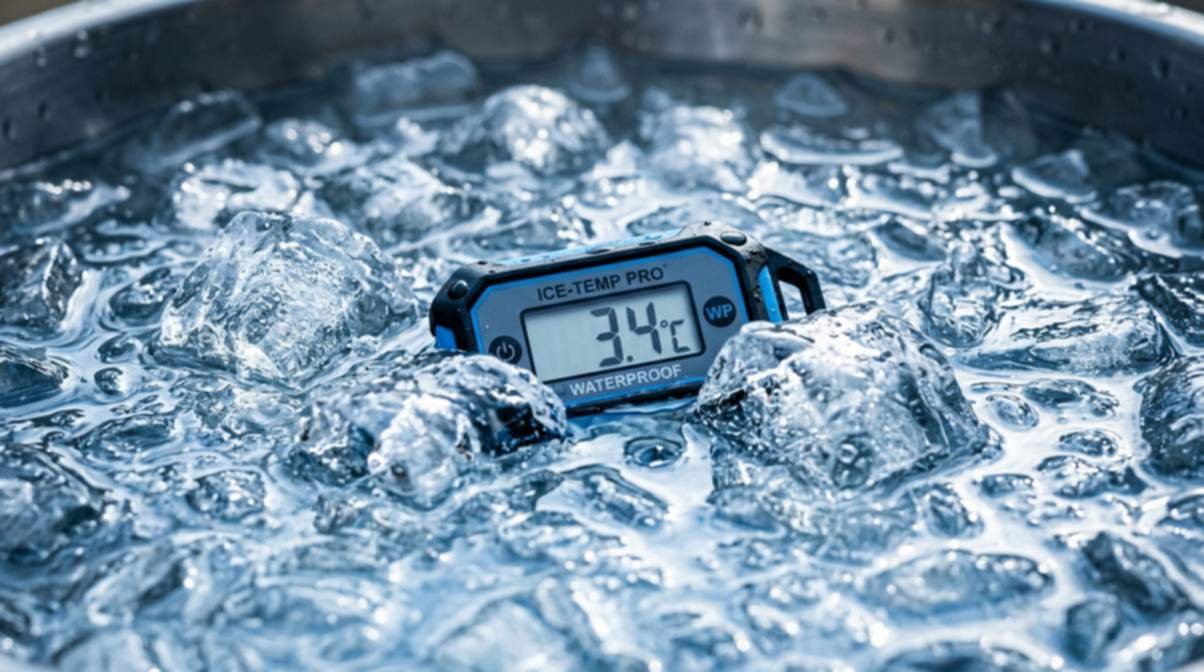
Use a digital waterproof thermometer. They’re cheap (under $15 AUD), accurate, and give you instant readings. Check the temperature at chest depth, not just at the surface cold water stratifies, and the top layer may be warmer than where your core sits.
If you have a chiller unit with a built-in temperature display, verify it against an independent thermometer periodically. Chiller sensors can drift over time, and a 2–3°C error at the cold end of the range is the difference between therapeutic and dangerous.
Log your temperature alongside duration and how you feel. Over time, you’ll notice patterns: the temperature that feels challenging but manageable is usually your sweet spot. If you’re not shivering at all, it’s probably not cold enough for a physiological response.
Frequently Asked Questions
How cold should an ice bath be?
The optimal range for most people is 10–15°C (50–59°F). A 2025 network meta-analysis of 55 RCTs found 11–15°C for 10–15 minutes was best for reducing muscle soreness, while 5–10°C for 10–15 minutes ranked highest for reducing muscle damage markers. Beginners should start at 15–16°C.
How cold are ice baths typically?
Most research studies and wellness protocols use water between 10–15°C. Influencer-driven “extreme cold” plunges at 1–5°C are not supported by evidence for general wellness and carry significant hypothermia risk.
What temperature should an ice bath be for recovery?
For muscle soreness (DOMS): 11–15°C for 10–15 minutes. For biochemical recovery markers (creatine kinase): 5–10°C for 10–15 minutes. The Wang 2025 meta-analysis found protocols longer than 15 minutes ranked lowest for recovery, regardless of temperature.
How cold is a cold plunge compared to a cold shower?
A cold plunge is typically colder and more immersive. Cold showers are often 15–20°C (tap temperature) and provide partial exposure. A therapeutic cold plunge is 10–15°C with full-body immersion, producing a stronger physiological response (noradrenaline/dopamine release, vasoconstriction).
Is 15°C cold enough for an ice bath?
Yes. 15°C is within the optimal range for reducing muscle soreness and triggering mood/alertness benefits. The Šrámek 2000 study showing 530% noradrenaline increase used 14°C water. You do not need to go below 10°C for mental health or recovery benefits.
Can an ice bath be too cold?
Yes. Below 5°C, the risk of hypothermia, cardiac stress, and cold shock increases sharply. A 2025 PLOS One study found immersion below 4°C caused moderate hypothermia within 2–3 minutes. No major meta-analysis supports going below 5°C for general wellness.
Does colder water burn more calories?
Marginally, but not enough for weight loss. Cold exposure activates brown fat, increasing energy expenditure by ~100–300 calories per session. This is modest compared to dietary changes or exercise. Colder water isn’t proven to burn significantly more calories than 10–15°C water.
How long should you stay in an ice bath at 10°C?
For recovery: 10–15 minutes. For mood/alertness: 2–10 minutes. The Wang 2025 meta-analysis found 10–15 minutes at 11–15°C was top-ranked for soreness. At 10°C, you can use similar durations, but listen to your body shivering is a sign to exit.
What’s the best time of day to take a cold plunge?
Morning for alertness and mood boost; afternoon/evening for recovery, but finish 90–120 minutes before bed to avoid disrupting sleep onset. The Chauvineau 2021 study found cold immersion too close to bedtime can delay sleep.
Do I need a chiller in Australia?
It depends on your location and season. In Melbourne/Hobart winter, tap water may be 8–12°C no chiller needed. In Brisbane/Darwin summer, tap water can be 28–32°C a chiller is essential year-round. See the Australian regional table in Section 6 for details.
Sources
1. Wang H, Wang L, Pan Y. Impact of different doses of cold water immersion on recovery from acute exercise-induced muscle damage: a network meta-analysis. Frontiers in Physiology. 2025;16:1525726. DOI: 10.3389/fphys.2025.1525726
2. Machado AF et al. Can water temperature and immersion time influence the effect of cold water immersion on muscle soreness? A systematic review and meta-analysis. Sports Medicine. 2016;46(4):503–514. DOI: 10.1007/s40279-015-0431-7
3. Šrámek P et al. Human physiological responses to immersion into water of different temperatures. European Journal of Applied Physiology. 2000;81:436–442. DOI: 10.1007/s004210050065
4. Johnson DG et al. Plasma norepinephrine responses of man in cold water. Journal of Applied Physiology. 1977;43(2):216–220. PubMed: 911386. PubMed: 911386
5. Cain T, Brinsley J, Bennett H, Nelson M, Maher C, Singh B. Effects of cold-water immersion on health and wellbeing: a systematic review and meta-analysis. PLOS One. 2025. DOI: 10.1371/journal.pone.0317615
6. Roberts LA et al. Post-exercise cold water immersion attenuates acute anabolic signalling and long-term adaptations in muscle to strength training. Journal of Physiology. 2015;593(18):4285–4301. DOI: 10.1113/JP270570
7. Peake JM et al. The effects of cold water immersion and active recovery on inflammation and cell stress responses in human skeletal muscle after resistance exercise. Journal of Physiology. 2017;595(3):695–711. DOI: 10.1113/JP272881
8. Chauvineau M et al. Effect of cold water immersion on sleep architecture. Frontiers in Sports and Active Living. 2021;3:659990. DOI: 10.3389/fspor.2021.659990
9. Mayo Clinic Health System. Can taking a cold plunge after your workout be beneficial? 2024. mayoclinichealthsystem.org
10. Leeder J et al. Cold water immersion and recovery from strenuous exercise: a meta-analysis. British Journal of Sports Medicine. 2012;46(4):233–240. PubMed: 21297080. PubMed: 21297080
11. Royal Life Saving Society Australia. Position Statement on Cold Water Immersion Safety. 2024. royallifesaving.com.au
Medical Disclaimer: This article is for informational purposes only and does not constitute medical advice. Cold water immersion carries risks. Consult your GP before starting any cold exposure routine, especially if you have pre-existing health conditions.
